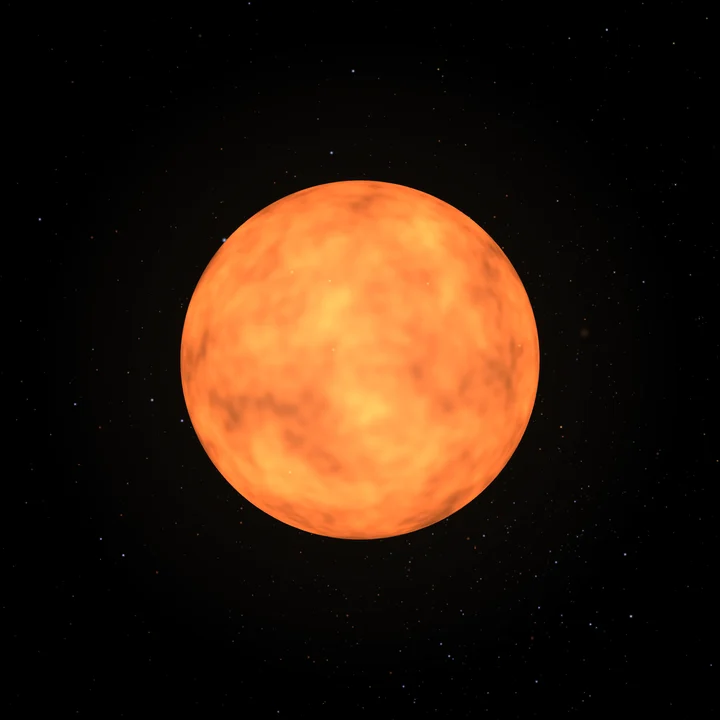
Antares facts at a glance
- Type: a red supergiant, spectral type M0.5Iab, in Scorpius.
- Distance: 554 light-years (170 parsecs).
- Temperature: 3,400 K (3,127 °C, 5,660 °F) at the surface.
- Size: 74,255 times the Earth's width (680 solar radii).
- Mass: 12 times the Sun's.
- Planets: none known.
The heart of the Scorpion
Antares is the red star at the heart of Scorpius, glowing low over the southern horizon on northern summer nights and high overhead in southern winter. Its colour is so like that of Mars, which often wanders past it, that the Greeks named it the rival of Ares, the god Mars was named after: "Ant-Ares". It lies about 554 light-years away.
It is a red supergiant of type M0.5Iab, a massive star near the end of its life and one of the largest stars visible to the naked eye. Its radius is around 680 times the Sun's, some 473,000,000 km: put in the Sun's place it would engulf Mercury, Venus, the Earth and Mars and reach out into the asteroid belt. Its surface is cool for a star, about 3,400 kelvin against the Sun's 5,772, but it is so vast that it gives out roughly 58,000 times as much energy as the Sun, much of it as infrared.
A giant's restless surface
Like all red supergiants, Antares has no sharp edge. Its surface is a slowly boiling layer of gigantic convection cells, and its outer atmosphere drifts off into space as a cool, slow wind, so that the star is wrapped in its own gas and dust. In 2017 astronomers used the Very Large Telescope Interferometer to make the first map of gas moving up and down across the face of a star other than the Sun, and found turbulent motions in Antares's atmosphere stronger than convection alone could easily explain.
Antares also flickers. It is a semiregular variable, drifting in brightness by a magnitude or so over months and years. All of this makes its size and output difficult to pin down: measurements of its radius differ noticeably depending on the wavelength used, since the star looks bigger in light that its extended atmosphere blocks.
The green companion
Antares has a companion, Antares B, a hot blue-white main-sequence star of spectral class B, several times the Sun's mass. It was first noticed in 1819 by Johann Tobias Bürg, who saw it appear separately as the Moon slid in front of Antares, and first seen directly in 1844 by James William Grant. In a telescope it often looks green, an illusion of contrast beside the brilliant red supergiant.
The two are separated by hundreds of times the distance between the Earth and the Sun and take well over a thousand years to complete an orbit. Antares B lights up part of the supergiant's wind, and the dust Antares sheds glows as a yellowish nebula around it in long-exposure photographs, part of the colourful star-forming region of Rho Ophiuchi. No planets are known in the system.
Young, and short-lived
Antares formed only some ten to fifteen million years ago, in the Upper Scorpius group, part of the nearest association of young, massive stars to the Sun. With about 12 times the Sun's mass it has run through its core hydrogen at a ferocious rate and swollen into a supergiant.
It will end as a supernova, probably within the next million years, leaving behind a neutron star. When it goes it will be one of the brightest sights in human history: for a few weeks it would shine about as brightly as a half Moon, bright enough to see in daylight. At its distance it poses no danger to the Earth.
Seeing Antares
Antares lies close to the ecliptic, the path the Sun, Moon and planets follow across the sky, so the Moon regularly passes in front of it and planets, especially Mars, sweep close by. From mid-northern latitudes it is a summer star, low in the south on June and July evenings, with the curling tail of Scorpius trailing below it. From the southern hemisphere it rides high in the winter sky, and the whole Scorpion is one of the most striking figures there.
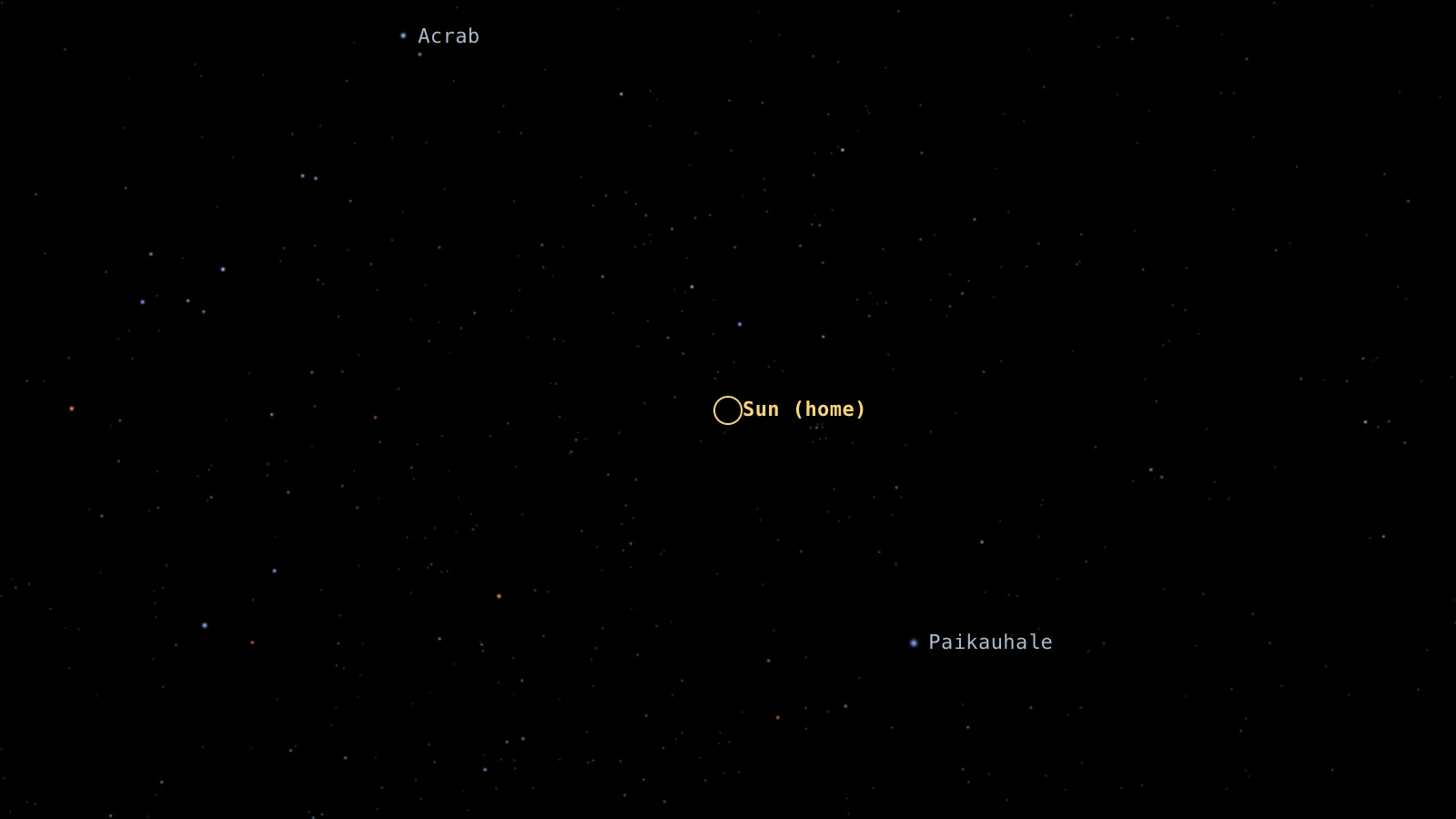
From Antares, the Sun would be invisible without a telescope, one faint point among countless others.
Going there
Light from Antares takes about 554 years to reach us. A ship accelerating at a steady one g for half the trip and braking for the other half would reach 99.99939 % of the speed of light at the midpoint; aboard, only 12 years would pass, while on Earth 560 years went by.
Light
554 years
The light reaching us now left Antares in 1472.
At a steady 1 g
12 years aboard
560 years pass on Earth; top speed 99.99939 % of light.
Arriving, you would see a vast, dim red disc filling much of the sky, wrapped in its own haze, with a hot blue-white companion far off to one side. A planet warm enough for liquid water would have to circle between 250 and 490 AU from Antares, where the companion's pull would likely make any orbit unstable. And with the supernova to come, no world there would have long.
Finding Antares in the night sky
Antares is in the constellation Scorpius. At magnitude 0.9 it is one of the brightest stars in the sky, easy to see even from a city.
It stands highest in the evening sky (around 9 pm) in July, and it is well placed in the evening from June to September: summer in the northern hemisphere, winter in the southern.
It never rises north of latitude 64° N, so it cannot be seen from Reykjavík; the farther south you are, the higher it climbs.
To find it, start from Shaula (magnitude 1.6): Antares is 17° to its northwest, about 2 fists at arm's length (a fist held out covers about 10°). It is also 22° northwest of Sargas and 26° west of Kaus Australis.
Data
Measured values come from the papers cited. The game's estimates are what Solarwind works out from the star catalogue's colour and brightness alone; where the two differ, the measurement is the better value.
| Measured | Game's estimate | ||
|---|---|---|---|
| Distance | — | 553.7 ly · 169.8 pc | from Gaia/Hipparcos parallax |
| Parallax | — | 5.890 mas | |
| Right ascension | — | 16h 29m 24s | J2016 |
| Declination | — | −26° 26′ | |
| Constellation | Scorpius | — | |
| Spectral type | M0.5Iab+B3V:[1] | M1Ib + B2.5V | |
| Temperature | 3,400 K[2] | 3,322 K | the Sun: 5,772 K |
| Radius | 680 R☉[2] | 1,130 R☉ | 6,800 × Jupiter |
| Mass | 12.4 M☉[2] | 26.8 M☉ (rough) | 13,005 × Jupiter |
| Luminosity | 57,500 L☉[3] | 139,000 L☉ | |
| Apparent magnitude (V) | 0.9100 [4] | 1.06 | naked-eye limit ≈ 6 |
| Absolute magnitude | — | -5.09 | |
| Habitable zone | — | 250–490 AU | Kopparapu et al. 2014, from the measured temperature |
| Frost line | — | 650 AU | where water freezes |
Nearest stars
- HIP 8161747.8 ly
- HIP 8088187.3 ly
- HIP 82433121 ly
- HIP 79610122 ly
- HIP 82439125 ly
- HIP 81782130 ly
- HIP 78817131 ly
- HIP 76657132 ly
- HIP 77164136 ly
- HIP 82536137 ly
Quick answers
What constellation is Antares in?
Scorpius, the scorpion, where it marks the creature's heart. It is the constellation's brightest star, Alpha Scorpii.
Is Antares the biggest star?
No. It is one of the largest stars visible to the naked eye, but red supergiants and hypergiants such as VY Canis Majoris and UY Scuti are estimated to be larger still, although the sizes of such stars are all uncertain.
Which is bigger, Antares or Betelgeuse?
They are about the same size, and the answer depends on whose measurements you use. Both have radii several hundred times the Sun's, and both would reach beyond the orbit of Mars in the Sun's place.
Is Antares a main sequence star?
No. Antares is a red supergiant that has used up the hydrogen in its core and left the main sequence. Its companion, Antares B, is still a main-sequence star.
How do you pronounce Antares?
"An-TAIR-eez", with the stress on the middle syllable. The name means "rival of Ares", the Greek god of war, for its Mars-like colour.
How far away is Antares?
Antares is 554 light-years (170 parsecs) from the Sun, so the light you see from it left 554 years ago.
Can you see Antares with the naked eye?
Yes: at magnitude 0.91 it is visible to the naked eye under a dark sky.
Where is Antares in the night sky?
In the constellation Scorpius. It is highest in the evening sky around July and never rises north of latitude 64° N. From Shaula, look 17° to the northwest.
What type of star is Antares?
A red supergiant of spectral type M0.5Iab, with a surface temperature of about 3,400 K (the Sun's is 5,772 K).
How big is Antares compared with the Sun?
Its radius is 680 times the Sun's, about 470,000,000 km; its mass is 12.4 solar masses, and it is 57,500 times as luminous as the Sun.
How hot is Antares?
Its surface is about 3,400 K (3,127 °C, 5,660 °F), cooler than the Sun's 5,772 K.
What colour is Antares?
At 3,400 K its light is orange-red: cooler stars glow redder, hotter ones bluer.
How massive is Antares?
About 12.4 times the Sun's mass, or 13,005 Jupiters.
How luminous is Antares?
It is about 57,500 times as luminous as the Sun (57,500 solar luminosities).
Will Antares go supernova?
Yes. At about 12 solar masses it is above the 8 or so a star needs to end in a core-collapse supernova, leaving a neutron star or a black hole. It has already left the main sequence, so on the cosmic clock that is soon, but nobody can predict the date.
What season is Antares visible in?
In the north it is a summer star: it stands highest in the evening sky in July and is well placed from June to September. In the southern hemisphere those months are winter.
What galaxy is Antares in?
The Milky Way, our own galaxy: every star you can see without a telescope belongs to it. At 554 light-years Antares is a close neighbour on the scale of the galaxy, which is about 100,000 light-years across, and it lies in the same spiral arm as the Sun, the Orion Arm.
How long would it take to travel to Antares?
Light takes 554 years. A ship accelerating at a steady 1 g and braking halfway would arrive after 12 years aboard (560 years on Earth), peaking at 99.99939 % of the speed of light.
Sources
Last updated .
- Close visual binaries. I. MK classifications
- Wikipedia, via Wikidata
- arXiv
- VizieR Online Data Catalog: Stellar Photometry in Johnson's 11-color system (Ducati, 2002)
Positions and photometry: HYG Database v4.1 (CC BY-SA 4.0) and the Gaia Catalogue of Nearby Stars, ESA/Gaia/DPAC. Planets: the NASA Exoplanet Archive, operated by Caltech under contract with NASA. Identifiers: Wikidata (CC0), Q12166. Habitable zone: Kopparapu et al. 2014. Text: written with an AI model from the data on this page, checked against the sources.
Also known as: 21 Sco · 2MASS J16292443-2625549 · ADS 10074 AB · CCDM J16294-2626AB · CD-26 11359 · CMC 184415 · CPD-26 5648 · CSI-26 11359 21 · CSI-26 11359 23 · Ced 132 · FK5 616 · GC 22157 · GCRV 9479 · GSC 06803-02158 · HD 148478 · HD 148478J · HIC 80763 · HIP 80763 · HR 6134 · IDS 16233-2613 AB · IRAS 16262-2619 · IRC -30265 · LBN 1108 · LBN 351.88+15.11 · N30 3686 · PLX 3741 · PMC 90-93 439 · PPM 265579 · RAFGL 1863 · ROT 2345 · SAO 184415 · SRS 30616 · TD1 19208 · UBV 21661 · UBV M 21449 · VDB 107 · WDS J16294-2626AB · α Sco