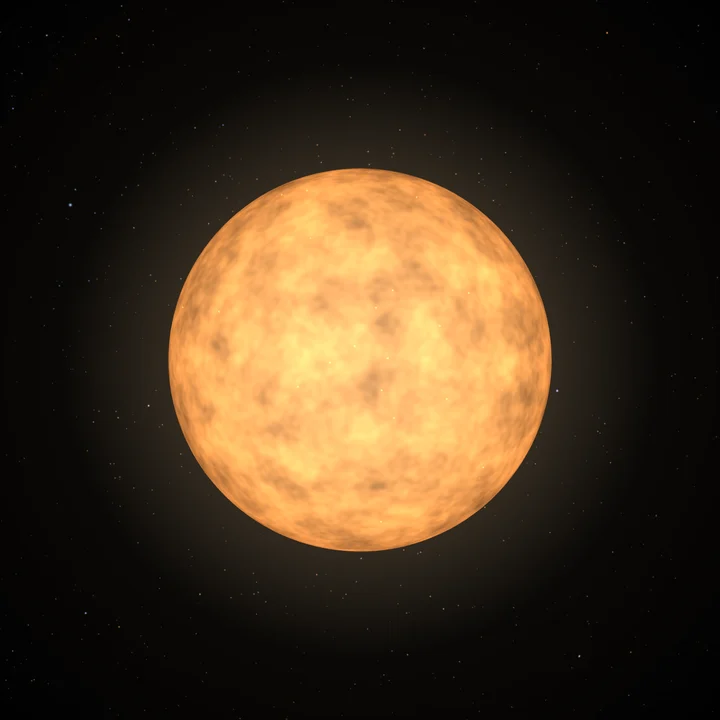
Arcturus facts at a glance
- Type: an orange giant, spectral type K2IIIp, in Boötes.
- Distance: 36.7 light-years (11.3 parsecs).
- Temperature: 4,251 K (3,978 °C, 7,192 °F) at the surface.
- Size: 2,774 times the Earth's width (25 solar radii).
- Mass: 1.3 times the Sun's.
- Planets: none known.
The bright star of spring
Arcturus is the brightest star in the northern half of the sky and the fourth brightest of all, a warm orange point that climbs high on spring and summer evenings. It lies 36.7 light-years away in Boötes, the herdsman, and its name is Greek for "guardian of the bear": it seems to follow the Great Bear, Ursa Major, round the pole.
It is an orange giant of type K2IIIp, a star that has finished the main stage of its life. With only a little more mass than the Sun, it has swollen to 25 times the Sun's radius, some 17,700,000 km: put in the Sun's place, it would reach a third of the way to Mercury's orbit. Its surface is cooler than the Sun's, around 4,251 kelvin against 5,772, which gives it its colour, but its sheer size makes it about 220 times as luminous.
Our Sun's future
Arcturus is a preview of what the Sun will become. It has used up the hydrogen in its core and now burns hydrogen in a shell around a core of helium, a change that makes a star swell and redden. Whether it has gone further, to burning helium in its core, is still debated. In a few billion years the Sun will go the same way, swelling into a red giant before shrinking to a white dwarf, the fate that awaits Arcturus too.
It is also old, older than the Sun by a few billion years. Its atmosphere holds only about a third as much iron and other heavy elements, for its hydrogen, as the Sun's, a sign that it formed early in the Milky Way's history, before generations of exploding stars had enriched the gas between the stars.
A visitor from elsewhere
Arcturus is not keeping pace with the Sun and its neighbours. It moves fast across the sky, one of the quickest of all the bright stars, and it is cutting steeply through the plane of the galaxy instead of circling with it. A loose group of other old stars shares its path, called the Arcturus stream. Some astronomers think the group is the debris of a small galaxy that the Milky Way swallowed long ago; others that it was stirred up by the galaxy's own bar. Either way, Arcturus is only passing through our neighbourhood: it is close to its nearest approach to the Sun now, and from here on it will slowly draw away.
A star with a history
In 1635 the French astronomer Jean-Baptiste Morin turned a telescope on Arcturus in daylight and saw it, the first time anyone had seen a star by day. In 1933 Arcturus opened a world's fair: its light, collected by telescopes and turned into an electric current by photocells, switched on the lights of Chicago's Century of Progress Exposition. It was chosen because the light was thought to have left the star around the time of Chicago's previous fair, in 1893; the distance was not quite right, but the idea stuck.
For Polynesian navigators it was Hōkūleʻa, the "star of gladness". It passes almost straight overhead at the latitude of Hawaii, so a voyager who saw it at the zenith knew they had reached the islands' latitude. No planets or companions have been confirmed around it; a faint companion was suggested in the 1990s, but later work did not support it.
Finding Arcturus
The easiest way is to follow the curve of the Plough's handle, the three stars at the end of the Big Dipper: carry the arc on and you reach Arcturus. Astronomers remember it as "arc to Arcturus, then speed on to Spica", the bright blue star the same curve leads to next. In the northern hemisphere it rules the evening sky from April to August; from the southern hemisphere it is lower in the north, but still easily seen from almost everywhere on Earth.
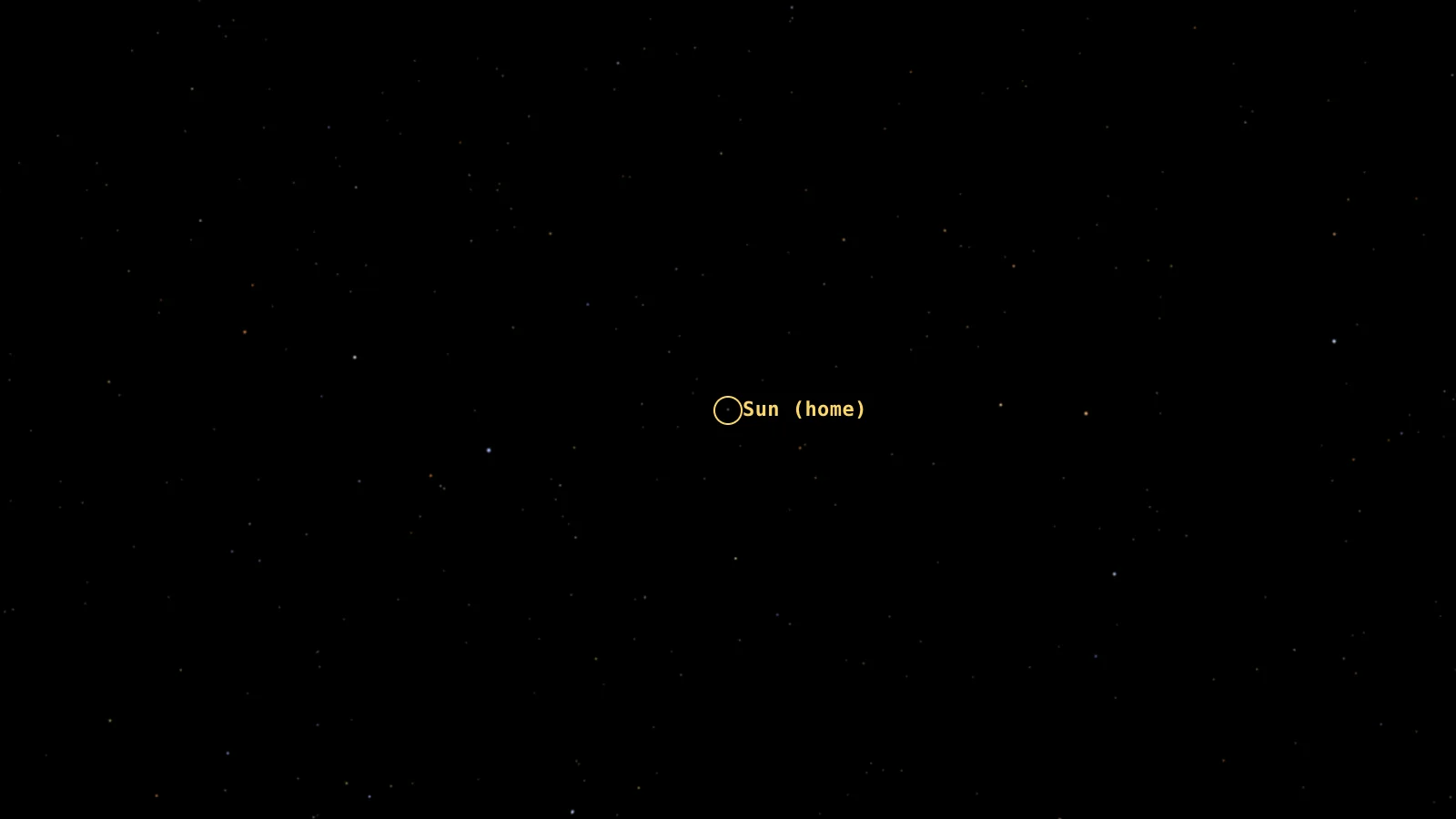
From Arcturus, the Sun would be a dim star barely visible to the naked eye.
Going there
Light from Arcturus takes 36.7 years to reach us. A ship accelerating at a steady one g for half the way and braking for the rest would reach it after 7.1 years aboard while 39 years passed on Earth, hitting 99.87 % of the speed of light at the midpoint.
Light
36.7 years
The light reaching us now left Arcturus in 1989.
At a steady 1 g
7.1 years aboard
39 years pass on Earth; top speed 99.87 % of light.
You would arrive at a huge, dull-orange sun. A planet would need to orbit between 15 and 28 AU from Arcturus, out where Uranus and Neptune circle our Sun, to stay warm enough for liquid water; but any world there would only recently have warmed up, since Arcturus was a much fainter star until it became a giant. The nearest neighbour, the star Muphrid, would be a bright one in your sky, only 3.3 light-years away.
Finding Arcturus in the night sky
Arcturus is in the constellation Boötes. At magnitude -0.1 it is one of the brightest stars in the sky, easy to see even from a city.
It stands highest in the evening sky (around 9 pm) in June, and it is well placed in the evening from May to August: summer in the northern hemisphere, winter in the southern.
It never rises south of latitude 71° S; the farther north you are, the higher it climbs.
To find it, start from Alkaid (magnitude 1.8): Arcturus is 31° to its south, about 3 fists at arm's length (a fist held out covers about 10°).
Data
Measured values come from the papers cited. The game's estimates are what Solarwind works out from the star catalogue's colour and brightness alone; where the two differ, the measurement is the better value.
| Measured | Game's estimate | ||
|---|---|---|---|
| Distance | — | 36.72 ly · 11.26 pc | from Gaia/Hipparcos parallax |
| Parallax | — | 88.83 mas | |
| Right ascension | — | 14h 15m 38s | J2016 |
| Declination | — | +19° 10′ | |
| Constellation | Boötes | — | |
| Spectral type | K2IIIp[1] | K2IIIp | |
| Temperature | 4,251 K[2] | 4,232 K | the Sun: 5,772 K |
| Radius | 25.4 R☉[3] | 28.0 R☉ | 250 × Jupiter |
| Mass | 1.30 M☉[3] | 1.52 M☉ (rough) | 1,362 × Jupiter |
| Luminosity | 215 L☉[3] | 226 L☉ | |
| Apparent magnitude (V) | -0.05000 [4] | −0.05 | naked-eye limit ≈ 6 |
| Absolute magnitude | — | -0.310 | |
| Habitable zone | — | 15–28 AU | Kopparapu et al. 2014, from the measured temperature |
| Frost line | — | 40 AU | where water freezes |
Nearest stars
- Muphrid3.27 ly
- Gliese GJ 1179B5.49 ly
- Gliese GJ 1179A5.49 ly
- Gliese 5675.93 ly
- Gliese 568B6.42 ly
- Gliese 568A6.53 ly
- Gliese 569A7.12 ly
- J1416+13487.17 ly
- J1501+22507.22 ly
- Gliese 5257.39 ly
Quick answers
Is Arcturus the North Star?
No. The North Star is Polaris, in Ursa Minor. Arcturus is the brightest star of the northern celestial hemisphere, but it lies far from the pole and rises and sets every day like most stars.
What constellation is Arcturus in?
Boötes, the herdsman, a kite-shaped constellation next to the Plough. Arcturus is its brightest star, Alpha Boötis.
How old is Arcturus?
Older than the Sun, by a few billion years. Its low share of heavy elements and its fast, tilted path through the galaxy are both marks of an old star.
Which is farther north, Arcturus or Antares?
Arcturus. It lies north of the celestial equator and is best seen from the northern hemisphere, while red Antares in Scorpius is well south of it and appears low in the south from mid-northern latitudes.
Is Arcturus a binary star?
Not as far as we know. A companion was once suggested from Hipparcos satellite data, but it has not been confirmed, and Arcturus is usually treated as a single star.
How far away is Arcturus?
Arcturus is 36.7 light-years (11.3 parsecs) from the Sun, so the light you see from it left 36.7 years ago.
Can you see Arcturus with the naked eye?
Yes: at magnitude −0.05 it is visible to the naked eye under a dark sky.
Where is Arcturus in the night sky?
In the constellation Boötes. It is highest in the evening sky around June and never rises south of latitude 71° S. From Alkaid, look 31° to the south.
What type of star is Arcturus?
An orange giant of spectral type K2IIIp, with a surface temperature of about 4,251 K (the Sun's is 5,772 K).
How big is Arcturus compared with the Sun?
Its radius is 25.4 times the Sun's, about 18,000,000 km; its mass is 1.30 solar masses, and it is 215 times as luminous as the Sun.
How hot is Arcturus?
Its surface is about 4,251 K (3,978 °C, 7,192 °F), cooler than the Sun's 5,772 K.
What colour is Arcturus?
At 4,251 K its light is orange: cooler stars glow redder, hotter ones bluer.
How massive is Arcturus?
About 1.30 times the Sun's mass, or 1,362 Jupiters.
How luminous is Arcturus?
It is about 215 times as luminous as the Sun (215 solar luminosities).
Is Arcturus a main sequence star?
No. Its luminosity class, III, marks a giant: it has used up the hydrogen in its core, left the main sequence and swollen.
Will Arcturus go supernova?
No. At about 1.3 solar masses it is too light: stars under about 8 solar masses end by shedding their outer layers and leaving a white dwarf.
What season is Arcturus visible in?
In the north it is a summer star: it stands highest in the evening sky in June and is well placed from May to August. In the southern hemisphere those months are winter.
What galaxy is Arcturus in?
The Milky Way, our own galaxy: every star you can see without a telescope belongs to it. At 36.7 light-years Arcturus is a close neighbour on the scale of the galaxy, which is about 100,000 light-years across, and it lies in the same spiral arm as the Sun, the Orion Arm.
How long would it take to travel to Arcturus?
Light takes 36.7 years. A ship accelerating at a steady 1 g and braking halfway would arrive after 7.1 years aboard (39 years on Earth), peaking at 99.87 % of the speed of light.
Sources
Last updated .
- Space-velocity vectors for 3483 stars with proper motion and radial velocity
- Abundances of disk and bulge giants from high-resolution optical spectra. I. O, Mg, Ca, and Ti in the solar neighborhood and Kepler field samples
- Wikipedia, via Wikidata
- VizieR Online Data Catalog: Stellar Photometry in Johnson's 11-color system (Ducati, 2002)
Positions and photometry: HYG Database v4.1 (CC BY-SA 4.0) and the Gaia Catalogue of Nearby Stars, ESA/Gaia/DPAC. Planets: the NASA Exoplanet Archive, operated by Caltech under contract with NASA. Identifiers: Wikidata (CC0), Q12985; SIMBAD. Habitable zone: Kopparapu et al. 2014. Text: written with an AI model from the data on this page, checked against the sources.
Also known as: 16 Boo · 2MASS J14153968+1910558 · AAVSO 1411+19 · AG+19 1335 · ASCC 870215 · BD+19 2777 · CCDM J14157+1911A · CSV 101433 · Ci 20 843 · FK5 526 · GC 19242 · GCRV 8341 · GJ 541 · HD 124897 · HIC 69673 · HIP 69673 · HR 5340 · IRAS 14133+1925 · IRC +20270 · JP11 2486 · LFT 1084 · LHS 48 · LSPM J1415+1910 · LTT 14184 · N30 3229 · NLTT 36756 · NSV 6603 · PLX 3242 · PLX 3242.00 · PM 14134+1927 · PM 14134-1927 · PMC 90-93 376 · PPM 130442 · RAFGL 1693 · ROT 2044 · SAO 100944 · SRS 30526 · TD1 17351 · TIC 459832522 · TYC 1472-1436-1 · UBV 12551 · UBV M 20076 · WDS J14157+1911A · WEB 12132 · YPAC 52 · uvby98 100124897 · α Boo