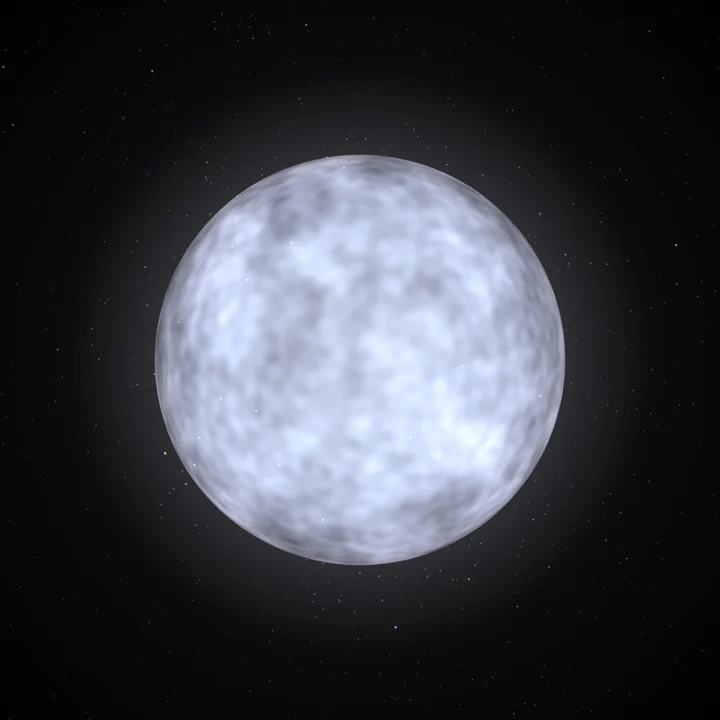
Canopus facts at a glance
- Type: a white bright giant, spectral type A9II, in Carina.
- Distance: 309 light-years (94.8 parsecs).
- Temperature: 7,557 K (7,284 °C, 13,143 °F) at the surface.
- Size: 5,639 times the Earth's width (52 solar radii).
- Mass: 13 times the Sun's.
- Planets: none known.
The second-brightest star
After Sirius, Canopus is the brightest star in the night sky, shining at magnitude −0.74. But where Sirius is bright because it is close, Canopus is bright because it is enormous. It lies 309 light-years away, so its light set out before the telescope was invented, and to look this bright from so far it must give out about 13,000 times the Sun's light.
It is classified A9II, a luminous giant on the border between bright giants and supergiants: a star that has finished burning hydrogen in its core and swollen to a huge size. An estimate from its brightness and temperature puts its radius at about 52 times the Sun's, some 35,900,000 km, and direct measurements of its disc by interferometry suggest it is larger still. Placed where the Sun is, it would reach more than halfway to the orbit of Mercury.
A white supergiant
Canopus's surface glows at about 7,557 kelvin, against the Sun's 5,772, hot enough to make it white with the faintest touch of yellow. When it is low on the horizon, as it often is, the Earth's air makes it twinkle through many colours, which is why some observers describe it as yellowish or even flashing red.
Its mass is not well known, because single stars cannot be weighed directly, but models put it at several times the Sun's mass. It probably began life as a hot blue-white star that has already used up the hydrogen in its core and is now in a brief, unsettled stage of its life. Exactly which stage is uncertain: it may be on its way to becoming a red supergiant, or burning helium in its core. Its distance, measured by the Hipparcos satellite, is also less certain than for nearer stars, which carries over into its size and power.
Canopus is probably near the dividing line between stars that end quietly and stars that explode. Most studies expect it to shed its outer layers and end as a heavy white dwarf, rather than as a supernova.
A star for navigators
Canopus has been a guide for a very long time. In Greek legend it is named after the helmsman of King Menelaus's fleet on the way home from Troy, and southern seafarers have steered by it for centuries. In Indian astronomy it is Agastya, named after a revered sage, and in many Polynesian and Aboriginal Australian traditions it is a star of seasons and of finding the way.
It still guides spacecraft. Because it is so bright and lies far from the Sun's path across the sky, Canopus has long been the reference star for spacecraft star trackers: Mariner probes and the Voyagers fixed their orientation by locking on to the Sun and Canopus.
No known planets
No planets are known around Canopus, and none would be easy to find: a supergiant's own brightness and restless surface swamp the tiny signals that reveal planets around quieter stars. A planet warm enough for liquid water would now need to orbit about 100 to 170 AU from it, farther than Pluto is from the Sun, and that zone has moved outwards as the star swelled, so nothing there would have been temperate for long.
Seeing Canopus
Canopus lies far to the south, in the constellation Carina, the Keel of the ship Argo. That puts it out of reach for much of the northern hemisphere: it never rises for observers north of roughly the latitude of Athens, Seoul or Richmond, Virginia, and from just south of that it only skims the horizon. From the southern hemisphere it is a brilliant sight high in the summer sky, and from far enough south it never sets.
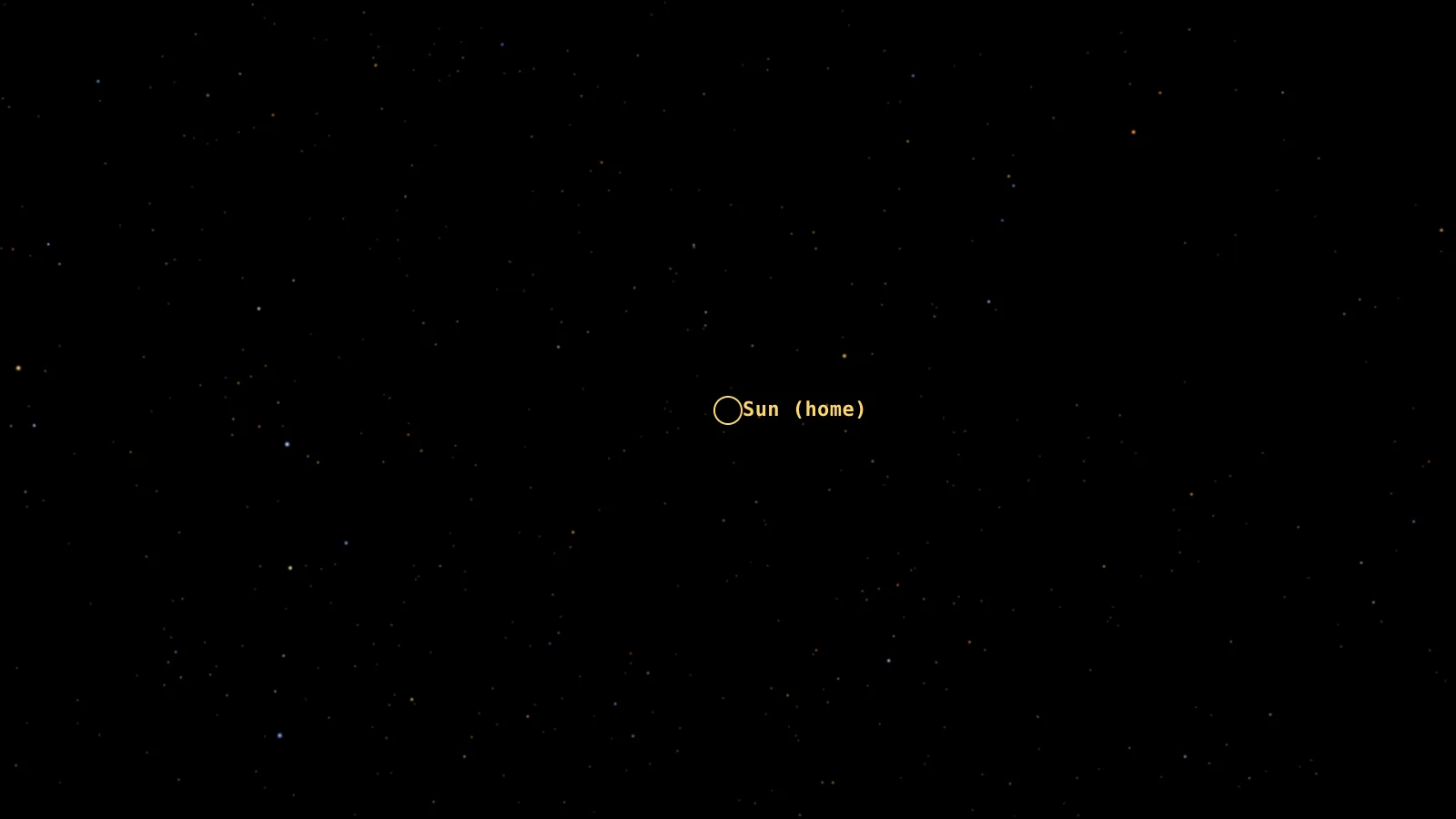
Visiting Canopus
At the distance where the Earth sits from the Sun, Canopus would not be a sun in the sky but a wall of white fire filling a huge part of it, and anything there would be scorched. A comfortable distance from it lies far out, where the star would look a little like our Sun does from the Earth, only pale white.
Getting there would be a long journey. A ship that could accelerate at a steady one g for half the way and brake for the other half would arrive after 11 years aboard, while 310 years passed at home, touching 99.9980 % of the speed of light on the way.
Light
309 years
The light reaching us now left Canopus in 1717.
At a steady 1 g
11 years aboard
310 years pass on Earth; top speed 99.9980 % of light.
Finding Canopus in the night sky
Canopus is in the constellation Carina. At magnitude -0.7 it is one of the brightest stars in the sky, easy to see even from a city.
South of latitude 37° S (Wellington) it never sets: it circles the south celestial pole all night, every night of the year. It stands highest in the evening sky (around 9 pm) in February.
It never rises north of latitude 37° N, so it cannot be seen from New York, London or Helsinki; the farther south you are, the higher it climbs.
To find it, start from Avior (magnitude 1.9): Canopus is 18° to its west, about 2 fists at arm's length (a fist held out covers about 10°). It is also 25° south of Adhara and 21° west of Alsephina.
Data
Measured values come from the papers cited. The game's estimates are what Solarwind works out from the star catalogue's colour and brightness alone; where the two differ, the measurement is the better value.
| Measured | Game's estimate | ||
|---|---|---|---|
| Distance | — | 309.2 ly · 94.79 pc | from Gaia/Hipparcos parallax |
| Parallax | — | 10.55 mas | |
| Right ascension | — | 6h 23m 57s | J2016 |
| Declination | — | −52° 42′ | |
| Constellation | Carina | — | |
| Spectral type | A9II[1] | F0Ib | |
| Temperature | 7,557 K[2] | 8,486 K | the Sun: 5,772 K |
| Radius | — | 51.6 R☉ | 510 × Jupiter |
| Mass | — | 13.4 M☉ (rough) | 14,084 × Jupiter |
| Luminosity | 13,300 L☉[3] | 12,500 L☉ | |
| Apparent magnitude (V) | -0.7400 [4] | −0.62 | naked-eye limit ≈ 6 |
| Absolute magnitude | — | -5.50 | |
| Habitable zone | — | 100–170 AU | Kopparapu et al. 2014, from the measured temperature |
| Frost line | — | 310 AU | where water freezes |
Nearest stars
- J0619-52275.76 ly
- J0617-53377.17 ly
- J0620-51557.76 ly
- J0628-53549.13 ly
- J0623-505510.6 ly
- J0615-533511.1 ly
- J0618-510011.2 ly
- J0613-512011.7 ly
Quick answers
Can you see Canopus from the northern hemisphere?
Only from its southern part. It never rises for observers north of roughly the latitude of southern Europe, Korea or Virginia; from places like southern Spain, Texas, Egypt or India it appears low in the south on winter evenings.
What constellation is Canopus in?
Carina, the Keel, once part of the large old constellation Argo Navis, the ship of the Argonauts. It is the brightest star in Carina and lies some way south-west of Sirius.
Is Canopus bigger than Sirius?
Far bigger. Sirius is a main-sequence star not quite twice the Sun's width, while Canopus is a supergiant tens of times wider than the Sun. Sirius looks brighter only because it is very much closer to us.
Why is Canopus used for spacecraft navigation?
It is the second-brightest star and lies well away from the plane in which the Sun and planets move, so a star tracker can lock on to it easily without the Sun getting in the way. Many probes, including the Voyagers, used it as their reference star.
How far away is Canopus?
Canopus is 309 light-years (94.8 parsecs) from the Sun, so the light you see from it left 309 years ago.
Can you see Canopus with the naked eye?
Yes: at magnitude −0.74 it is visible to the naked eye under a dark sky, from the southern hemisphere.
Where is Canopus in the night sky?
In the constellation Carina. It is highest in the evening sky around February and never rises north of latitude 37° N. From Avior, look 18° to the west.
What type of star is Canopus?
A white bright giant of spectral type A9II, with a surface temperature of about 7,557 K (the Sun's is 5,772 K).
How big is Canopus compared with the Sun?
Its radius is 51.6 times the Sun's, about 36,000,000 km; its mass is 13.4 solar masses, and it is 13,300 times as luminous as the Sun.
How hot is Canopus?
Its surface is about 7,557 K (7,284 °C, 13,143 °F), hotter than the Sun's 5,772 K.
What colour is Canopus?
At 7,557 K its light is bluish white: cooler stars glow redder, hotter ones bluer.
How massive is Canopus?
About 13.4 times the Sun's mass, or 14,084 Jupiters: the game's estimate from its colour and brightness, rough for a star that has left the main sequence.
How luminous is Canopus?
It is about 13,300 times as luminous as the Sun (13,300 solar luminosities).
Is Canopus a main sequence star?
No. Its luminosity class, II, marks a bright giant: a massive star that has left the main sequence.
What galaxy is Canopus in?
The Milky Way, our own galaxy: every star you can see without a telescope belongs to it. At 309 light-years Canopus is a close neighbour on the scale of the galaxy, which is about 100,000 light-years across, and it lies in the same spiral arm as the Sun, the Orion Arm.
How long would it take to travel to Canopus?
Light takes 309 years. A ship accelerating at a steady 1 g and braking halfway would arrive after 11 years aboard (310 years on Earth), peaking at 99.9980 % of the speed of light.
Sources
Last updated .
- The early F-type stars: refined classification, confrontation with Stroemgren photometry, and the effects of rotation
- High-precision effective temperatures of 161 FGK supergiants from line-depth ratios
- Wikipedia, via Wikidata
- VizieR Online Data Catalog: Stellar Photometry in Johnson's 11-color system (Ducati, 2002)
Positions and photometry: HYG Database v4.1 (CC BY-SA 4.0) and the Gaia Catalogue of Nearby Stars, ESA/Gaia/DPAC. Planets: the NASA Exoplanet Archive, operated by Caltech under contract with NASA. Identifiers: Wikidata (CC0), Q12189; SIMBAD. Habitable zone: Kopparapu et al. 2014. Text: written with an AI model from the data on this page, checked against the sources.
Also known as: 1ES 0622-52.6 · 1RXS J062357.2-524139 · 2EUVE J0624-52.6 · 2MASS J06235709-5241441 · CEL 1228 · CPC 19 2125 · EUVE J0624-52.6 · EXSS 0622.7-5240 · FK5 245 · GC 8302 · GCRV 4091 · HD 45348 · HIC 30438 · HIP 30438 · HR 2326 · IRAS 06228-5240 · JP11 1384 · N30 1391 · PLX 1497 · PLX 1497.00 · PPM 335149 · ROT 1039 · SAO 234480 · SRS 30245 · TD1 7115 · TIC 255559489 · TYC 8534-2277-1 · UBV 6431 · UBV M 12094 · WEB 6060 · uvby98 100045348 · α Car