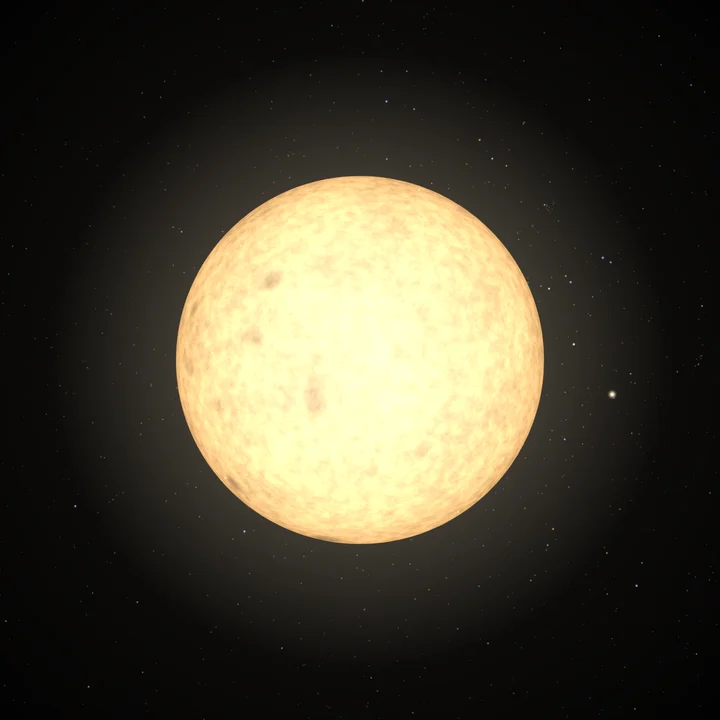
Capella facts at a glance
- Type: a yellow giant, spectral type G3III, in Auriga.
- Distance: 42.8 light-years (13.1 parsecs).
- Temperature: 5,272 K (4,999 °C, 9,030 °F) at the surface.
- Size: 1,605 times the Earth's width (15 solar radii).
- Mass: 3.8 times the Sun's.
- Planets: none known.
Two golden giants in one point of light
Capella looks like a single yellow star, one of the brightest in the sky, but it is two. At its heart are two giant stars, each many times wider than the Sun, circling each other closer than the Earth is to the Sun. They are so near each other, and so far from us at 42.8 light-years, that no ordinary telescope can split them: their light blends into the one golden point that you see.
Together the pair gives out about 150 times the Sun's light, and their surfaces glow at around 5,272 kelvin, a little cooler than the Sun's 5,772, which is why Capella has the warm, butter-yellow colour of a giant rather than the white of the Sun. The figures in the fact table treat the light as if it came from one star; the truth is two stars of almost equal mass, each a little more than twice as heavy as the Sun.
Found in the spectrum, then measured by light waves
Capella's double nature was found in 1899, not by seeing two stars but by reading one spectrum. Astronomers at Lick Observatory noticed that its spectral lines doubled and merged as the two stars swung towards and away from us in turn. The pair goes round once every few months.
In 1920 John Anderson at Mount Wilson Observatory pointed an interferometer at Capella: an instrument that combines light from two separated mirrors so that the way their light waves line up reveals details far smaller than any single telescope can see. Capella became the first binary star resolved this way, and astronomers have used the same technique on it ever since, along with spectroscopy, to weigh both stars with high precision.
A pair at different stages of old age
The two giants were born together and are nearly twins, yet they are not at the same point in their lives. The slightly heavier star, usually called Capella Aa, is the cooler and more evolved of the two: it has already passed through the red giant stage and is now steadily burning helium in its core. Its companion, Capella Ab, is a little hotter and is still crossing the short, fast stage between the main sequence and the giant branch.
That makes Capella a valuable test of stellar theory: two stars of almost the same mass and age, caught at different moments, so any model of how stars age must explain both at once. The hotter star also spins faster and is magnetically restless, and the pair glows brightly in X-rays from a hot outer atmosphere, a corona like the Sun's but far stronger.
A family of four
Far out from the giants is a second, much fainter pair: two red dwarfs, known as Capella H and Capella L, which share the giants' motion through space. They orbit the giants at a distance of thousands of times the Earth-Sun distance and would be invisible to the naked eye even from nearby. Together the four stars make Capella a quadruple system, although some of its fainter companions once claimed in catalogues turned out to be unrelated stars along the same line of sight.
No planets are known around Capella. Two giants in a close, tight orbit, both still changing as they age, make a difficult place for planets to form or to stay comfortable: any world in the region where liquid water could exist today would see that region move outwards as the giants brighten.
| Body | Kind | Orbit, AU | Year, days | Mass, Earths | Temp., K |
|---|---|---|---|---|---|
| Capella inner belt game-made | Asteroid belt | 25–40 | — | — | 173 |
The goat star of the northern winter
Capella is the brightest star in Auriga, the Charioteer, and its name is Latin for "little she-goat": the goat Amalthea, carried on the charioteer's arm in the old star maps. It is the sixth-brightest star in the night sky and the third-brightest in the northern celestial hemisphere, after Arcturus and Vega. From much of Europe, Canada and the northern United States it is circumpolar, never setting, and it rides high overhead on winter evenings as part of the Winter Hexagon of bright stars.
When Capella sits low over the horizon on autumn evenings, it twinkles fiercely and can flash red and green. That is not the star itself but the Earth's air: turbulent layers bend and split its light, and a bright star seen through a thick slab of atmosphere shows it most.
Visiting Capella
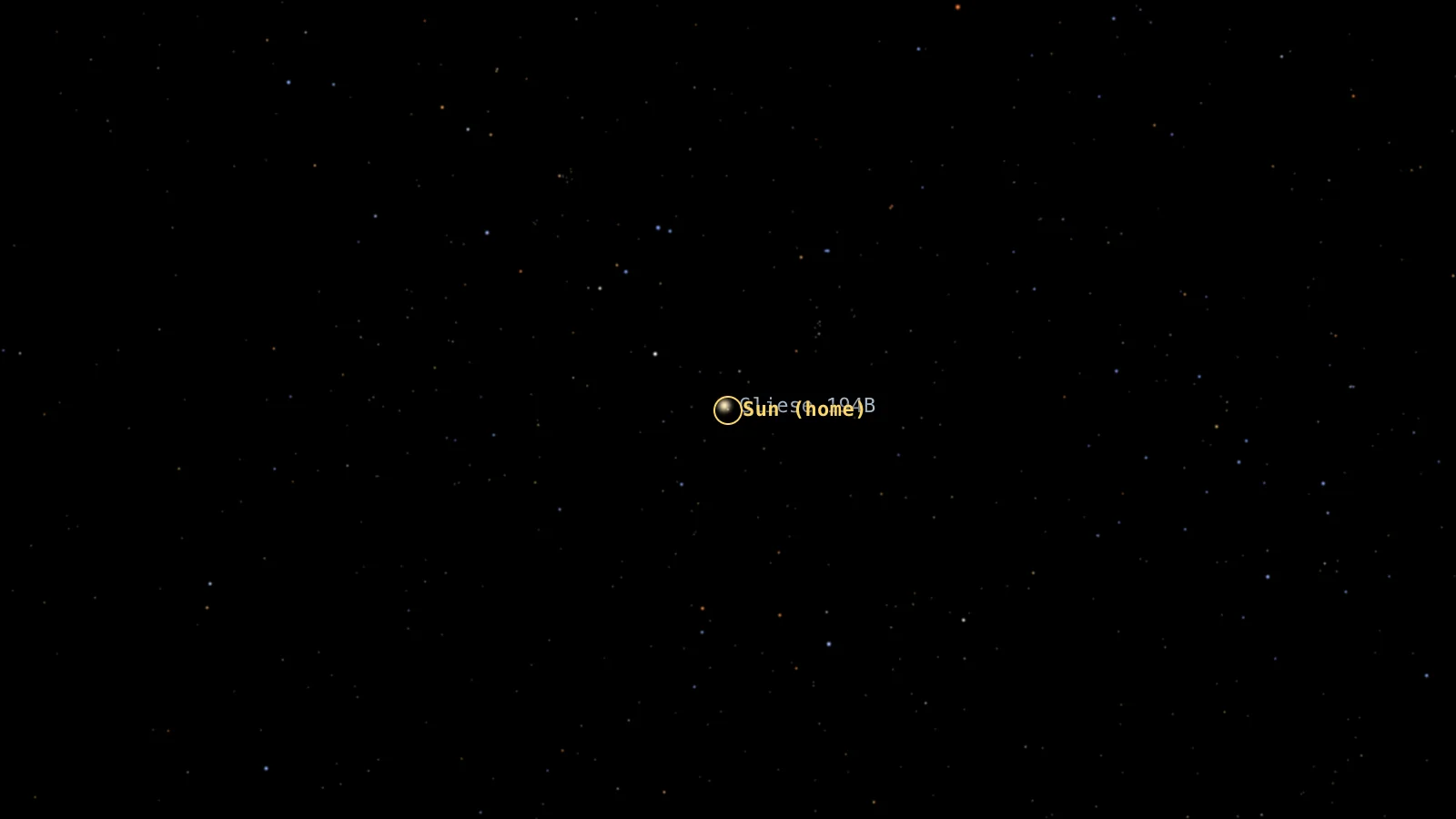
Close up, Capella would be a spectacle: two swollen golden suns hanging near each other in the sky, slowly changing their separation as they orbit, both far larger in the sky than the Sun looks from the Earth. Far beyond them the two red dwarfs would be just a pair of bright reddish stars.
Reaching it would take a very long time. A ship that could accelerate at a steady one g for half the way and brake for the other half would arrive after 7.4 years aboard, while 45 years passed at home, touching 99.906 % of the speed of light on the way. Light makes the trip in 42.8 years.
Light
42.8 years
The light reaching us now left Capella in 1983.
At a steady 1 g
7.4 years aboard
45 years pass on Earth; top speed 99.906 % of light.
Finding Capella in the night sky
Capella is in the constellation Auriga. At magnitude 0.1 it is one of the brightest stars in the sky, easy to see even from a city.
North of latitude 44° N (Reykjavík, Helsinki or London) it never sets: it circles the north celestial pole all night, every night of the year. It stands highest in the evening sky (around 9 pm) in January.
It never rises south of latitude 44° S; the farther north you are, the higher it climbs.
To find it, start from Menkalinan (magnitude 1.9): Capella is 7.6° to its west, about one fist at arm's length (a fist held out covers about 10°). It is also 17° north of Elnath and 19° east of Mirfak.
Data
Measured values come from the papers cited. The game's estimates are what Solarwind works out from the star catalogue's colour and brightness alone; where the two differ, the measurement is the better value.
| Measured | Game's estimate | ||
|---|---|---|---|
| Distance | — | 42.80 ly · 13.12 pc | from Gaia/Hipparcos parallax |
| Parallax | — | 76.20 mas | |
| Right ascension | — | 5h 16m 42s | J2016 |
| Declination | — | +45° 60′ | |
| Constellation | Auriga | — | |
| Spectral type | G3III:[1] | M1: comp | |
| Temperature | 5,272 K[2] | 5,281 K | the Sun: 5,772 K |
| Radius | — | 14.7 R☉ | 150 × Jupiter |
| Mass | — | 3.81 M☉ | 3,994 × Jupiter |
| Luminosity | — | 151 L☉ | |
| Apparent magnitude (V) | 0.08000 [3] | 0.08 | naked-eye limit ≈ 6 |
| Absolute magnitude | — | -0.510 | |
| Habitable zone | — | 12–22 AU | Kopparapu et al. 2014, from the measured temperature |
| Frost line | — | 33 AU | where water freezes |
Nearest stars
- Gliese 195B0.594 ly
- Gliese 194B0.598 ly
- Gliese 195A0.721 ly
- J0505+44142.37 ly
- Gliese GJ 33363.42 ly
- 15Lam Aur4.70 ly
- Gliese GJ 10735.34 ly
- J0503+53076.16 ly
- Gliese 1846.19 ly
- Gliese 2116.72 ly
Quick answers
Is Capella the North Star?
No. The North Star is Polaris, in Ursa Minor, which sits almost exactly above the Earth's north pole. Capella lies well away from the pole, but it is far enough north that from mid-northern latitudes it never sets, which is why it is often mistaken for a pole star.
Is Capella a main sequence star?
No. Both of its bright stars are giants that have used up the hydrogen in their cores and swollen to many times the Sun's size. The cooler one is burning helium in its core; the hotter one is still on its way to becoming a red giant.
Why does Capella flicker red and green?
Its flicker is twinkling, caused by turbulence in the Earth's atmosphere, not by the star. Capella is bright and, from many places, often seen low in the sky, where its light passes through more air and is split into colours, so it flashes red, green and blue.
Where is Capella in the sky?
In the constellation Auriga, the Charioteer, in the northern sky. On winter evenings it stands high overhead for northern observers, the brightest star in that part of the sky; look roughly between the Pleiades and the Big Dipper's bowl, or follow the line of Orion's belt away from Sirius and keep going.
How far away is Capella?
Capella is 42.8 light-years (13.1 parsecs) from the Sun, so the light you see from it left 42.8 years ago.
Can you see Capella with the naked eye?
Yes: at magnitude 0.08 it is visible to the naked eye under a dark sky, from the northern hemisphere.
Where is Capella in the night sky?
In the constellation Auriga. It is highest in the evening sky around January and never rises south of latitude 44° S. From Menkalinan, look 7.6° to the west.
What type of star is Capella?
A yellow giant of spectral type G3III, with a surface temperature of about 5,272 K (the Sun's is 5,772 K).
How big is Capella compared with the Sun?
Its radius is 14.7 times the Sun's, about 10,000,000 km; its mass is 3.81 solar masses, and it is 151 times as luminous as the Sun.
How hot is Capella?
Its surface is about 5,272 K (4,999 °C, 9,030 °F), cooler than the Sun's 5,772 K.
What colour is Capella?
At 5,272 K its light is white with a hint of yellow: cooler stars glow redder, hotter ones bluer.
How massive is Capella?
About 3.81 times the Sun's mass, or 3,994 Jupiters: the game's estimate from its colour and brightness.
How luminous is Capella?
It is about 151 times as luminous as the Sun (151 solar luminosities), the game's estimate from its colour and brightness.
What galaxy is Capella in?
The Milky Way, our own galaxy: every star you can see without a telescope belongs to it. At 42.8 light-years Capella is a close neighbour on the scale of the galaxy, which is about 100,000 light-years across, and it lies in the same spiral arm as the Sun, the Orion Arm.
How long would it take to travel to Capella?
Light takes 42.8 years. A ship accelerating at a steady 1 g and braking halfway would arrive after 7.4 years aboard (45 years on Earth), peaking at 99.906 % of the speed of light.
Sources
Last updated .
Positions and photometry: HYG Database v4.1 (CC BY-SA 4.0) and the Gaia Catalogue of Nearby Stars, ESA/Gaia/DPAC. Planets: the NASA Exoplanet Archive, operated by Caltech under contract with NASA. Identifiers: Wikidata (CC0), Q12970; SIMBAD. Habitable zone: Kopparapu et al. 2014. Text: written with an AI model from the data on this page, checked against the sources.
Also known as: 13 Aur · 1RXS J051642.2+460001 · 2EUVE J0516+45.9 · 2MASS J05164138+4559525 · AAVSO 0509+45 · ADS 3841 AP · AG+45 512 · ASCC 317037 · BD+45 1077 · CCDM J05168+4559AP · CEL 586 · CNS5 1318 · CSV 100460 · Ci 20 321 · EUVE J0516+45.9 · FK5 193 · GC 6427 · GCRV 3121 · GJ 194 · GJ 194 A · GJ 194 B · HD 34029 · HIC 24608 · HIP 24608 · HR 1708 · IDS 05093+4554 AP · IRAS 05130+4556 · IRC +50139 · JP11 1010 · LSPM J0516+4559 · LTT 11619 · N30 1121 · NLTT 14766 · NSV 1897 · PLX 1187 · PMC 90-93 139 · PMSC 05093+4553AB · PPM 47925 · RAFGL 713 · RX J0516.7+4559 · SAO 40186 · SBC7 214 · SBC9 306 · SKY# 8333 · TD1 4244 · TIC 368326352 · TYC 3358-3141-1 · UBV 5009 · WDS J05167+4600A · WDS J05167+4600Aa,Ab · WEB 4762 · YPAC 23 · [HFE83] 366 · uvby98 100034029 · α Aur