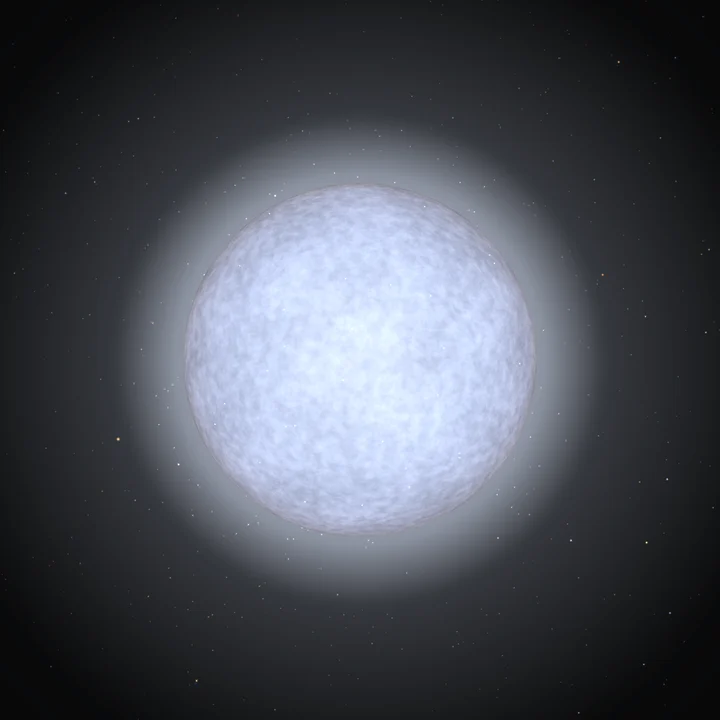
Fomalhaut facts at a glance
- Type: a white star, spectral type A4V, in Piscis Austrinus.
- Distance: 25.1 light-years (7.70 parsecs).
- Temperature: 8,745 K (8,472 °C, 15,281 °F) at the surface.
- Size: 201 times the Earth's width (1.8 solar radii).
- Mass: 1.9 times the Sun's.
- Age: about 0.44 billion years.
- Planets: none known.
The lonely star of autumn
Fomalhaut is the bright star that hangs alone low in the southern sky on autumn evenings, seen from the northern hemisphere, with no other bright star anywhere near it. It lies 25.1 light-years away, one of the closer bright stars, and shines at magnitude 1.16. Its name comes from the Arabic for "the mouth of the fish": it marks the mouth of Piscis Austrinus, the Southern Fish.
It is a white A4V star, a young main-sequence star a little under twice the Sun's mass at 1.9 times, and about 1.8 times as wide. Its surface glows at around 8,745 kelvin, against the Sun's 5,772, and it pours out 16 times the Sun's light. Stars like this burn fast: Fomalhaut is much younger than the Sun, and it will run through its hydrogen in a fraction of the Sun's lifetime.
The eye of Sauron
What has made Fomalhaut famous is not the star but what surrounds it. In the 1980s the infrared satellite IRAS found that Fomalhaut glows more brightly in the far infrared than a star alone should: something cool and dusty around it was soaking up starlight and re-radiating it as heat. In 2005 the Hubble Space Telescope photographed the source, a vast, narrow ring of dust and ice circling the star far beyond where Pluto would be in our Solar System.
The ring is sharp-edged and slightly off-centre, offset from the star, which looks like the work of unseen planets tugging on it. Its look, a bright eye-shaped ellipse with a star near its middle, gave it the nickname the "Eye of Sauron". The radio telescopes of ALMA later mapped its cold dust in detail, and in 2023 the James Webb Space Telescope showed that there is more: an inner, warmer belt close to the star and an intermediate belt between the two, three nested belts in all, much like an exaggerated version of our own asteroid and Kuiper belts.
| Body | Kind | Orbit, AU | Year, days | Mass, Earths | Temp., K |
|---|---|---|---|---|---|
| Fomalhaut inner belt game-made | Asteroid belt | 6.3–9.9 | — | — | 198 |
Fomalhaut b, the planet that faded
In 2008 a team led by Paul Kalas announced that Hubble had caught a faint point of light moving just inside the ring: Fomalhaut b, one of the first exoplanets claimed in a direct image. In 2015 it was given the name Dagon in a public naming contest. But it never behaved like a planet. It was bright in visible light but invisible in the infrared, where a warm young planet should glow, and its path seemed to carry it out of the system rather than round it.
In 2020 András Gáspár and George Rieke, going through the full set of Hubble images, found that it had been fading and spreading out over the years until it all but disappeared. Their explanation, now widely accepted, is that Fomalhaut b was never a planet at all, but an expanding cloud of dust from a collision between two icy bodies, each perhaps a couple of hundred kilometres across. Webb has since spotted another dust cloud in the outer belt, which suggests that collisions like this are not rare there. No planet around Fomalhaut has been confirmed, though the shape of its belts still hints that planets are shepherding them.
A wide family
Fomalhaut is not alone. Nearly a light-year away, at 0.92 light-years, the orange dwarf Gliese 879, better known as TW Piscis Austrini or Fomalhaut B, shares its motion through space. Further still is a red dwarf, LP 876-10 or Fomalhaut C, which turns out to have a dusty ring of its own. All three seem to have formed together, making Fomalhaut one of the widest known triple systems.
They are so far apart that each of the three would be just a bright star in the others' skies. One idea is that the faint companions' long, slow orbits may stir the outer belt of Fomalhaut itself and help explain its offset, although this is not settled.
Finding Fomalhaut
From mid-northern latitudes Fomalhaut never climbs far above the southern horizon, which is part of why it looks so solitary: the sky around it, in the dim watery constellations of autumn, has nothing else of its brightness. Follow the western side of the Great Square of Pegasus downwards and keep going, and Fomalhaut is the bright star you reach. From the southern hemisphere it passes high overhead on spring evenings.
Visiting Fomalhaut
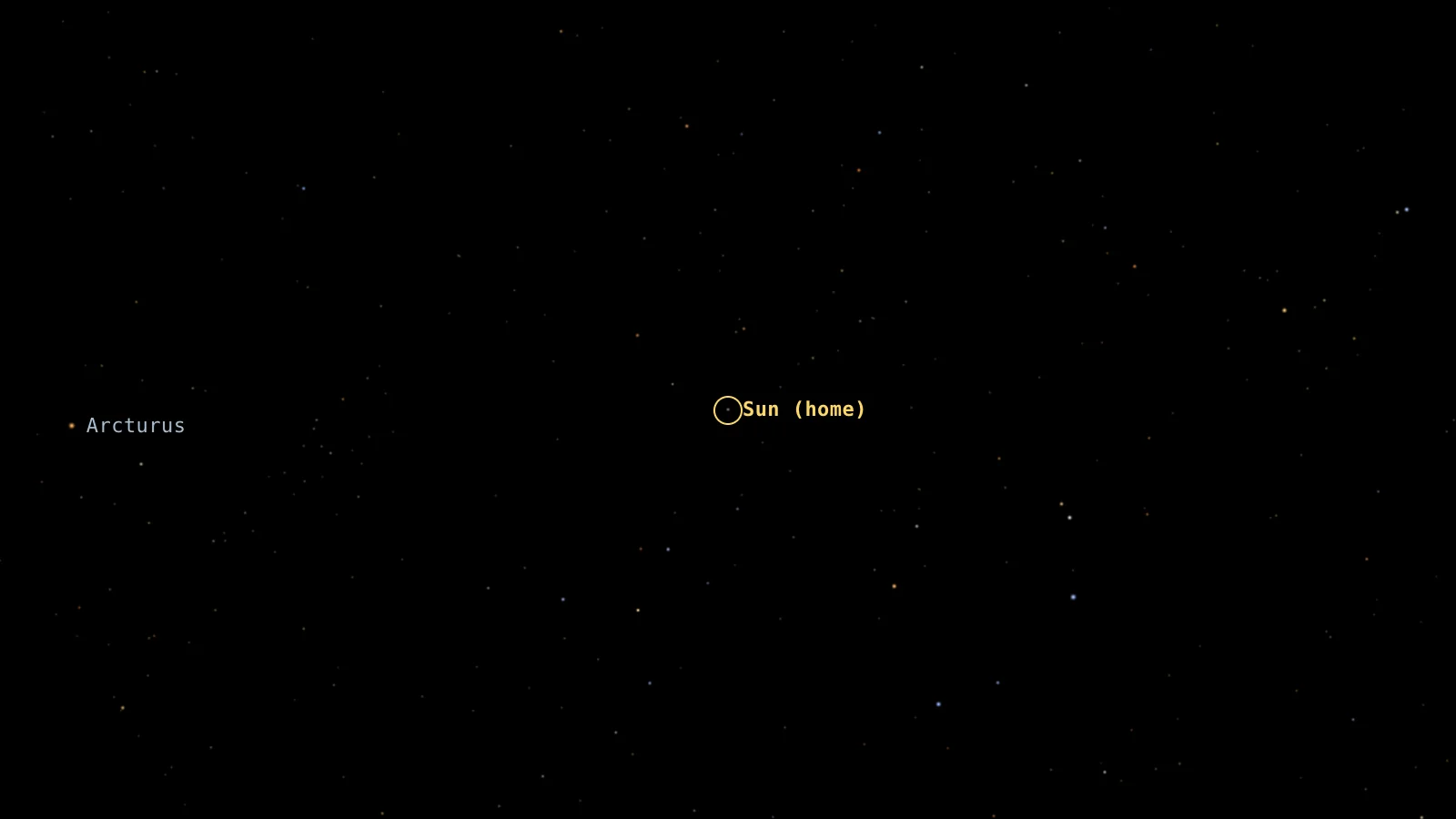
From inside the system, the star would be a brilliant white sun, and the great ring would be invisible as a ring: its dust is spread so thin that you would fly through it hardly noticing, though from far above it would glow faintly in the infrared. Two of the brighter stars in your sky would be Fomalhaut's own companions.
A ship that could accelerate at a steady one g for half the way and brake for the other half would arrive after 6.4 years aboard, while 27 years passed at home, touching 99.74 % of the speed of light on the way.
Light
25.1 years
The light reaching us now left Fomalhaut in 2001.
At a steady 1 g
6.4 years aboard
27 years pass on Earth; top speed 99.74 % of light.
Finding Fomalhaut in the night sky
Fomalhaut is in the constellation Piscis Austrinus. At magnitude 1.2 it is one of the brightest stars in the sky, easy to see even from a city.
It stands highest in the evening sky (around 9 pm) in October, and it is well placed in the evening from September to December: autumn in the northern hemisphere, spring in the southern.
It never rises north of latitude 60° N, so it cannot be seen from Reykjavík; the farther south you are, the higher it climbs.
To find it, start from Alnair (magnitude 1.7): Fomalhaut is 20° to its northeast, about 2 fists at arm's length (a fist held out covers about 10°). It is also 18° north of Tiaki and 27° southwest of Diphda.
Data
Measured values come from the papers cited. The game's estimates are what Solarwind works out from the star catalogue's colour and brightness alone; where the two differ, the measurement is the better value.
| Measured | Game's estimate | ||
|---|---|---|---|
| Distance | — | 25.13 ly · 7.704 pc | from Gaia/Hipparcos parallax |
| Parallax | — | 129.8 mas | |
| Right ascension | — | 22h 57m 40s | J2016 |
| Declination | — | −29° 37′ | |
| Constellation | Piscis Austrinus | — | |
| Spectral type | A4V[1] | A3V | |
| Temperature | 8,745 K[2] | 8,658 K | the Sun: 5,772 K |
| Radius | 1.84 R☉[3] | 1.78 R☉ | 18 × Jupiter |
| Mass | 1.92 M☉[3] | 2.01 M☉ | 2,012 × Jupiter |
| Luminosity | 16.0 L☉[4] | 16.1 L☉ | |
| Apparent magnitude (V) | 1.160 [5] | 1.17 | naked-eye limit ≈ 6 |
| Absolute magnitude | — | 1.74 | |
| Habitable zone | — | 3.5–6.1 AU | Kopparapu et al. 2014, from the measured temperature |
| Frost line | — | 11 AU | where water freezes |
Nearest stars
- Gliese 8790.919 ly
- J2248-24222.48 ly
- Gliese 8843.65 ly
- J2202-37045.98 ly
- Gliese 867B5.99 ly
- Gliese 867A6.10 ly
- Gliese GJ 42746.28 ly
- Gliese GJ 20058.43 ly
- Gliese 9158.73 ly
- Gliese GJ 43609.24 ly
Quick answers
What is Fomalhaut b?
An object first reported in 2008 as a planet photographed by Hubble inside Fomalhaut's dust ring, later named Dagon. Follow-up images showed it fading and spreading out, and it is now thought to have been an expanding cloud of dust from a collision between two icy bodies rather than a planet.
Is Fomalhaut a main sequence star?
Yes. It is a young A4V star steadily fusing hydrogen in its core, much younger than the Sun and burning through its fuel far faster.
Is there a Fomalhaut c?
There is no confirmed planet c. Searches for the name usually mean Fomalhaut C, the red dwarf LP 876-10, the most distant member of Fomalhaut's triple system, which has a debris ring of its own.
Where is Fomalhaut in the night sky?
In the constellation Piscis Austrinus, the Southern Fish. Northern observers see it low in the south on autumn evenings, the only bright star in that part of the sky; the western edge of the Great Square of Pegasus points down towards it.
How far away is Fomalhaut?
Fomalhaut is 25.1 light-years (7.70 parsecs) from the Sun, so the light you see from it left 25.1 years ago.
Can you see Fomalhaut with the naked eye?
Yes: at magnitude 1.16 it is visible to the naked eye under a dark sky.
What type of star is Fomalhaut?
A white star of spectral type A4V, with a surface temperature of about 8,745 K (the Sun's is 5,772 K).
How big is Fomalhaut compared with the Sun?
Its radius is 1.84 times the Sun's, about 1,300,000 km; its mass is 1.92 solar masses, and it is 16.0 times as luminous as the Sun.
How hot is Fomalhaut?
Its surface is about 8,745 K (8,472 °C, 15,281 °F), hotter than the Sun's 5,772 K.
What colour is Fomalhaut?
At 8,745 K its light is bluish white: cooler stars glow redder, hotter ones bluer.
How massive is Fomalhaut?
About 1.92 times the Sun's mass, or 2,012 Jupiters.
How luminous is Fomalhaut?
It is about 16.0 times as luminous as the Sun (16.0 solar luminosities).
Will Fomalhaut go supernova?
No. At about 1.9 solar masses it is too light: stars under about 8 solar masses end by shedding their outer layers and leaving a white dwarf.
What season is Fomalhaut visible in?
In the north it is a autumn star: it stands highest in the evening sky in October and is well placed from September to December. In the southern hemisphere those months are spring.
What galaxy is Fomalhaut in?
The Milky Way, our own galaxy: every star you can see without a telescope belongs to it. At 25.1 light-years Fomalhaut is a close neighbour on the scale of the galaxy, which is about 100,000 light-years across, and it lies in the same spiral arm as the Sun, the Orion Arm.
How long would it take to travel to Fomalhaut?
Light takes 25.1 years. A ship accelerating at a steady 1 g and braking halfway would arrive after 6.4 years aboard (27 years on Earth), peaking at 99.74 % of the speed of light.
Sources
Last updated .
- Contributions to the Nearby Stars (NStars) Project: Spectroscopy of Stars Earlier than M0 within 40 pc-The Southern Sample
- Chemical analysis of early-type stars with planets
- On the age and binarity of Fomalhaut
- Wikipedia, via Wikidata
- VizieR Online Data Catalog: Stellar Photometry in Johnson's 11-color system (Ducati, 2002)
Positions and photometry: HYG Database v4.1 (CC BY-SA 4.0) and the Gaia Catalogue of Nearby Stars, ESA/Gaia/DPAC. Planets: the NASA Exoplanet Archive, operated by Caltech under contract with NASA. Identifiers: Wikidata (CC0), Q76446963; SIMBAD. Habitable zone: Kopparapu et al. 2014. Text: written with an AI model from the data on this page, checked against the sources.
Also known as: 24 PsA · 2MASS J22573901-2937193 · CEL 5549 · CPC 17 12409 · FK5 867 · GC 32000 · GCRV 14409 · GJ 881 · GJ 881.0 · HD 216956 · HIC 113368 · HIP 113368 · HR 8728 · IRAS 22549-2953 · IRC -30458 · JP11 3556 · LTT 9292 · N30 5050 · NLTT 55380 · NSV 14372 · PLX 5565 · PLX 5565.00 · PMC 90-93 611 · PPM 274426 · RAFGL 2995 · ROT 3340 · SAO 191524 · SRS 30867 · TD1 29476 · TIC 47552789 · TYC 6977-1267-1 · UBV 19672 · UBV M 26732 · WDS J22577-2937A · WEB 20167 · Zkh 345 · [DML87] 545 · uvby98 100216956 · α PsA