Polaris facts at a glance
- Type: a yellow-white supergiant, spectral type F7 Ib-II, in Ursa Minor.
- Distance: 433 light-years (133 parsecs).
- Temperature: 6,206 K (5,933 °C, 10,711 °F) at the surface.
- Size: 3,276 times the Earth's width (30 solar radii).
- Mass: 6.0 times the Sun's.
- Planets: none known.
The star that stands still
Polaris, the North Star, is the one star in the northern sky that hardly moves. It sits less than a degree from the north celestial pole, the point the Earth's axis aims at, so while every other star wheels around it through the night, Polaris stays put above the northern horizon. For centuries sailors and travellers have steered by it, and its height above the horizon tells you your latitude.
It is not, as many people expect, the brightest star in the sky. At magnitude 2.02 it is only around the fiftieth brightest, a modest yellow-white star you could easily overlook. Its fame comes entirely from where it is.
Finding Polaris
The easiest way to find Polaris is with the Big Dipper (the Plough), the bright saucepan of seven stars in Ursa Major. Find the two stars at the end of the Dipper's bowl, away from the handle: Merak at the bottom and Dubhe at the top, the Pointers. Draw a line from Merak through Dubhe and carry it on about five times the gap between them. The first moderately bright star you reach is Polaris.
If the Dipper is low, use Cassiopeia, the W-shaped constellation on the other side of the pole: Polaris lies roughly between the two, and a line from the middle of the W points towards it. Once you have it, you will see that it is the last star in the handle of the Little Dipper, Ursa Minor, a faint pattern that needs a dark sky. Facing Polaris, you are facing north. From the southern hemisphere it is below the horizon and cannot be seen at all.
A yellow supergiant
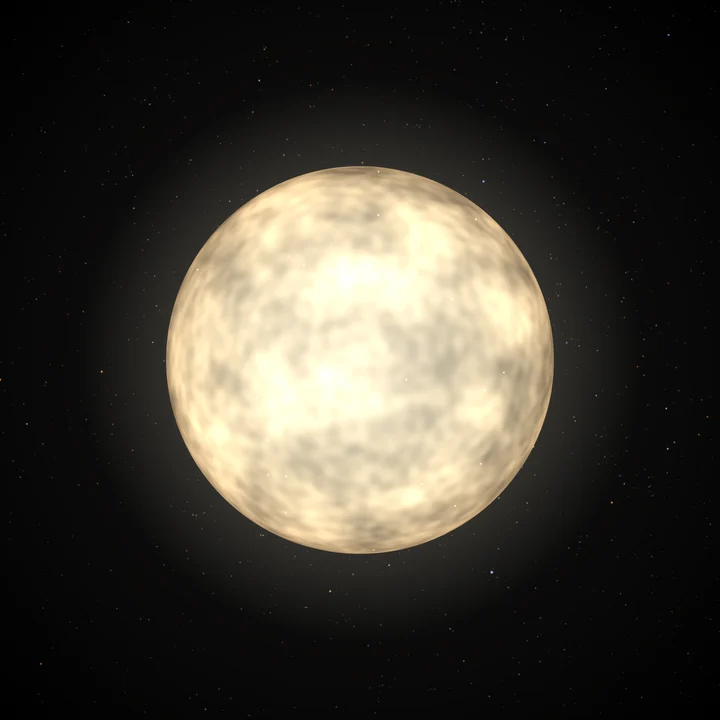
Polaris is far more impressive than it looks. It is a yellow-white supergiant of spectral class F, about 30 times as wide as the Sun, some 20,900,000 km in radius, and about 6.0 times its mass. Its surface glows at 6,206 kelvin, a little hotter than the Sun's 5,772, and it shines with roughly 2,200 times the Sun's light. It looks faint only because it is so far away.
How far is debated. The Hipparcos satellite measured a parallax of 7.540 milliarcseconds, a distance of 433 light-years, which this page uses. But Polaris is so bright that it overwhelms many instruments, and other methods disagree: one study put it about a quarter closer, while later Hubble and Gaia measurements, including of its fainter companion, suggest a distance at least as great. For a star this famous and this important, the uncertainty is a real problem.
A pulsing star with partners
Polaris is a Cepheid variable: a star that rhythmically swells and shrinks, brightening and fading as it goes, in a cycle of just under four days. Cepheids are the yardsticks of the universe, because their pulsation period reveals their true brightness, and so their distance. As the nearest Cepheid, Polaris should be a key calibrator, which is exactly why its own uncertain distance matters.
Its pulsation is odd. Over the twentieth century the swings in brightness shrank until they were barely detectable, then grew again; the period is also slowly lengthening. Some readings of ancient star catalogues even suggest it has brightened noticeably since antiquity; whether or not that holds, Polaris is a star still visibly changing.
Polaris is not one star but at least three. A close companion, Polaris Ab, orbits it once in about three decades and was first photographed directly by the Hubble Space Telescope in 2006. A third star, Polaris B, lies much further out and can be seen in a small telescope as a faint point beside the bright one.
North Star for now
Polaris has not always been the North Star and will not always be. The Earth's axis wobbles slowly like a spinning top, a motion called precession, tracing a great circle in the sky over about twenty-six thousand years. When the pyramids were built, the pole star was Thuban in Draco. Polaris has been close enough to serve for the last thousand years or so, and it will be at its nearest to the pole around the year 2100. Then it will drift away, and in some twelve thousand years the brilliant Vega will be the pole star.
A distant journey
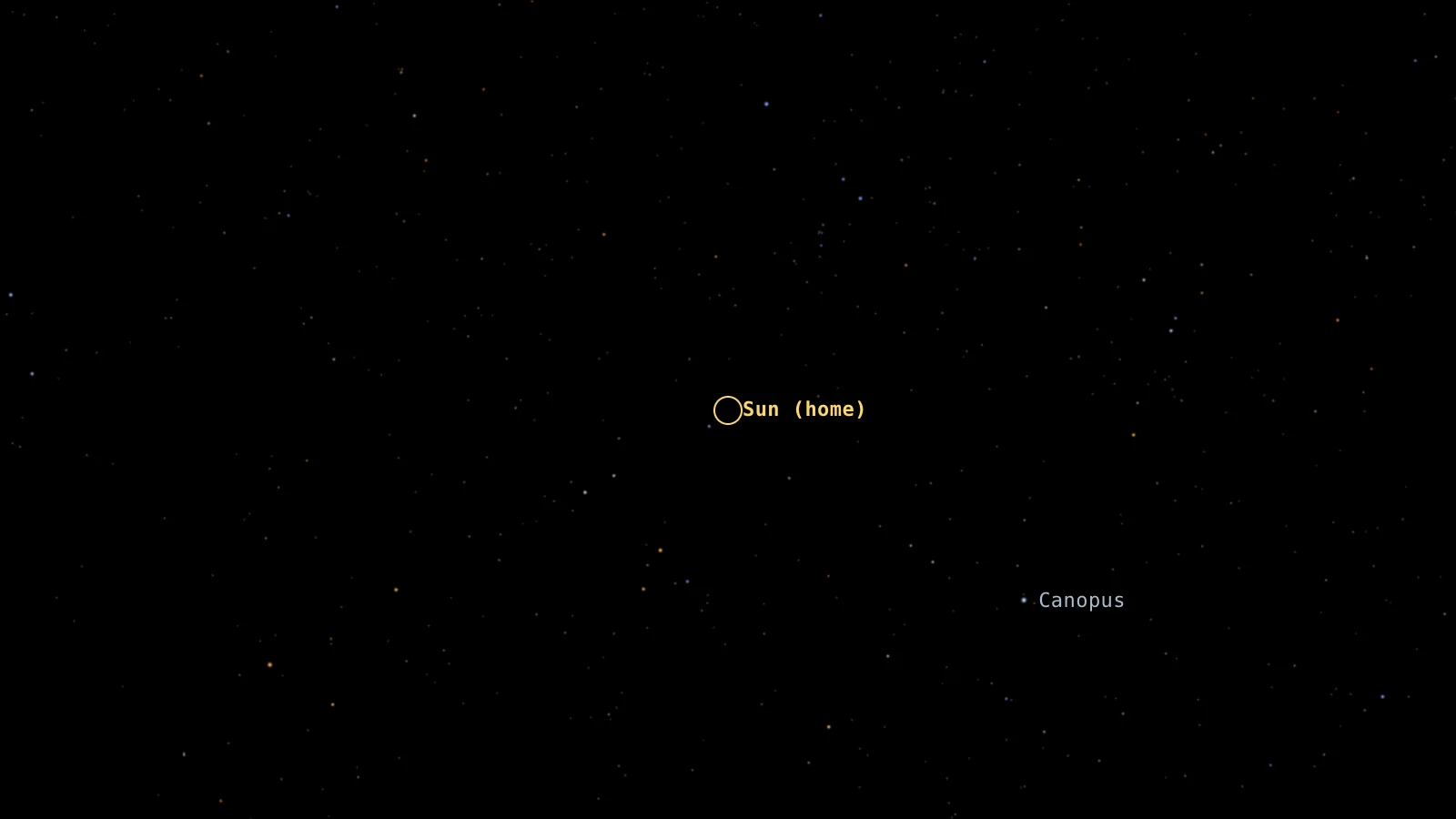
At 433 light-years, the light you see from Polaris tonight set out several centuries ago. A ship accelerating at a steady one g for half the way and braking for the other half would get there after 12 years aboard, but 430 years would pass on Earth, the ship touching 99.99900 % of the speed of light at the turnaround.
Light
433 years
The light reaching us now left Polaris in 1593.
At a steady 1 g
12 years aboard
430 years pass on Earth; top speed 99.99900 % of light.
Finding Polaris in the night sky
Polaris is in the constellation Ursa Minor. At magnitude 2.0 it is a naked-eye star, easy to see away from bright city lights.
From almost anywhere in the northern hemisphere (north of 1° N) it never sets: it circles the north celestial pole all night, every night of the year.
It never rises south of latitude 1° S, so it cannot be seen from Johannesburg, Sydney or Buenos Aires; the farther north you are, the higher it climbs.
To find it, start from Kochab (magnitude 2.1): Polaris is 17° to its north, about 2 fists at arm's length (a fist held out covers about 10°). It is also 29° north of Dubhe.
Data
Measured values come from the papers cited. The game's estimates are what Solarwind works out from the star catalogue's colour and brightness alone; where the two differ, the measurement is the better value.
| Measured | Game's estimate | ||
|---|---|---|---|
| Distance | — | 432.6 ly · 132.6 pc | from Gaia/Hipparcos parallax |
| Parallax | — | 7.540 mas | |
| Right ascension | — | 2h 31m 53s | J2016 |
| Declination | — | +89° 16′ | |
| Constellation | Ursa Minor | — | |
| Spectral type | F7 :IB-II SB,V[1] | F7:Ib-IIv SB | |
| Temperature | 6,206 K[2] | 5,815 K | the Sun: 5,772 K |
| Radius | 30.0 R☉[3] | 48.3 R☉ | 300 × Jupiter |
| Mass | 6.00 M☉[3] | 8.40 M☉ (rough) | 6,288 × Jupiter |
| Luminosity | 2,200 L☉[3] | 2,410 L☉ | |
| Apparent magnitude (V) | 2.020 [4] | 1.97 | naked-eye limit ≈ 6 |
| Absolute magnitude | — | -3.64 | |
| Habitable zone | — | 43–76 AU | Kopparapu et al. 2014, from the measured temperature |
| Frost line | — | 130 AU | where water freezes |
Nearest stars
- HIP 5188669.2 ly
- HIP 6290871.6 ly
- HIP 1806474.6 ly
- HIP 8056174.6 ly
- HIP 2357784.2 ly
- HIP 5151686.3 ly
- HIP 5909196.2 ly
- HIP 4033798.4 ly
- HIP 9544101 ly
- HIP 22011105 ly
Quick answers
Is Polaris the brightest star in the sky?
No. Sirius is the brightest star in the night sky; Polaris, at magnitude 2.02, ranks around fiftieth. It is famous for its position near the north celestial pole, not its brightness.
Why is Polaris called the North Star?
Because it lies almost exactly above the Earth's North Pole in the sky, less than a degree from the celestial pole. It barely moves through the night, and it always marks due north.
What was the North Star before Polaris?
Around the time of the Egyptian pyramids it was Thuban, in Draco. The Earth's axis slowly wobbles, and Polaris only became a good pole star in the last thousand years or so; in the far future Vega will take over.
How old is Polaris?
It is much younger than the Sun, probably tens of millions of years old. Stars as heavy as Polaris burn through their fuel fast, and it has already left the main sequence to become a supergiant.
How far away is Polaris?
Polaris is 433 light-years (133 parsecs) from the Sun, so the light you see from it left 433 years ago.
Can you see Polaris with the naked eye?
Yes: at magnitude 2.02 it is visible to the naked eye under a dark sky, from the northern hemisphere.
Where is Polaris in the night sky?
In the constellation Ursa Minor. It never sets as seen from almost all of the northern hemisphere and never rises south of latitude 1° S. From Kochab, look 17° to the north.
What type of star is Polaris?
A yellow-white supergiant of spectral type F7 Ib-II, with a surface temperature of about 6,206 K (the Sun's is 5,772 K).
How big is Polaris compared with the Sun?
Its radius is 30.0 times the Sun's, about 21,000,000 km; its mass is 6.00 solar masses, and it is 2,200 times as luminous as the Sun.
How hot is Polaris?
Its surface is about 6,206 K (5,933 °C, 10,711 °F), hotter than the Sun's 5,772 K.
What colour is Polaris?
At 6,206 K its light is white: cooler stars glow redder, hotter ones bluer.
How massive is Polaris?
About 6.00 times the Sun's mass, or 6,288 Jupiters.
How luminous is Polaris?
It is about 2,200 times as luminous as the Sun (2,200 solar luminosities).
Is Polaris a main sequence star?
No. Its luminosity class, Ib-II, marks a supergiant: a massive star that has used up the hydrogen in its core and left the main sequence.
Will Polaris go supernova?
No. At about 6.0 solar masses it is too light: stars under about 8 solar masses end by shedding their outer layers and leaving a white dwarf.
What galaxy is Polaris in?
The Milky Way, our own galaxy: every star you can see without a telescope belongs to it. At 433 light-years Polaris is a close neighbour on the scale of the galaxy, which is about 100,000 light-years across, and it lies in the same spiral arm as the Sun, the Orion Arm.
How long would it take to travel to Polaris?
Light takes 433 years. A ship accelerating at a steady 1 g and braking halfway would arrive after 12 years aboard (430 years on Earth), peaking at 99.99900 % of the speed of light.
Sources
Last updated .
- Color excesses for supergiants and classical Cepheids. I. Calibration of the G-band photometry
- Stellar population models in the UV. I. Characterisation of the New Generation Stellar Library
- Wikipedia, via Wikidata
- VizieR Online Data Catalog: Stellar Photometry in Johnson's 11-color system (Ducati, 2002)
Positions and photometry: HYG Database v4.1 (CC BY-SA 4.0) and the Gaia Catalogue of Nearby Stars, ESA/Gaia/DPAC. Planets: the NASA Exoplanet Archive, operated by Caltech under contract with NASA. Identifiers: Wikidata (CC0), Q12980; SIMBAD. Habitable zone: Kopparapu et al. 2014. Text: written with an AI model from the data on this page, checked against the sources.
Also known as: 1 UMi · 2MASS J02314822+8915503 · AAVSO 0122+88 · ADS 1477 A · ADS 1477 AP · AG+89 4 · BD+88 8 · CCDM J02319+8915A · FK5 907 · GC 2243 · GCRV 1037 · GSC 04628-00237 · HD 8890 · HIC 11767 · HIP 11767 · HR 424 · IDS 01226+8846 A · IRAS 01490+8901 · JP11 498 · N30 381 · PLX 299 · PLX 299.00 · PMC 90-93 640 · PPM 431 · ROT 3491 · SAO 308 · SBC7 51 · SBC9 76 · TD1 835 · TIC 303256075 · TYC 4628-237-1 · UBV 21589 · UBV M 8201 · WDS J02318+8916A · WDS J02318+8916Aa,Ab · WEB 2438 · alf UMi · α UMi