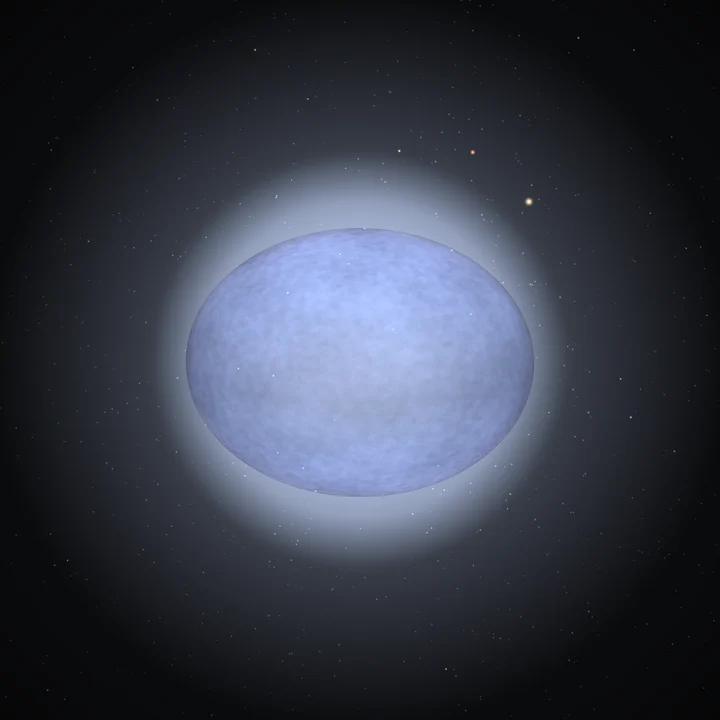
Regulus facts at a glance
- Type: a blue-white subgiant, spectral type B8IVn, in Leo.
- Distance: 79.3 light-years (24.3 parsecs).
- Temperature: 11,535 K (11,262 °C, 20,303 °F) at the surface.
- Size: 382 times the Earth's width (3.5 solar radii).
- Mass: 3.8 times the Sun's.
- Planets: none known.
The heart of the lion
Regulus is the brightest star in Leo, the Lion, marking its heart. It lies 79.3 light-years away and shines at magnitude 1.40, one of the two dozen or so brightest stars in the night sky. Its name, Latin for "little king", was given by Copernicus, but its royal reputation is much older: Babylonian and Persian sky-watchers counted it among the great stars that guarded the heavens.
It is a B8IVn star, a hot blue-white star far grander than the Sun. It is about 3.5 times as wide, some 2,430,000 km in radius, and holds 3.8 times the Sun's mass. Its surface glows at 11,535 kelvin, about twice as hot as the Sun's 5,772, and it gives out roughly 200 times as much light. Stand near it and you would see a fierce white sun, its light rich in blue and ultraviolet.
A star spinning almost to pieces
What makes Regulus remarkable is its spin. Its equator races round once in about sixteen hours, so fast that it is close to the speed at which the star would begin to fly apart. The spin has squashed it: Regulus is markedly wider at the equator than from pole to pole, an oval rather than a ball.
In 2005 astronomers used the CHARA array of telescopes in California, which combine their light to act as one giant instrument, to measure that shape directly. They also saw the effect called gravity darkening: the poles, closer to the star's centre, are hotter and brighter than the cooler, dimmer equator. The quoted size and temperature of Regulus are therefore averages over a star that is not the same all over.
A hidden companion
Why does Regulus spin so fast? A clue came in 2008, when astronomers found from its slight wobble that it has a faint, close partner orbiting it in about forty days. In 2020 the partner's ultraviolet light was detected directly: it is a white dwarf, or nearly one, the stripped core of a once larger star. Long ago that companion was probably the heavier star; as it swelled, it poured gas onto Regulus, and the gas brought its spin with it, winding Regulus up.
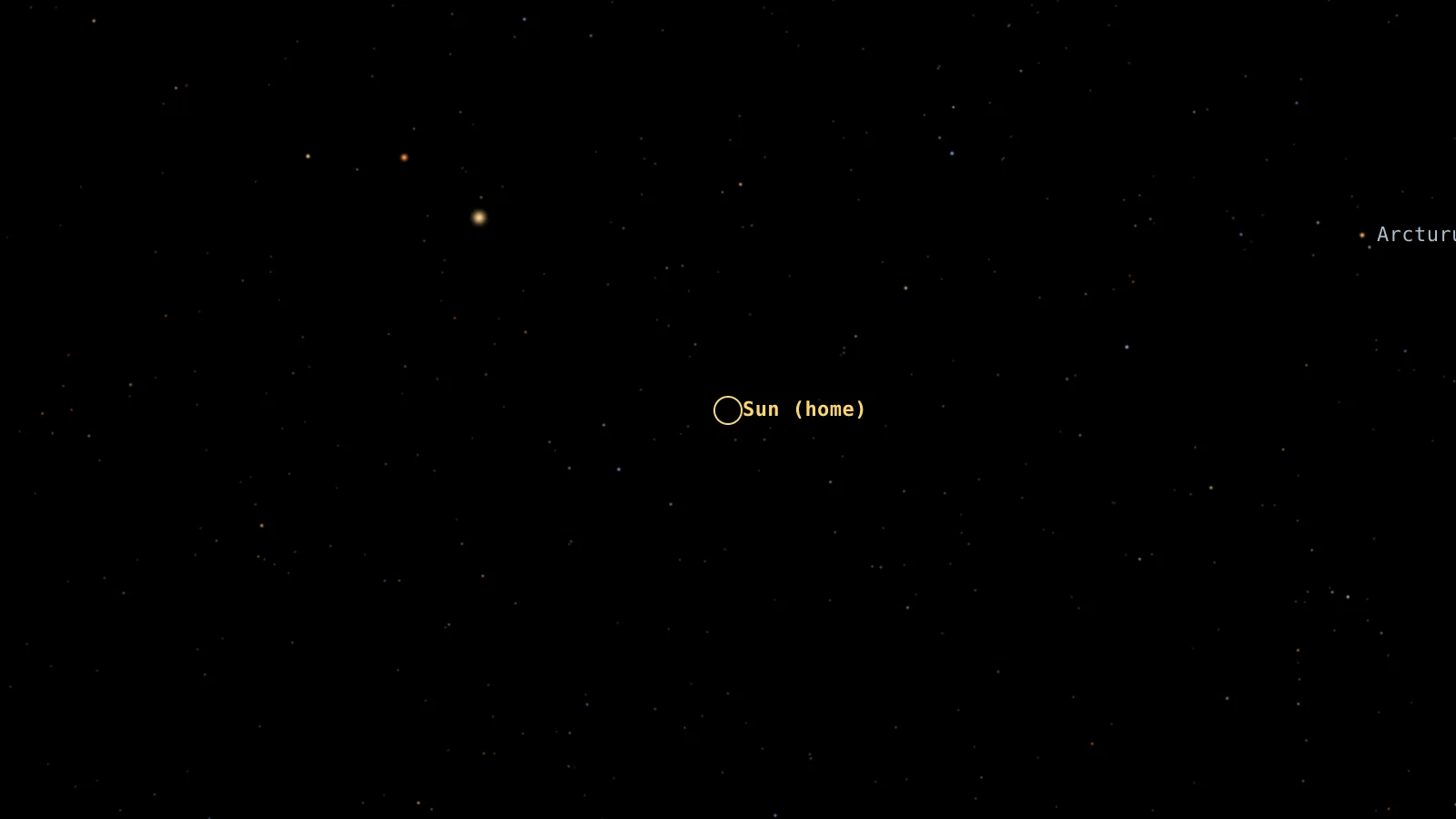
Regulus is not a lonely star even beyond that. A pair of fainter stars, an orange dwarf and a red dwarf, shares its motion through space a long way out, making Regulus a system of at least four stars. The bright star itself is still a main-sequence star, fusing hydrogen in its core, though possibly near the end of that stage.
Finding it in the sky
Regulus sits almost exactly on the ecliptic, the Sun's yearly path across the sky, which makes it a familiar stop for the Moon and planets. The Moon regularly passes in front of it, and in 1959 Venus did, a rare event. The Sun passes it each year in late August, when it is lost in the glare.
To find it, look for Leo on spring evenings in the northern hemisphere (autumn in the southern). Its head and mane form the Sickle, a backwards question mark of stars, and Regulus is the bright dot at its base. The pointer stars of the Big Dipper, followed the opposite way from Polaris, lead you towards Leo.
The journey to the king
At 79.3 light-years, the light you see from Regulus left it about a human lifetime ago. A ship accelerating at a steady one g for half the way and braking for the other half would arrive after 8.6 years aboard, while 81 years passed on Earth, reaching 99.971 % of the speed of light at the midpoint.
Light
79.3 years
The light reaching us now left Regulus in 1947.
At a steady 1 g
8.6 years aboard
81 years pass on Earth; top speed 99.971 % of light.
Arriving, you would find a blinding white, flattened star whose poles shine brighter than its waist, a faint white dwarf in a tight orbit beside it, and no known planets. With its intense ultraviolet light, a world around it would need deep shelter.
Finding Regulus in the night sky
Regulus is in the constellation Leo. At magnitude 1.4 it is one of the brightest stars in the sky, easy to see even from a city.
It stands highest in the evening sky (around 9 pm) in April, and it is well placed in the evening from March to June: spring in the northern hemisphere, autumn in the southern.
It never rises south of latitude 78° S; the farther north you are, the higher it climbs.
To find it, start from Algieba (magnitude 2.0): Regulus is 8.4° to its south, about one fist at arm's length (a fist held out covers about 10°). It is also 23° northeast of Alphard.
Data
Measured values come from the papers cited. The game's estimates are what Solarwind works out from the star catalogue's colour and brightness alone; where the two differ, the measurement is the better value.
| Measured | Game's estimate | ||
|---|---|---|---|
| Distance | — | 79.30 ly · 24.31 pc | from Gaia/Hipparcos parallax |
| Parallax | — | 41.13 mas | |
| Right ascension | — | 10h 8m 22s | J2016 |
| Declination | — | +11° 58′ | |
| Constellation | Leo | — | |
| Spectral type | B8IVn[1] | B7V | |
| Temperature | 11,540 K[2] | 11,407 K | the Sun: 5,772 K |
| Radius | 3.50 R☉[3] | 3.81 R☉ | 35 × Jupiter |
| Mass | 3.80 M☉[3] | 4.25 M☉ | 3,982 × Jupiter |
| Luminosity | 200 L☉ from the radius and temperature | 222 L☉ | |
| Apparent magnitude (V) | 1.400 [1] | 1.36 | naked-eye limit ≈ 6 |
| Absolute magnitude | — | -0.570 | |
| Habitable zone | — | 12–21 AU | Kopparapu et al. 2014, from the measured temperature |
| Frost line | — | 38 AU | where water freezes |
Nearest stars
- J1008+11590.217 ly
- J1006+12402.21 ly
- J0956+11344.02 ly
- Gliese GJ 35764.76 ly
- J1017+07197.13 ly
- J1005+17038.22 ly
- J0954+09598.41 ly
- Gliese GJ 35838.74 ly
- J0954+06388.79 ly
Quick answers
Which star is cooler, Polaris or Regulus?
Polaris. Regulus is a blue-white star with a surface around 11,535 kelvin, while Polaris is a yellow-white supergiant with a surface only a little hotter than the Sun's, roughly half as hot as Regulus.
Is Regulus the North Star?
No. The North Star is Polaris, in Ursa Minor, close to the north celestial pole. Regulus lies near the ecliptic in Leo, so it rises and sets like the Sun and planets.
Is Regulus a main-sequence star?
Yes, it is still fusing hydrogen in its core, though some astronomers classify it as slightly evolved, nearing the end of its main-sequence life. Its fast spin makes it look different from different directions, which complicates the classification.
What is the "star of Regulus" alignment with the Sphinx?
Claims that the Great Sphinx was aligned with Leo or Regulus, or that Regulus will mark some coming event, come from alternative history and prophecy, not astronomy. Regulus moves through the sky like any other star, its position shifting only slowly over thousands of years.
How far away is Regulus?
Regulus is 79.3 light-years (24.3 parsecs) from the Sun, so the light you see from it left 79.3 years ago.
Can you see Regulus with the naked eye?
Yes: at magnitude 1.40 it is visible to the naked eye under a dark sky.
Where is Regulus in the night sky?
In the constellation Leo. It is highest in the evening sky around April and never rises south of latitude 78° S. From Algieba, look 8.4° to the south.
What type of star is Regulus?
A blue-white subgiant of spectral type B8IVn, with a surface temperature of about 11,535 K (the Sun's is 5,772 K).
How big is Regulus compared with the Sun?
Its radius is 3.50 times the Sun's, about 2,400,000 km; its mass is 3.80 solar masses, and it is 195 times as luminous as the Sun.
How hot is Regulus?
Its surface is about 11,535 K (11,262 °C, 20,303 °F), hotter than the Sun's 5,772 K.
What colour is Regulus?
At 11,535 K its light is blue-white: cooler stars glow redder, hotter ones bluer.
How massive is Regulus?
About 3.80 times the Sun's mass, or 3,982 Jupiters.
How luminous is Regulus?
It is about 195 times as luminous as the Sun (195 solar luminosities), worked out from its measured radius and temperature.
Will Regulus go supernova?
No. At about 3.8 solar masses it is too light: stars under about 8 solar masses end by shedding their outer layers and leaving a white dwarf.
What season is Regulus visible in?
In the north it is a spring star: it stands highest in the evening sky in April and is well placed from March to June. In the southern hemisphere those months are autumn.
What galaxy is Regulus in?
The Milky Way, our own galaxy: every star you can see without a telescope belongs to it. At 79.3 light-years Regulus is a close neighbour on the scale of the galaxy, which is about 100,000 light-years across, and it lies in the same spiral arm as the Sun, the Orion Arm.
How long would it take to travel to Regulus?
Light takes 79.3 years. A ship accelerating at a steady 1 g and braking halfway would arrive after 8.6 years aboard (81 years on Earth), peaking at 99.971 % of the speed of light.
Sources
Last updated .
- Directly determined linear radii and effective temperatures of exoplanet host stars
- Rotational velocities of A-type stars. IV. Evolution of rotational velocities
- Wikipedia, via Wikidata
Positions and photometry: HYG Database v4.1 (CC BY-SA 4.0) and the Gaia Catalogue of Nearby Stars, ESA/Gaia/DPAC. Planets: the NASA Exoplanet Archive, operated by Caltech under contract with NASA. Identifiers: Wikidata (CC0), Q13013; SIMBAD. Habitable zone: Kopparapu et al. 2014. Text: written with an AI model from the data on this page, checked against the sources.
Also known as: 2MASS J10082229+1158018 · 32 Leo · ADS 7654 A · AG+12 1199 · ASCC 949713 · BD+12 2149 · CCDM J10083+1159A · CSV 101099 · FK5 380 · GC 13926 · GCRV 6417 · GJ 9316 A · HD 87901 · HGAM 596 · HIC 49669 · HIP 49669 · HR 3982 · IRAS 10056+1212 · IRC +10226 · JP11 1896 · LSPM J1008+1158 · LTT 12716 · N30 2414 · NLTT 23490 · NSV 4750 · PLX 2384 · PMC 90-93 274 · PMSC 10030+1227A · PPM 127140 · RAFGL 4771S · ROT 1536 · SAO 98967 · SRS 30380 · TD1 14585 · TIC 357348164 · TYC 833-1381-1 · UBV 9452 · UBV M 15960 · WDS J10084+1158A · WEB 9160 · YPAC 43 · uvby98 100087901 A · α Leo