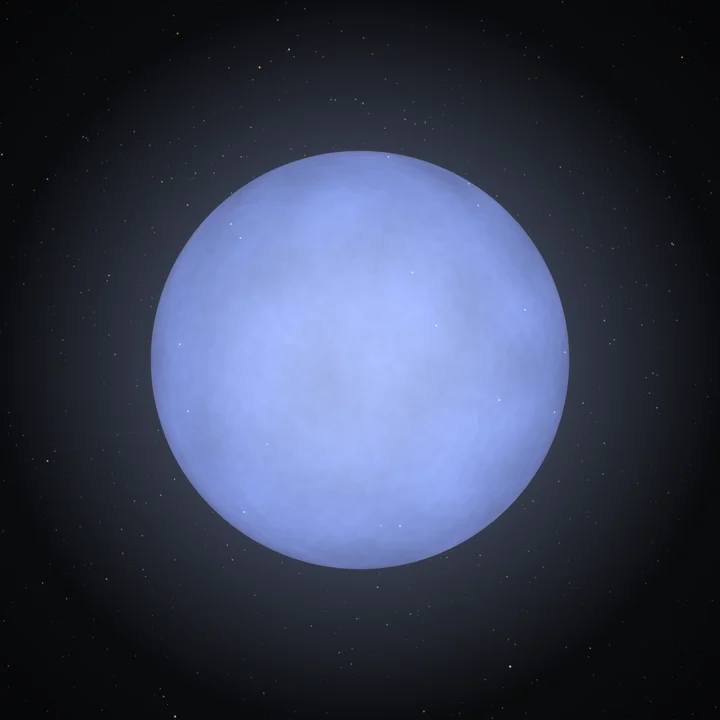
Spica facts at a glance
- Type: a blue-white star, spectral type B2 V, in Virgo.
- Distance: 250 light-years (76.6 parsecs).
- Temperature: 25,300 K (25,027 °C, 45,080 °F) at the surface.
- Size: 808 times the Earth's width (7.4 solar radii).
- Mass: 11 times the Sun's.
- Planets: none known.
The ear of wheat
Spica is the brightest star in Virgo, a steely blue-white light shining at magnitude 0.97 low in the spring sky of the northern hemisphere. Its name is Latin for an ear of grain, the one the Virgin holds in her hand, and in the ancient Mediterranean its rising and setting were tied to the farming year.
It lies 250 light-years away, and what looks like one star is two. Spica is a pair of hot, heavy blue stars locked in an orbit so tight that no telescope can split them. We know them only through the light they share.
Two stars in one point
The brighter star, Spica A, is a hot blue star of about 11 times the Sun's mass and 7.4 times its width, some 5,150,000 km in radius. Its surface burns at about 25,300 kelvin, more than four times hotter than the Sun's 5,772, and most of its light comes out as ultraviolet. Together with its companion it shines tens of thousands of times more brightly than the Sun.
Its partner, Spica B, is a smaller blue star with roughly half its mass. The two whirl round each other once every four days, closer together than Mercury is to the Sun. At that range each star's gravity pulls the other out of round, into a slightly egg-shaped form, and as they turn we see first their broad sides and then their narrow ends, so Spica brightens and fades a little with every orbit.
How we know
No one has ever seen Spica as two points. In 1890 the German astronomer Hermann Vogel found that the lines in its spectrum shifted back and forth, first towards the blue and then the red, as the stars swung towards and away from us. Spica was one of the first stars found to be a binary this way, a spectroscopic binary.
Around 1970 the Narrabri stellar intensity interferometer in Australia resolved the pair's orbit by measuring how the light from the two stars combined, giving their masses and distance. Spica A also pulses on a period of a few hours, a beta Cephei variable, and that ringing tells astronomers about the inside of a massive star.
No planets are known around Spica. With two massive stars so close together, any planet would have to orbit well outside both, and the stars' fierce ultraviolet light would make it a hostile place.
| Body | Kind | Orbit, AU | Year, days | Mass, Earths | Temp., K |
|---|---|---|---|---|---|
| Spica I game-made | Ice giant | 0.196 | 9.72 | 4.9 | 5,428 |
A star that measured the sky
Spica has a special place in the history of astronomy. Around 130 BC the Greek astronomer Hipparchus compared his measurements of Spica's position with records made by Timocharis more than a century earlier, and found the star had shifted relative to the equinox. From that he discovered the precession of the equinoxes, the slow wobble of the Earth's axis.
Spica lies very close to the ecliptic, the path the Sun, Moon and planets follow across the sky, so the Moon often passes in front of it and planets drift by. It is easy to find: follow the curve of the Plough's handle to orange Arcturus, then carry on to Spica. "Arc to Arcturus, speed on to Spica", as the saying goes. With Arcturus and Denebola it forms the Spring Triangle.
A short, bright future
Stars this heavy do not last. Spica A is already near the end of its time burning hydrogen in its core, and within a few tens of millions of years it will swell into a supergiant. It is massive enough that it will very probably end as a supernova, which would shine brighter than Venus in our sky.
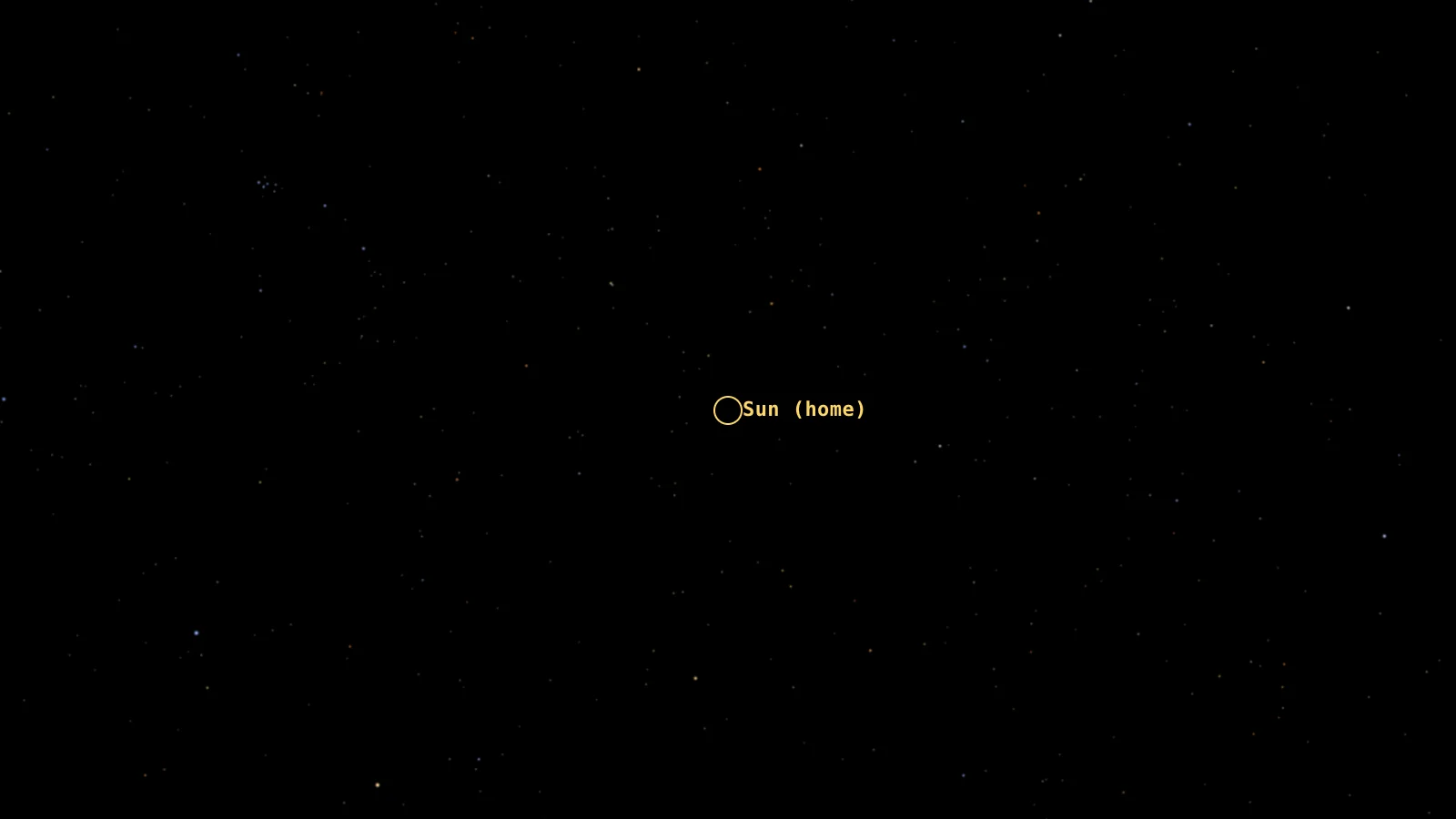
Travelling there at a constant one g, speeding up half the way and slowing the rest, would take 11 years aboard the ship but 250 years on Earth, at a top speed of 99.9970 % of the speed of light.
Light
250 years
The light reaching us now left Spica in 1776.
At a steady 1 g
11 years aboard
250 years pass on Earth; top speed 99.9970 % of light.
Near Spica the pair would be a blinding blue-white glare, too bright and too ultraviolet to look at safely, and our Sun would be far too faint to see without a telescope.
Finding Spica in the night sky
Spica is in the constellation Virgo. At magnitude 1.0 it is one of the brightest stars in the sky, easy to see even from a city.
It stands highest in the evening sky (around 9 pm) in May, and it is well placed in the evening from April to July: spring in the northern hemisphere, autumn in the southern.
It never rises north of latitude 79° N; the farther south you are, the higher it climbs.
To find it, start from Menkent (magnitude 2.1): Spica is 27° to its northwest, about 3 fists at arm's length (a fist held out covers about 10°).
Data
Measured values come from the papers cited. The game's estimates are what Solarwind works out from the star catalogue's colour and brightness alone; where the two differ, the measurement is the better value.
| Measured | Game's estimate | ||
|---|---|---|---|
| Distance | — | 249.7 ly · 76.57 pc | from Gaia/Hipparcos parallax |
| Parallax | — | 13.06 mas | |
| Right ascension | — | 13h 25m 12s | J2016 |
| Declination | — | −11° 10′ | |
| Constellation | Virgo | — | |
| Spectral type | B 2 V +B2V[1] | B1V | |
| Temperature | 25,300 K[2] | 14,633 K | the Sun: 5,772 K |
| Radius | 7.40 R☉[3] | 11.6 R☉ | 74 × Jupiter |
| Mass | — | 10.7 M☉ | 11,174 × Jupiter |
| Luminosity | 20,000 L☉ from the radius and temperature | 5,540 L☉ | |
| Apparent magnitude (V) | 0.9700 [4] | 0.98 | naked-eye limit ≈ 6 |
| Absolute magnitude | — | -3.44 | |
| Habitable zone | — | 120–220 AU | Kopparapu et al. 2014, from the measured temperature |
| Frost line | — | 380 AU | where water freezes |
Nearest stars
- J1323-11152.26 ly
- J1323-10204.28 ly
- J1328-11354.34 ly
- J1318-10507.11 ly
- J1317-10328.70 ly
- HIP 648348.71 ly
- J1332-12149.52 ly
- J1324-13209.68 ly
- J1322-113710.3 ly
Quick answers
Is Spica a main-sequence star?
Mostly, but not for long. Both stars are still fusing hydrogen in their cores, but Spica A is near the end of that stage, and many astronomers class it as a slightly evolved subgiant. Its companion is a main-sequence star.
Is Spica a binary star?
Yes. Spica is two hot blue stars orbiting each other every four days, so close that no telescope separates them; the pair was discovered from shifts in their spectrum in 1890.
Which is brighter, Spica or Tau Ceti?
Spica, by a long way. Spica is one of the brightest stars in the sky, while Tau Ceti is a nearby Sun-like star that is only faintly visible to the naked eye. In true brightness the gap is even larger: Spica gives out tens of thousands of times more light.
How do you pronounce Spica?
In English usually "SPY-ka", though "SPEE-ka", closer to the Latin, is also heard. The name means an ear of grain.
What constellation is Spica in?
Virgo, the Virgin, where it marks the ear of grain in her hand. It is the constellation's brightest star and lies close to the ecliptic.
How far away is Spica?
Spica is 250 light-years (76.6 parsecs) from the Sun, so the light you see from it left 250 years ago.
Can you see Spica with the naked eye?
Yes: at magnitude 0.97 it is visible to the naked eye under a dark sky.
Where is Spica in the night sky?
In the constellation Virgo. It is highest in the evening sky around May and never rises north of latitude 79° N. From Menkent, look 27° to the northwest.
What type of star is Spica?
A blue-white star of spectral type B2 V, with a surface temperature of about 25,300 K (the Sun's is 5,772 K).
How big is Spica compared with the Sun?
Its radius is 7.40 times the Sun's, about 5,100,000 km; its mass is 10.7 solar masses, and it is 20,200 times as luminous as the Sun.
How hot is Spica?
Its surface is about 25,300 K (25,027 °C, 45,080 °F), hotter than the Sun's 5,772 K.
What colour is Spica?
At 25,300 K its light is blue-white: cooler stars glow redder, hotter ones bluer.
How massive is Spica?
About 10.7 times the Sun's mass, or 11,174 Jupiters: the game's estimate from its colour and brightness.
How luminous is Spica?
It is about 20,200 times as luminous as the Sun (20,200 solar luminosities), worked out from its measured radius and temperature.
What season is Spica visible in?
In the north it is a spring star: it stands highest in the evening sky in May and is well placed from April to July. In the southern hemisphere those months are autumn.
What galaxy is Spica in?
The Milky Way, our own galaxy: every star you can see without a telescope belongs to it. At 250 light-years Spica is a close neighbour on the scale of the galaxy, which is about 100,000 light-years across, and it lies in the same spiral arm as the Sun, the Orion Arm.
How long would it take to travel to Spica?
Light takes 250 years. A ship accelerating at a steady 1 g and braking halfway would arrive after 11 years aboard (250 years on Earth), peaking at 99.9970 % of the speed of light.
Sources
Last updated .
- Rotational velocities and spectral types for a sample of binary systems
- Stellar modelling of Spica, a high-mass spectroscopic binary with a β Cep variable primary component
- Wikipedia, via Wikidata
- The HYG Database
Positions and photometry: HYG Database v4.1 (CC BY-SA 4.0) and the Gaia Catalogue of Nearby Stars, ESA/Gaia/DPAC. Planets: the NASA Exoplanet Archive, operated by Caltech under contract with NASA. Identifiers: Wikidata (CC0), Q13008; SIMBAD. Habitable zone: Kopparapu et al. 2014. Text: written with an AI model from the data on this page, checked against the sources.
Also known as: 1ES 1322-10.8 · 1RXS J132511.6-110932 · 2E 1322.5-1053 · 2E 3039 · 2MASS J13251158-1109404 · 2RE J1325-111 · 2RE J132508-111117 · 67 Vir · AKARI-IRC-V1 J1325115-110940 · ALS 14813 · BD-10 3672 · CCDM J13252-1109A · CSI-10 3672 1 · EUVE J1325-11.1 · FK5 498 · GC 18144 · GCRV 7963 · GEN# +1.00116658 · GSC 05547-01518 · HD 116658 · HGAM 623 · HIC 65474 · HIP 65474 · HR 5056 · IDS 13200-1038 A · IRAS 13225-1054 · IRC -10286 · JP11 2392 · MCW 553 · N30 3066 · PLX 3063 · PMC 90-93 354 · PMSC 13199-1038Aabcd · PPM 227262 · RAFGL 1622 · RBS 1263 · RE J1325-110 · RE J132512-110856 · ROT 1963 · RX J1325.2-1109 · SACS 290 · SAO 157923 · SBC7 487 · SBC9 766 · SKY# 24751 · TD1 16831 · TIC 178999156 · TYC 5547-1518-1 · UBV 12103 · UBV M 19362 · WDS J13252-1110A · WEB 11556 · alf Vir · uvby98 100116658 · α Vir