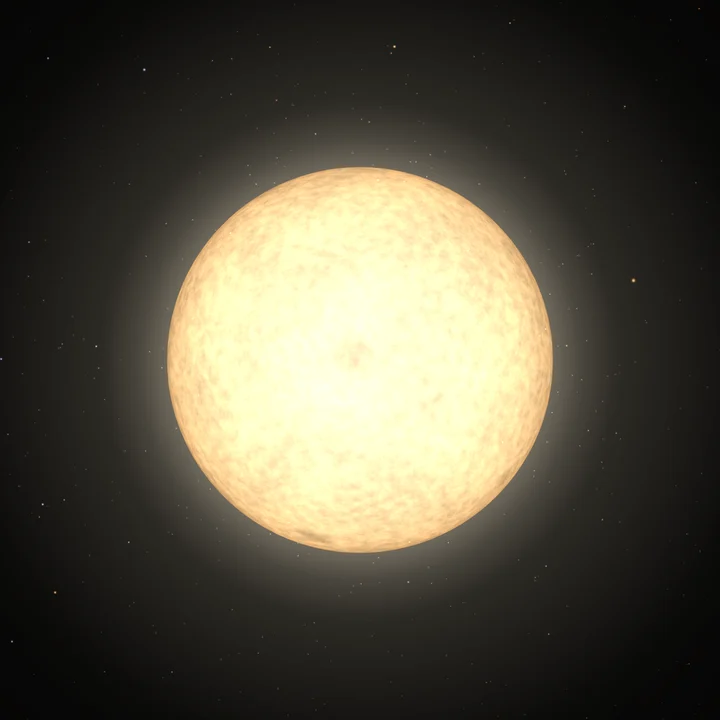
Tau Ceti facts at a glance
- Type: a yellow dwarf, spectral type G8.5V, in Cetus.
- Distance: 11.9 light-years (3.65 parsecs).
- Temperature: 5,310 K (5,037 °C, 9,098 °F) at the surface.
- Size: 91 times the Earth's width (0.83 solar radii).
- Mass: 0.78 times the Sun's.
- Age: about 12 billion years.
- Planets: three.
A real star with a fictional fame
Tau Ceti is one of the most famous destinations in science fiction, and it is entirely real. It lies 11.9 light-years away in the constellation Cetus, the Whale, and shines at magnitude 3.50: faint, but easy to see with the naked eye from a dark site. Of all the single stars near us, it is the one most like the Sun, which is exactly why writers keep sending their characters there.
It is a G8.5V star, a yellow dwarf a little smaller and cooler than the Sun. It is about 0.83 times the Sun's width, some 577,000 km in radius, and holds 0.78 times the Sun's mass. Its surface glows at 5,310 kelvin, against the Sun's 5,772, and it gives out about 50 % of the Sun's light. Seen from one of its planets it would look almost like home: a slightly warmer, more golden sunlight.
Sun-like, but not a twin
Look closer and the resemblance fades. Tau Ceti is poor in heavy elements, holding only a fraction of the iron and other metals the Sun has, a sign that it formed from older, less enriched gas. Its age is uncertain, with estimates ranging widely; one puts it at 12 billion years, and nearly all agree it is older than the Sun.
It also seems to be a remarkably quiet star. It shows little of the spotty, flaring magnetic activity of younger stars, and its brightness barely changes. For anyone hoping for a calm, long-lived sun with planets around it, Tau Ceti has long been near the top of the list.
The first star we listened to
In 1960 the radio astronomer Frank Drake pointed a radio telescope at Tau Ceti and its neighbour Epsilon Eridani in Project Ozma, the first modern search for signals from another civilisation. He heard nothing but noise, but the choice of target said a lot: these were the nearest stars that looked like the Sun.
Fiction followed. Ursula K. Le Guin set the twin worlds of The Dispossessed around Tau Ceti, and Andy Weir's Project Hail Mary sends its lone astronaut there to find out why this one star is untouched by a plague dimming the Sun. The real Tau Ceti has no such mystery, but it does have a mess of dust.
Dust and candidate planets
Tau Ceti is surrounded by a debris disk: a broad ring of dust and rubble, probably from colliding comets and asteroids, far more massive than our own Kuiper belt. A disk that heavy suggests a crowded outer system, where icy bodies smash together often. That could mean frequent large impacts on any inner planets, not an easy place for life.
The planets are harder to pin down. They are found from the tiny wobble they cause in the star's motion, and Tau Ceti's signals are close to the limit of what spectrographs can measure. A first analysis in 2012 proposed five planets; a reanalysis in 2017 dropped three of them and proposed four others, called e, f, g and h. All four are still candidates whose existence depends on careful statistics, and some astronomers remain cautious about them.
If they are real, the inner two are warm: g, at least 1.8 times the Earth's mass, circles in 20.0 days at 0.133 AU, and h, about 1.8 Earth masses, in 49.4 days. Both are far too hot for liquid water. The habitable zone runs from 0.69 to 1.2 AU. Planet e orbits a little inside its inner edge, and f, at least 3.9 Earth masses, sits at 1.33 AU, just beyond its outer edge, with a year of 636 days and only 0.28 times the starlight the Earth receives. Both are probably several times heavier than the Earth, more super-Earths or mini-Neptunes than twins of our planet.
| Body | Kind | Orbit, AU | Year, days | Mass, Earths | Temp., K |
|---|---|---|---|---|---|
| 52Tau Cet I game-made | Ice giant | 0.102 | 13.4 | 4.5 | 727 |
| tau Cet g confirmed | Rocky planet | 0.133 | 20.00[4] | ≥ 1.75[4] | 635 |
| tau Cet h confirmed | Rocky planet | 0.243 | 49.41[4] | ≥ 1.83[4] | 470 |
| tau Cet f confirmed | Ice giant | 1.33 | 636.1[4] | ≥ 3.93[4] | 201 |
| 52Tau Cet outer belt game-made | Icy belt | 3.8–5.4 | — | — | 109 |
Finding it in the sky
Tau Ceti sits in Cetus, a large, dim constellation below Pisces and Aries, best seen on autumn evenings from the northern hemisphere and spring evenings from the southern. Being close to the celestial equator, it can be seen from almost everywhere on Earth. Find the bright orange Menkar or the variable star Mira in the Whale, then look south-west for a modest, steady, yellowish star: that is Tau Ceti.
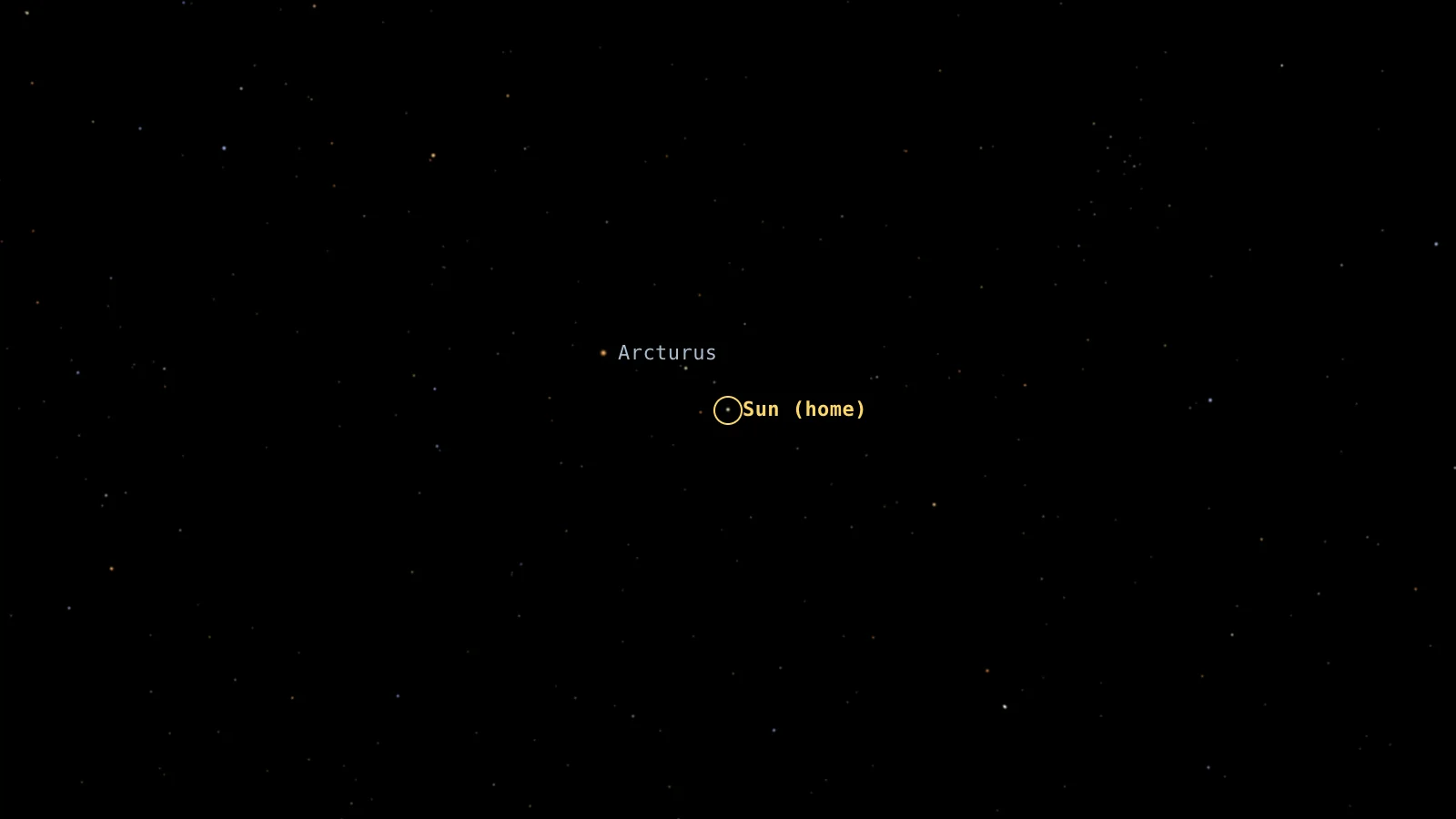
The journey
At 11.9 light-years, the light reaching you tonight left Tau Ceti over a decade ago. A ship that accelerated at a steady one g for half the way and braked for the other half would arrive after 5.1 years aboard, while 14 years passed on Earth, reaching 99.01 % of the speed of light at the turnaround.
Light
11.9 years
The light reaching us now left Tau Ceti in 2014.
At a steady 1 g
5.1 years aboard
14 years pass on Earth; top speed 99.01 % of light.
Arriving, you would find a familiar golden sun, a sky full of rubble glinting in the outer system, and, if the candidate planets hold up, a handful of hot, heavy worlds close in. Its nearest stellar neighbour, the red dwarf Gliese 54.1, lies 1.6 light-years away.
Finding Tau Ceti in the night sky
Tau Ceti is in the constellation Cetus. At magnitude 3.5 it is a naked-eye star, easy to see away from bright city lights.
It stands highest in the evening sky (around 9 pm) in December, and it is well placed in the evening from November to February: winter in the northern hemisphere, summer in the southern.
It never rises north of latitude 74° N; the farther south you are, the higher it climbs.
To find it, start from Diphda (magnitude 2.0): Tau Ceti is 15° to its east, about one fist at arm's length (a fist held out covers about 10°).
Data
Measured values come from the papers cited. The game's estimates are what Solarwind works out from the star catalogue's colour and brightness alone; where the two differ, the measurement is the better value.
| Measured | Game's estimate | ||
|---|---|---|---|
| Distance | — | 11.90 ly · 3.650 pc | from Gaia/Hipparcos parallax |
| Parallax | — | 274.0 mas | |
| Right ascension | — | 1h 44m 2s | J2016 |
| Declination | — | −15° 56′ | |
| Constellation | Cetus | — | |
| Spectral type | G8.5V[1] | G8V | |
| Temperature | 5,310 ± 17 K[2] | 5,501 K | the Sun: 5,772 K |
| Radius | 0.830 ± 0.020 R☉[3] | 0.761 R☉ | 8.3 × Jupiter |
| Mass | 0.783 ± 0.012 M☉[4] | 0.831 M☉ | 821 × Jupiter |
| Luminosity | 0.495 L☉[2] | 0.478 L☉ | |
| Apparent magnitude (V) | 3.496 [5] | 3.49 | naked-eye limit ≈ 6 |
| Absolute magnitude | — | 5.68 | |
| Habitable zone | — | 0.69–1.2 AU | Kopparapu et al. 2014, from the measured temperature |
| Frost line | — | 1.9 AU | where water freezes |
Nearest stars
- Gliese 54.11.61 ly
- Gliese 65B3.06 ly
- Gliese 65A3.22 ly
- Ran5.46 ly
- Van Maanen's Star6.05 ly
- Gliese GJ 1005A6.74 ly
- Gliese GJ 10027.16 ly
- Gliese 83.17.17 ly
- Gliese 17.21 ly
- Gliese GJ 10617.59 ly
Quick answers
Is Tau Ceti a real star?
Yes. Tau Ceti is a real, nearby star in the constellation Cetus, visible to the naked eye. Its fame in science fiction, from Le Guin to Project Hail Mary, comes from the fact that it really is one of the closest Sun-like stars.
Is Tau Ceti a planet?
No, it is a star. Planets that may orbit it are named after it with a letter, such as Tau Ceti e or Tau Ceti f; these are candidate planets, not yet confirmed beyond doubt.
What is Tau Ceti e?
A candidate planet found in 2017 from the star's wobble, probably a few times the Earth's mass and orbiting a little inside the habitable zone, so likely too hot for liquid water. It is the planet whose atmosphere plays a central part in Project Hail Mary; the real planet's air, if it has any, is unknown.
Is Tau Ceti in the Milky Way?
Yes. Every star you can see with the naked eye is in our own galaxy, and Tau Ceti is one of our close neighbours, just 11.9 light-years away.
How do you pronounce Tau Ceti?
"Tau" rhymes with "cow", and "Ceti" is usually said "SEE-tie" or "SET-ee". The name means the star labelled tau in Cetus.
How far away is Tau Ceti?
Tau Ceti is 11.9 light-years (3.65 parsecs) from the Sun, so the light you see from it left 11.9 years ago.
Can you see Tau Ceti with the naked eye?
Yes: at magnitude 3.50 it is visible to the naked eye under a dark sky.
Where is Tau Ceti in the night sky?
In the constellation Cetus. It is highest in the evening sky around December and never rises north of latitude 74° N. From Diphda, look 15° to the east.
What type of star is Tau Ceti?
A yellow dwarf of spectral type G8.5V, with a surface temperature of about 5,310 K (the Sun's is 5,772 K).
How big is Tau Ceti compared with the Sun?
Its radius is 0.830 times the Sun's, about 580,000 km; its mass is 0.783 solar masses, and it gives off 50 % of the Sun's light.
How hot is Tau Ceti?
Its surface is about 5,310 K (5,037 °C, 9,098 °F), cooler than the Sun's 5,772 K.
What colour is Tau Ceti?
At 5,310 K its light is white with a hint of yellow: cooler stars glow redder, hotter ones bluer.
How massive is Tau Ceti?
About 0.783 times the Sun's mass, or 821 Jupiters.
How luminous is Tau Ceti?
It gives off 50 % of the Sun's light (0.495 solar luminosities).
Is Tau Ceti a main sequence star?
Yes. Its luminosity class, V, marks a main-sequence star: like the Sun, it shines by fusing hydrogen into helium in its core.
Will Tau Ceti go supernova?
No. At about 0.78 solar masses it is too light: stars under about 8 solar masses end by shedding their outer layers and leaving a white dwarf.
What season is Tau Ceti visible in?
In the north it is a winter star: it stands highest in the evening sky in December and is well placed from November to February. In the southern hemisphere those months are summer.
What galaxy is Tau Ceti in?
The Milky Way, our own galaxy: every star you can see without a telescope belongs to it. At 11.9 light-years Tau Ceti is a close neighbour on the scale of the galaxy, which is about 100,000 light-years across, and it lies in the same spiral arm as the Sun, the Orion Arm.
Does Tau Ceti have planets?
Yes: three confirmed planets, tau Cet g (0.13 AU, a year of 20.0 days) and tau Cet h (0.24 AU, a year of 49.4 days) and tau Cet f (1.3 AU, a year of 636 days).
How long would it take to travel to Tau Ceti?
Light takes 11.9 years. A ship accelerating at a steady 1 g and braking halfway would arrive after 5.1 years aboard (14 years on Earth), peaking at 99.01 % of the speed of light.
Sources
Last updated .
Positions and photometry: HYG Database v4.1 (CC BY-SA 4.0) and the Gaia Catalogue of Nearby Stars, ESA/Gaia/DPAC. Planets: the NASA Exoplanet Archive, operated by Caltech under contract with NASA. Identifiers: Wikidata (CC0), Q15820; SIMBAD. Habitable zone: Kopparapu et al. 2014. Text: written with an AI model from the data on this page, checked against the sources.
Also known as: 1RXS J014404.7-155632 · 2MASS J01440402-1556141 · 52 Cet · CCDM J01441-1557A · Ci 20 124 · FK5 59 · GC 2123 · GCRV 979 · GJ 71 · GJ 71.0 · Gaia DR2 2452378776434276992 · Gaia DR3 2452378776434477184 · HD 10700 · HIC 8102 · HIP 8102 · HR 509 · IDS 01394-1628 A · IRAS 01416-1611 · IRC -20018 · JP11 535 · LFT 159 · LHS 146 · LPM 84 · LTT 935 · N30 359 · NLTT 5787 · PLX 365 · PLX 365.00 · PM 01417-1612 · PMC 90-93 41 · PPM 210580 · RAFGL 4135S · RAVE J014404.1-155615 · ROT 249 · SACS 31 · SAO 147986 · SPOCS 96 · TD1 997 · TIC 419015728 · TYC 5855-2292-1 · UBV 1769 · UBV M 8397 · WDS J01441-1556A · WEB 1733 · YZ 106 431 · Zkh 33 · uvby98 100010700 · τ Cet