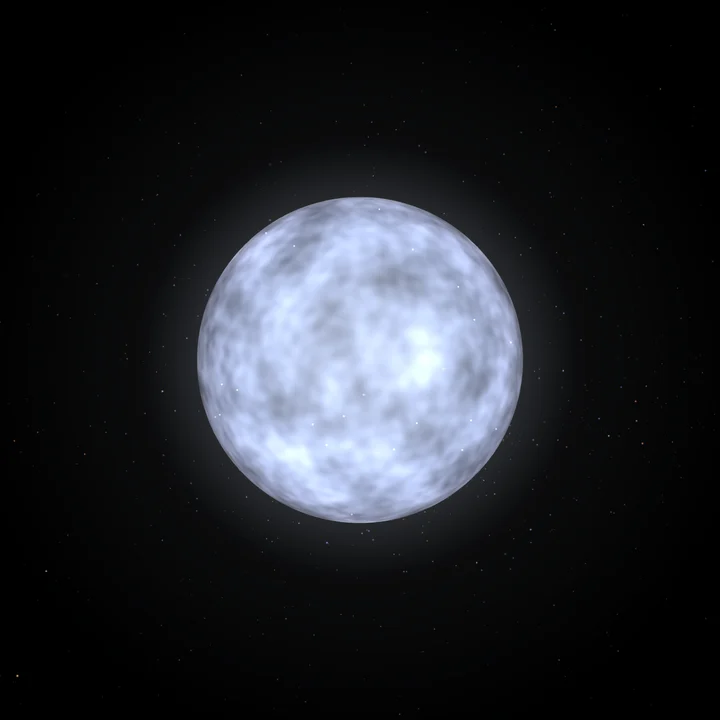
Deneb facts at a glance
- Type: a white supergiant, spectral type A2Ia, in Cygnus.
- Distance: 1,410 light-years (433 parsecs).
- Temperature: 8,700 K (8,427 °C, 15,200 °F) at the surface.
- Size: 22,167 times the Earth's width (200 solar radii).
- Mass: 21 times the Sun's.
- Planets: none known.
The tail of the swan
High overhead on summer nights in the northern hemisphere, three bright stars make a great triangle: Vega, Altair and Deneb. Deneb is the faintest of the three, at magnitude 1.25, and the one that looks least remarkable. It is by far the most extraordinary. Vega and Altair are near neighbours of the Sun; Deneb looks almost as bright from hundreds of times farther away.
Its name comes from the Arabic for "tail": it marks the tail of Cygnus, the Swan, flying down the Milky Way with its wings outstretched. Several other stars carry the same word, such as Deneb Kaitos in Cetus and Deneb Algedi in Capricornus, but plain Deneb is this one.
How far, nobody is sure
Deneb is so far away that its distance is one of the hard problems of naked-eye astronomy. The Hipparcos satellite measured a parallax that puts it about 1,410 light-years away, but at that distance the shift is tiny and the measurement uncertain. Studies of its spectrum and its place in the Cygnus star-forming region point to a distance nearly twice as great. The Gaia mission, which measures most stars far better, cannot help: Deneb is too bright for it.
The distance matters because everything else follows from it. The most widely quoted figures, a star about 200 times as wide as the Sun and giving out some 210,000 times its light, assume the larger distance; if Hipparcos is right, Deneb is smaller and fainter, though still a giant among stars. The light you see tonight set out no later than the early Middle Ages, and perhaps in the time of classical Greece.
A white supergiant
Deneb is classed A2Ia: a white supergiant, one of the most luminous stars the naked eye can see. Its surface is hotter than the Sun's, about 8,700 kelvin against 5,772, so it shines a cool, faintly blue white. It was born with something like 21 times the Sun's mass, though that too rests on the distance.
Put Deneb in place of the Sun and, on the larger estimate, its surface would reach close to the Earth's orbit. Its light pushes so hard on its outer layers that it blows a powerful wind, losing mass far faster than the Sun does, and its surface ripples irregularly. Deneb is the prototype of the Alpha Cygni variables, supergiants whose brightness wavers slightly and irregularly as their outer layers pulse.
A short, brilliant life
Stars this heavy live fast. Deneb is perhaps ten million years old, a blink beside the Sun's age, and it has already finished burning hydrogen in its core. Whether it is now swelling towards a red supergiant, or has been one and is shrinking back, is still argued over.
Its end is likely to be violent. Most stars of its mass finish as a supernova, leaving behind a neutron star or a black hole. When that happens it will outshine everything in our night sky except the Sun and the Moon, though there is no sign it is imminent. No planets are known around Deneb, and its fierce light and short life make it an unlikely place to look for them.
Finding Deneb
Deneb is easy to find from the northern hemisphere from late spring to autumn: it is the top of the Northern Cross, the brightest part of Cygnus, and the north-eastern corner of the Summer Triangle. It lies far enough north that from Britain or Scandinavia it never sets, circling the pole all year.
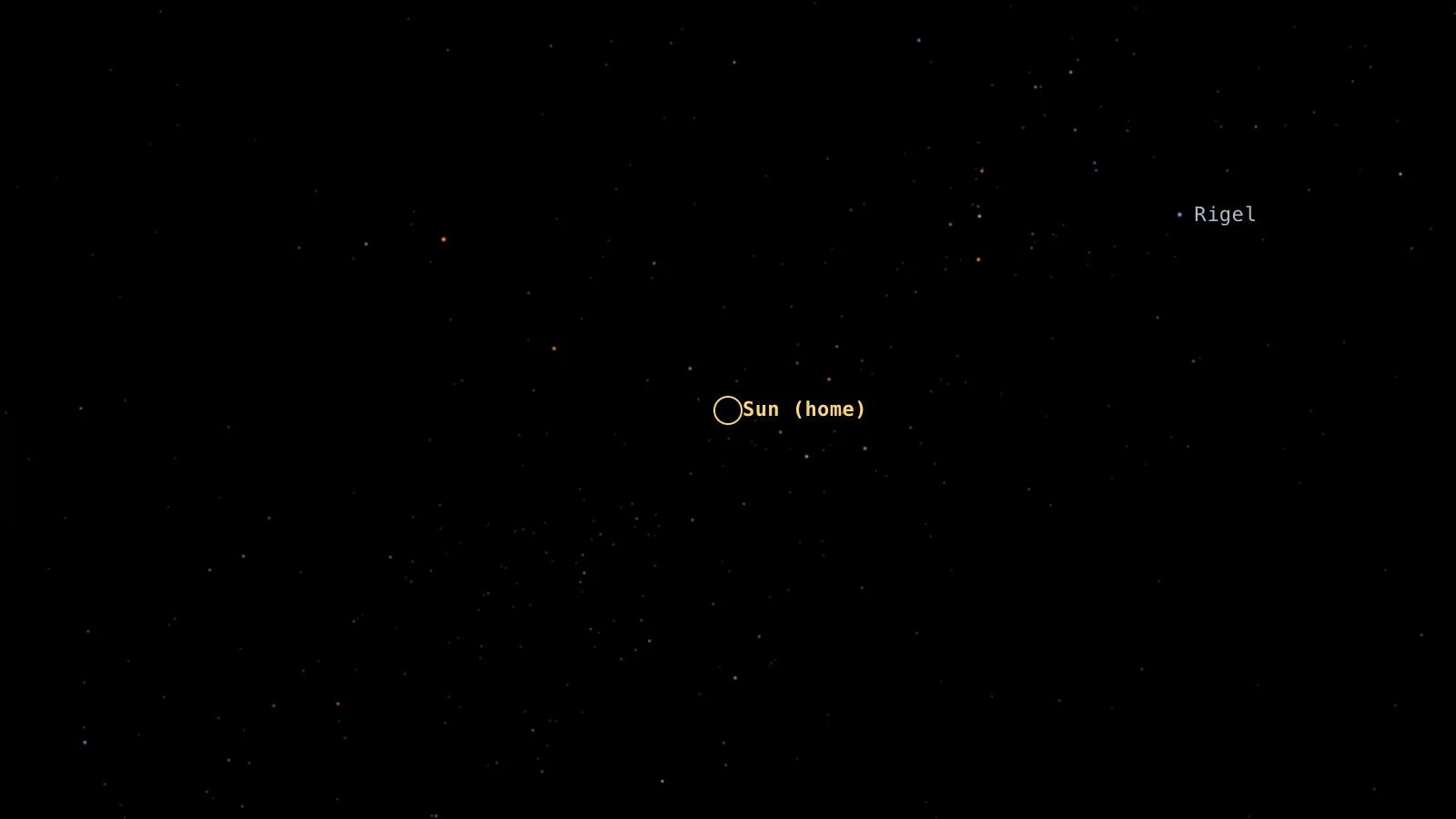
The Earth's slow wobble moves the celestial pole in a great circle over about twenty-six thousand years. Around the year 9800 the pole will pass near Deneb, and it will serve as a rough north star, though not as closely as Polaris does now.
The longest trip
Even at a steady one g, accelerating half the way and braking the rest, a journey to Deneb would take 14 years aboard the ship, thanks to time dilation. On Earth 1,400 years would pass, and the ship would touch 99.999906 % of the speed of light.
Light
1,410 years
The light reaching us now left Deneb in 614.
At a steady 1 g
14 years aboard
1,400 years pass on Earth; top speed 99.999906 % of light.
Near Deneb there would be no question which star was in charge. Its white glare would dominate a sky strewn with the young stars and glowing gas clouds of Cygnus, and our Sun, a modest star even close up, would be far too faint to see without a telescope.
Finding Deneb in the night sky
Deneb is in the constellation Cygnus. At magnitude 1.3 it is one of the brightest stars in the sky, easy to see even from a city.
North of latitude 45° N (Reykjavík, Helsinki or London) it never sets: it circles the north celestial pole all night, every night of the year. It stands highest in the evening sky (around 9 pm) in September.
It never rises south of latitude 45° S; the farther north you are, the higher it climbs.
To find it, start from Vega (magnitude 0.0): Deneb is 24° to its northeast, about 2 fists at arm's length (a fist held out covers about 10°).
Data
Measured values come from the papers cited. The game's estimates are what Solarwind works out from the star catalogue's colour and brightness alone; where the two differ, the measurement is the better value.
| Measured | Game's estimate | ||
|---|---|---|---|
| Distance | — | 1,412 ly · 432.9 pc | from Gaia/Hipparcos parallax |
| Parallax | — | 2.310 mas | |
| Right ascension | — | 20h 41m 26s | J2016 |
| Declination | — | +45° 17′ | |
| Constellation | Cygnus | — | |
| Spectral type | A2Ia[1] | A2Ia | |
| Temperature | 8,700 K[2] | 9,125 K | the Sun: 5,772 K |
| Radius | 203 R☉[3] | 89.7 R☉ | 2,000 × Jupiter |
| Mass | 21.0 M☉[3] | 20.0 M☉ (rough) | 22,007 × Jupiter |
| Luminosity | 210,000 L☉[3] | 50,200 L☉ | |
| Apparent magnitude (V) | 1.250 [4] | 1.25 | naked-eye limit ≈ 6 |
| Absolute magnitude | — | -6.93 | |
| Habitable zone | — | 400–690 AU | Kopparapu et al. 2014, from the measured temperature |
| Frost line | — | 1,200 AU | where water freezes |
Nearest stars
- HIP 99879318 ly
- Gliese GJ 4171365 ly
- HIP 97232398 ly
- HIP 90750584 ly
- HIP 101539648 ly
- HIP 104180652 ly
- HIP 91869680 ly
- HIP 103533687 ly
- HIP 100451708 ly
- HIP 112334722 ly
Quick answers
Is Deneb a main-sequence star?
No. Deneb is a white supergiant of type A2Ia. It burned through the hydrogen in its core long ago and has swollen enormously; it is one of the most luminous stars visible to the naked eye.
Is Deneb a binary star?
Not as far as anyone knows. A companion has occasionally been suggested from small shifts in its spectrum, but the pulsations of its surface explain them, and no companion has been confirmed.
Which is dimmer, Deneb or Mira?
Usually Mira. Deneb holds steady at magnitude 1.25, while Mira is a variable that spends most of its long cycle too faint for the naked eye. Only at its rare best maxima does Mira come close to Deneb.
When was Deneb the pole star?
It has not been yet. The celestial pole moves slowly among the stars, and around the year 9800 it will pass near Deneb, which will then serve as a rough north star. It was last near the pole around 16,000 BC.
What does Deneb mean?
It comes from the Arabic for "tail", because it marks the tail of Cygnus, the Swan. The same word appears in the names of other stars, such as Deneb Kaitos and Deneb Algedi, which are unrelated to this one.
How far away is Deneb?
Deneb is 1,410 light-years (433 parsecs) from the Sun, so the light you see from it left 1,410 years ago.
Can you see Deneb with the naked eye?
Yes: at magnitude 1.25 it is visible to the naked eye under a dark sky, from the northern hemisphere.
Where is Deneb in the night sky?
In the constellation Cygnus. It is highest in the evening sky around September and never rises south of latitude 45° S. From Vega, look 24° to the northeast.
What type of star is Deneb?
A white supergiant of spectral type A2Ia, with a surface temperature of about 8,700 K (the Sun's is 5,772 K).
How big is Deneb compared with the Sun?
Its radius is 203 times the Sun's, about 140,000,000 km; its mass is 21.0 solar masses, and it is 210,000 times as luminous as the Sun.
How hot is Deneb?
Its surface is about 8,700 K (8,427 °C, 15,200 °F), hotter than the Sun's 5,772 K.
What colour is Deneb?
At 8,700 K its light is bluish white: cooler stars glow redder, hotter ones bluer.
How massive is Deneb?
About 21.0 times the Sun's mass, or 22,007 Jupiters.
How luminous is Deneb?
It is about 210,000 times as luminous as the Sun (210,000 solar luminosities).
Will Deneb go supernova?
Yes. At about 21 solar masses it is above the 8 or so a star needs to end in a core-collapse supernova, leaving a neutron star or a black hole. It has already left the main sequence, so on the cosmic clock that is soon, but nobody can predict the date.
What galaxy is Deneb in?
The Milky Way, our own galaxy: every star you can see without a telescope belongs to it. At 1,410 light-years Deneb is a close neighbour on the scale of the galaxy, which is about 100,000 light-years across, and it lies in the same spiral arm as the Sun, the Orion Arm.
How long would it take to travel to Deneb?
Light takes 1,410 years. A ship accelerating at a steady 1 g and braking halfway would arrive after 14 years aboard (1,400 years on Earth), peaking at 99.999906 % of the speed of light.
Sources
Last updated .
- Revised Standards for Supergiants on the System of the Yerkes Spectral Atlas
- Parameters and abundances in luminous stars
- Wikipedia, via Wikidata
- VizieR Online Data Catalog: Stellar Photometry in Johnson's 11-color system (Ducati, 2002)
Positions and photometry: HYG Database v4.1 (CC BY-SA 4.0) and the Gaia Catalogue of Nearby Stars, ESA/Gaia/DPAC. Planets: the NASA Exoplanet Archive, operated by Caltech under contract with NASA. Identifiers: Wikidata (CC0), Q12179; SIMBAD. Habitable zone: Kopparapu et al. 2014. Text: written with an AI model from the data on this page, checked against the sources.
Also known as: 2MASS J20412592+4516491 · 50 Cyg · ADS 14172 A · AG+45 1730 · ALS 11488 · BD+44 3541 · CCDM J20415+4517A · CEL 5144 · FK5 777 · GC 28846 · GCRV 12971 · GEN# +1.00197345 · GSC 03574-03347 · HD 197345 · HIC 102098 · HIP 102098 · HR 7924 · IDS 20380+4455 A · IRC +50337 · JP11 3264 · N30 4579 · PLX 4935 · PLX 4935.00 · PMC 90-93 546 · PPM 60323 · RAFGL 2633 · ROT 3019 · SAO 49941 · SKY# 39204 · TD1 27159 · TIC 195554360 · TYC 3574-3347-1 · UBV 17953 · UBV M 25099 · WDS J20414+4517A · WEB 18466 · [HFE83] 1387 · [KW97] 48-33 · alf Cyg · uvby98 100197345 · α Cyg