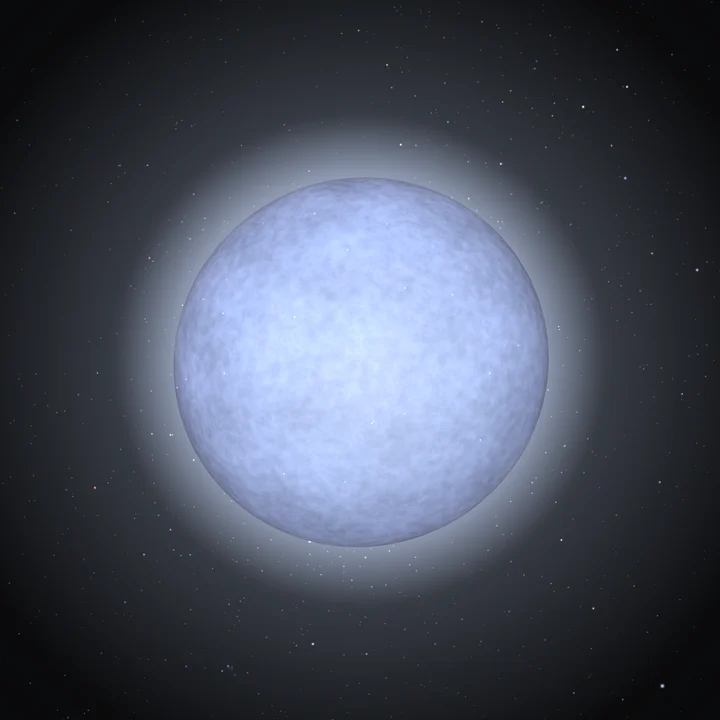
Vega facts at a glance
- Type: a white star, spectral type A0Va, in Lyra.
- Distance: 25.0 light-years (7.68 parsecs).
- Temperature: 9,550 K (9,277 °C, 16,730 °F) at the surface.
- Size: 308 times the Earth's width (2.8 solar radii).
- Mass: 2.1 times the Sun's.
- Planets: none known.
The yardstick of the sky
Vega is the brilliant blue-white star that stands almost overhead on northern summer nights, the fifth brightest in the whole sky and, for astronomers, something more: a yardstick. For more than a century the brightness of every other star was measured against it. Vega was the zero point of the magnitude scale, the star from which the numbers count up for fainter stars and down for brighter ones, and it still anchors many of the systems astronomers use to calibrate starlight. It lies 25.0 light-years away, in the small constellation of Lyra, the lyre.
It is a young main-sequence star of type A0Va, burning hydrogen in its core like the Sun but much faster. It holds about 2.1 times the Sun's mass, its surface averages around 9,550 kelvin against the Sun's 5,772, and it pours out some 40 times as much light. Around its equator it measures 1,960,000 km in radius, 2.8 times the Sun's, so wide that it would hold about 28 Jupiters side by side across its radius.
A spinning top seen from above
Vega turns so fast that its day lasts only about half an Earth day, and the spin flattens it: its equator bulges out well beyond its poles. We happen to look down on it almost exactly pole-on, which hid all this for a long time. In the 2000s, interferometers, which combine the light of several telescopes to see detail far finer than any one of them can, showed that its poles are brighter and hotter than its equator, by a couple of thousand kelvin. The temperature in the fact table is an average over a surface that has no single temperature.
Its make-up is unusual as well. Vega has noticeably less of the elements heavier than helium than the Sun does, a peculiarity it shares with a small family of hot stars whose surfaces may have been diluted by gas they swept up. And it is young: a few hundred million years old, roughly a tenth of the Sun's age. Heavier stars live faster, so Vega has already used up a good part of its main-sequence life. In time it will swell into a red giant, shed its outer layers and end as a white dwarf.
A history of firsts
Vega was one of the first stars whose distance anyone measured. Friedrich Georg Wilhelm von Struve, working at Dorpat, published a parallax for it in 1837, the small shift in its position as the Earth goes round the Sun, at the same time as Friedrich Bessel's better-remembered measurement of 61 Cygni. In 1850 William Bond and John Adams Whipple at Harvard made a daguerreotype of it, the first photograph of any star other than the Sun, and in 1872 Henry Draper photographed its spectrum, the first star whose absorption lines were caught on a plate.
In 1983 it surprised astronomers again. The infrared satellite IRAS found Vega glowing far more brightly in the infrared than a bare star should, and the excess came from cold dust spread around it. That was the first debris disc found around another star: a ring of grit ground down by colliding comets and asteroids, like a much richer version of the Sun's own Kuiper belt. For years such discs were simply called "Vega-like".
Dust, but no planets yet
Since then Spitzer, Herschel and, in 2024, the James Webb Space Telescope and Hubble have imaged the disc in detail. It turned out remarkably smooth, without the sharp gaps and rings that a large planet usually carves into a disc. Planets may still hide there, smaller than Neptune or too faint to see, and a possible close-in planet reported from the star's wobble in 2021 has not been confirmed. For now no planet is known around Vega.
If one did exist, the habitable zone, where a planet like the Earth could keep liquid water, runs from 5.6 to 9.6 AU from Vega: roughly where Jupiter and Saturn circle the Sun. A world there would orbit a star blazing blue-white in its sky, with a fierce share of ultraviolet light. With Vega's short life, it would also have little time for anything to evolve.
Lyra's jewel
From mid-northern latitudes Vega is the first star to appear overhead on a summer evening, and it is never far from the sky all year; it sets only briefly, if at all, for observers in Europe and Canada. With Deneb and Altair it forms the Summer Triangle, the great asterism of the northern summer sky. Its name comes from the Arabic for "the swooping eagle". In China and Japan it is the weaver girl of the Qixi and Tanabata legend, parted from her cowherd, Altair, by the river of the Milky Way and allowed to cross it once a year.
Vega has been the pole star, and will be again. The Earth's axis slowly wobbles, carrying the north celestial pole around a great circle in the sky, and about fourteen thousand years ago that pole lay near Vega. It will return there in about twelve thousand years, when Vega will take over from Polaris as a brilliant, if not very exact, north star.
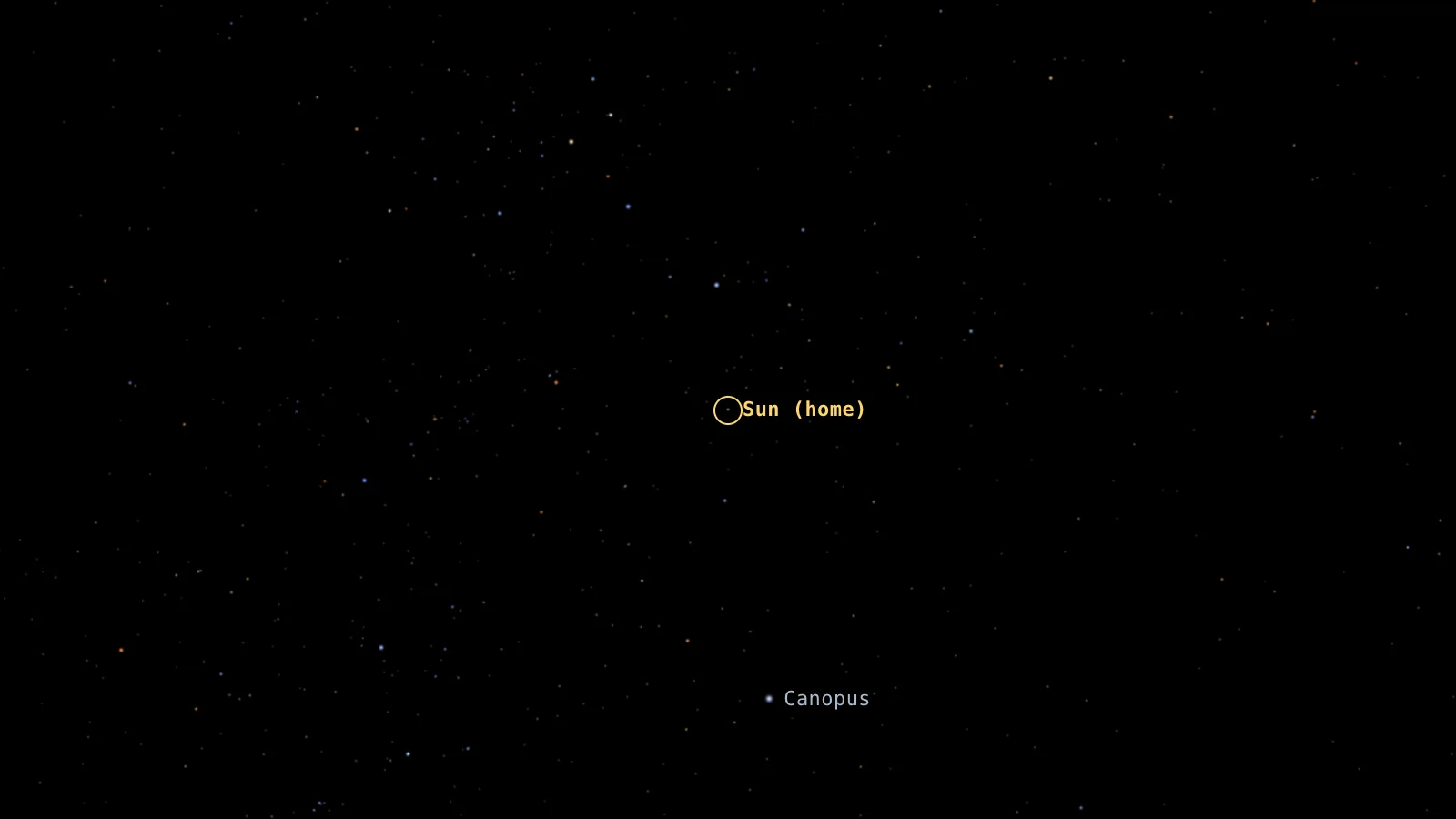
From Vega the view runs the other way. Our Sun would be a faint star near the limit of the naked eye, lost among thousands of others.
Going there
Light from Vega takes 25.0 years to reach us, so the light you see tonight left it a quarter of a century ago. A ship that accelerated at a steady one g for half the way and braked for the rest would make the trip in 6.4 years of its crew's time, while 27 years passed on Earth, reaching 99.74 % of the speed of light at the midpoint.
Light
25.0 years
The light reaching us now left Vega in 2001.
At a steady 1 g
6.4 years aboard
27 years pass on Earth; top speed 99.74 % of light.
Arriving, you would see Vega as a dazzling blue-white disc, its brighter poles invisible to the eye, wrapped in a faint haze of dust that reflects and re-radiates its light. The nearest other star would be the small red dwarf Gliese GJ 4063, just 1.4 light-years away.
Finding Vega in the night sky
Vega is in the constellation Lyra. At magnitude 0.0 it is one of the brightest stars in the sky, easy to see even from a city.
It stands highest in the evening sky (around 9 pm) in August, and it is well placed in the evening from July to October: summer in the northern hemisphere, winter in the southern.
It never rises south of latitude 51° S; the farther north you are, the higher it climbs.
To find it, start from Deneb (magnitude 1.3): Vega is 24° to its west, about 2 fists at arm's length (a fist held out covers about 10°). It is also 30° northeast of Rasalhague.
Data
Measured values come from the papers cited. The game's estimates are what Solarwind works out from the star catalogue's colour and brightness alone; where the two differ, the measurement is the better value.
| Measured | Game's estimate | ||
|---|---|---|---|
| Distance | — | 25.04 ly · 7.678 pc | from Gaia/Hipparcos parallax |
| Parallax | — | 130.2 mas | |
| Right ascension | — | 18h 36m 57s | J2016 |
| Declination | — | +38° 47′ | |
| Constellation | Lyra | — | |
| Spectral type | A0Va[1] | A0Vvar | |
| Temperature | 9,550 K[2] | 10,125 K | the Sun: 5,772 K |
| Radius | 2.82 R☉[3] | 2.48 R☉ | 28 × Jupiter |
| Mass | 2.14 M☉[3] | 2.90 M☉ | 2,237 × Jupiter |
| Luminosity | 40.1 L☉[3] | 58.4 L☉ | |
| Apparent magnitude (V) | 0.03000 [4] | 0.03 | naked-eye limit ≈ 6 |
| Absolute magnitude | — | 0.600 | |
| Habitable zone | — | 5.6–9.6 AU | Kopparapu et al. 2014, from the measured temperature |
| Frost line | — | 17 AU | where water freezes |
Nearest stars
- Gliese GJ 40631.41 ly
- Gliese 747A4.26 ly
- Gliese 747B4.27 ly
- Gliese GJ 1230B6.08 ly
- Gliese GJ 1230A6.08 ly
- J1835+32596.84 ly
- Gliese 695B7.22 ly
- 86Mu Her7.26 ly
- Gliese 695C7.26 ly
- Gliese GJ 39917.41 ly
Quick answers
Is Vega the North Star?
Not today: the North Star is Polaris. Because the Earth's axis slowly wobbles, the pole drifts across the sky, and it lay near Vega about fourteen thousand years ago. It will be close to Vega again in about twelve thousand years.
What constellation is Vega in?
Lyra, the lyre, a small constellation of the northern sky. Vega is its brightest star, Alpha Lyrae, and one corner of the Summer Triangle with Deneb in Cygnus and Altair in Aquila.
How old is Vega?
A few hundred million years, roughly a tenth of the Sun's age. Its fast spin makes it hard to date exactly, so different studies disagree somewhat, but all agree it is a young star.
Is Vega the brightest star in the sky?
No. It is the fifth brightest, after Sirius, Canopus, Alpha Centauri and Arcturus. In the northern summer sky, though, only Arcturus outshines it.
How far away is Vega?
Vega is 25.0 light-years (7.68 parsecs) from the Sun, so the light you see from it left 25.0 years ago.
Can you see Vega with the naked eye?
Yes: at magnitude 0.03 it is visible to the naked eye under a dark sky.
Where is Vega in the night sky?
In the constellation Lyra. It is highest in the evening sky around August and never rises south of latitude 51° S. From Deneb, look 24° to the west.
What type of star is Vega?
A white star of spectral type A0Va, with a surface temperature of about 9,550 K (the Sun's is 5,772 K).
How big is Vega compared with the Sun?
Its radius is 2.82 times the Sun's, about 2,000,000 km; its mass is 2.14 solar masses, and it is 40.1 times as luminous as the Sun.
How hot is Vega?
Its surface is about 9,550 K (9,277 °C, 16,730 °F), hotter than the Sun's 5,772 K.
What colour is Vega?
At 9,550 K its light is bluish white: cooler stars glow redder, hotter ones bluer.
How massive is Vega?
About 2.14 times the Sun's mass, or 2,237 Jupiters.
How luminous is Vega?
It is about 40.1 times as luminous as the Sun (40.1 solar luminosities).
Is Vega a main sequence star?
Yes. Its luminosity class, V, marks a main-sequence star: like the Sun, it shines by fusing hydrogen into helium in its core.
Will Vega go supernova?
No. At about 2.1 solar masses it is too light: stars under about 8 solar masses end by shedding their outer layers and leaving a white dwarf.
What season is Vega visible in?
In the north it is a summer star: it stands highest in the evening sky in August and is well placed from July to October. In the southern hemisphere those months are winter.
What galaxy is Vega in?
The Milky Way, our own galaxy: every star you can see without a telescope belongs to it. At 25.0 light-years Vega is a close neighbour on the scale of the galaxy, which is about 100,000 light-years across, and it lies in the same spiral arm as the Sun, the Orion Arm.
How long would it take to travel to Vega?
Light takes 25.0 years. A ship accelerating at a steady 1 g and braking halfway would arrive after 6.4 years aboard (27 years on Earth), peaking at 99.74 % of the speed of light.
Sources
Last updated .
- Source on Wikidata
- Normal A0−A1 stars with low rotational velocities. I. Abundance determination and classification
- A New View of Vega's Composition, Mass, and Age
- VizieR Online Data Catalog: Stellar Photometry in Johnson's 11-color system (Ducati, 2002)
Positions and photometry: HYG Database v4.1 (CC BY-SA 4.0) and the Gaia Catalogue of Nearby Stars, ESA/Gaia/DPAC. Planets: the NASA Exoplanet Archive, operated by Caltech under contract with NASA. Identifiers: Wikidata (CC0), Q3427; SIMBAD. Habitable zone: Kopparapu et al. 2014. Text: written with an AI model from the data on this page, checked against the sources.
Also known as: 2MASS J18365633+3847012 · 3 Lyr · ADS 11510 A · AG+38 1711 · AKARI-IRC-V1 J1836564+384703 · ASCC 507896 · BD+38 3238 · CCDM J18369+3847A · CEL 4636 · CSV 101745 · EUVE J1836+38.7 · FK5 699 · GC 25466 · GCRV 11085 · GEN# +1.00172167 · GJ 721 · GJ 721.0 · HD 172167 · HGAM 706 · HIC 91262 · HIP 91262 · HR 7001 · IDS 18336+3841 A · IRAS 18352+3844 · IRAS F18352+3844 · IRC +40322 · JP11 2999 · LSPM J1836+3847 · LTT 15486 · N30 4138 · NLTT 46746 · NSV 11128 · PLX 4293 · PLX 4293.00 · PMC 90-93 496 · PPM 81558 · RAFGL 2208 · ROT 2633 · SAO 67174 · SKY# 34103 · TD1 22883 · TIC 157587146 · TYC 3105-2070-1 · UBV 15842 · UBV M 23118 · WDS J18369+3846A · WEB 15681 · WISE J183656.49+384703.9 · Zkh 277 · [HFE83] 1223 · alf Lyr · uvby98 100172167 · α Lyr