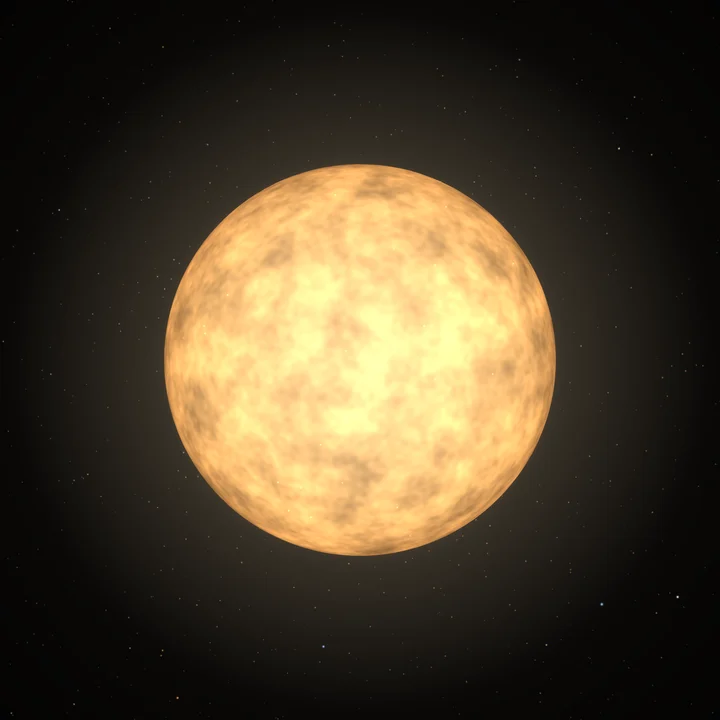
Pollux facts at a glance
- Type: an orange giant, spectral type K0III, in Gemini.
- Distance: 33.8 light-years (10.4 parsecs).
- Temperature: 4,893 K (4,619 °C, 8,347 °F) at the surface.
- Size: 972 times the Earth's width (8.9 solar radii).
- Mass: 2.0 times the Sun's.
- Age: about 0.98 billion years.
- Planets: one.
The brighter twin
Look up on a winter evening in the northern hemisphere and you will find two stars side by side above Orion: the heads of Gemini, the Twins. The warmer, more golden of the pair is Pollux. It shines at magnitude 1.13, among the brightest stars in the sky, and outshines its twin Castor, even though the old Bayer system labelled it beta rather than alpha.
The twins are only a pairing in the sky. Pollux lies 33.8 light-years away; Castor is a separate system, a family of six stars, a good deal farther off. What Pollux has to itself is a distinction of its own: it is the nearest giant star to the Sun.
A giant in middle age
Pollux is an orange giant of type K0III. It was born as a hot white star, about 2.0 times the Sun's mass, and in its 980 million years it has already burned through the hydrogen in its core. Without that furnace the core contracted and the outer layers swelled and cooled, and Pollux grew to about 8.9 times the Sun's width, some 6,190,000 km in radius. Set in place of the Sun, its surface would reach about a tenth of the way to Mercury's orbit.
Its surface is cooler than the Sun's, about 4,893 kelvin against 5,772, which gives it its orange-gold tint. But that surface is vast, and together it pours out about 41 times as much light as the Sun.
Its future is one the Sun will follow, only faster. Whether Pollux is still on its way up the giant branch or has already settled into burning helium in its core is not certain from its measurements alone. Either way, it will eventually shed its outer layers and end as a white dwarf.
A planet around a giant
In 2006 a team led by Artie Hatzes confirmed what years of measurements had hinted at: Pollux rocks back and forth with a steady rhythm of 590 days, tugged by an orbiting planet. Catalogued as HD 62509 b and now officially named Thestias, it has at least 730 times the Earth's mass, a gas giant several times heavier than Jupiter. It circles Pollux at 1.64 AU, a little farther than Mars is from the Sun.
Giant stars are tricky hosts: their surfaces pulse and their spots rotate, and those motions can mimic a planet's tug. Pollux's signal has stayed steady for decades, which is the main reason astronomers accept it, though the star's weak magnetic activity has been studied closely to rule out an impostor.
Could anything live there? Not on Thestias, and probably nowhere near it. The planet takes in about 15 times the starlight the Earth does, enough to heat it to roughly 550 kelvin. Pollux's habitable zone now lies from 6.4 to 12 AU, from a little beyond Jupiter's distance from the Sun to beyond Saturn's, and it has been moving outward as the star brightens. No planet is known there.
Finding the twins
Castor and Pollux are among the easiest stars to find. Follow a line from Rigel through Betelgeuse in Orion and carry on: the twins are the bright pair at the end of it. Pollux, the more southerly and more orange of the two, is also a corner of the Winter Hexagon, the ring of bright stars around Orion. It is visible from almost everywhere on Earth, best from December to April.
In Greek myth Castor and Pollux, the Dioscuri, were twin brothers, Pollux the immortal son of Zeus. When Castor died, Pollux asked to share his immortality with him, and Zeus set the pair in the sky together. Sailors took them as protectors, and the Romans built them a temple in the Forum.
A trip to the giant
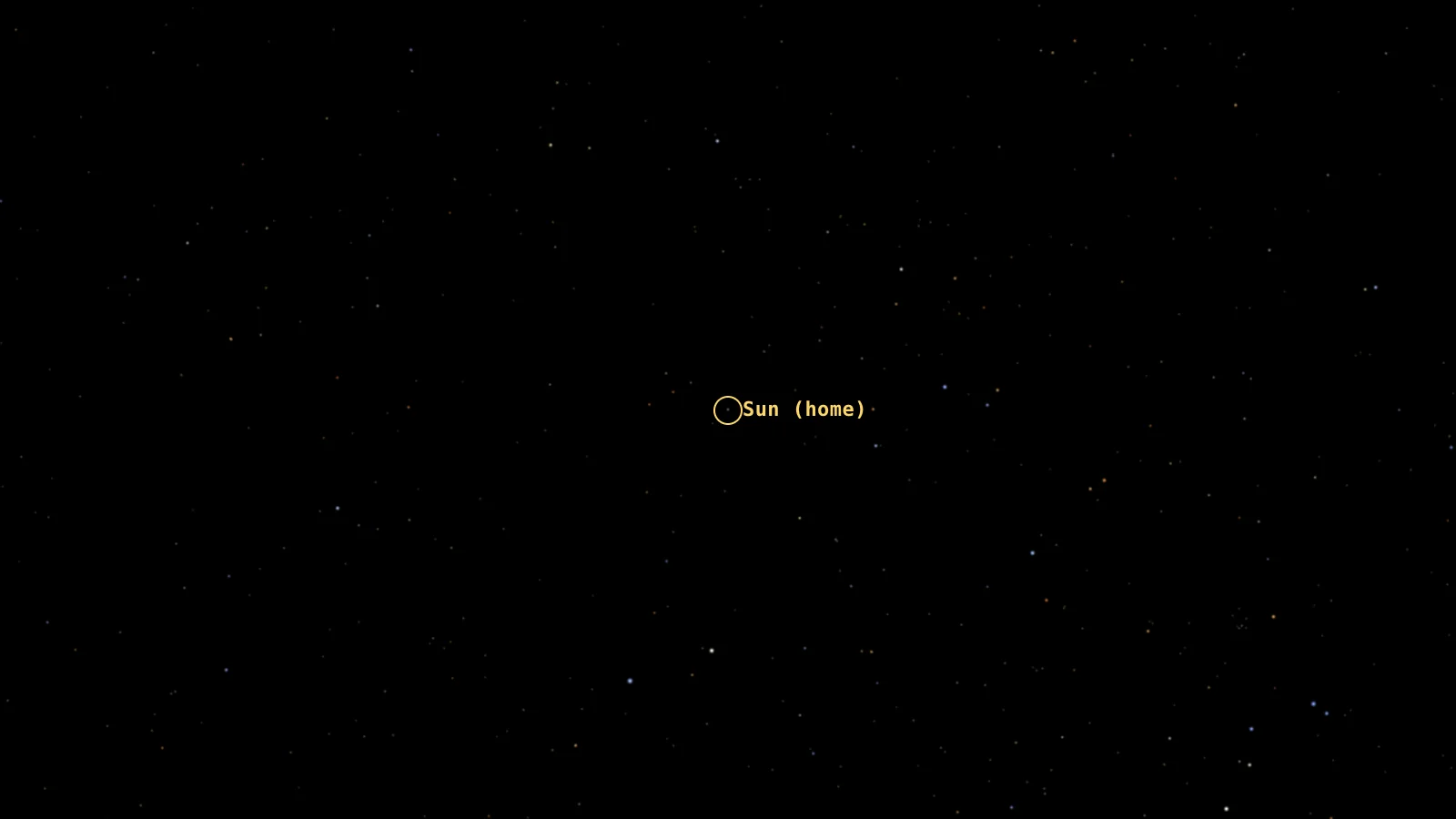
Pollux is close as giants go. A ship accelerating at one g for half the way and braking for the rest would cross the 33.8 light-years in 7.0 years aboard, while 36 years passed on Earth, reaching 99.85 % of the speed of light at the midpoint.
Light
33.8 years
The light reaching us now left Pollux in 1992.
At a steady 1 g
7.0 years aboard
36 years pass on Earth; top speed 99.85 % of light.
Arriving would be something to see. From the orbit of Thestias, Pollux would cover a patch of sky several times wider than the Sun does from Earth, an enormous orange disc blazing with heat. Its nearest neighbour is a faint red dwarf about 3.8 light-years away, and our Sun would be an inconspicuous star among thousands.
Finding Pollux in the night sky
Pollux is in the constellation Gemini. At magnitude 1.1 it is one of the brightest stars in the sky, easy to see even from a city.
It stands highest in the evening sky (around 9 pm) in March, and it is well placed in the evening from February to May: spring in the northern hemisphere, autumn in the southern.
It never rises south of latitude 62° S; the farther north you are, the higher it climbs.
To find it, start from Castor (magnitude 1.6): Pollux is 4.5° to its southeast, close beside it. It is also 23° north of Procyon and 19° northeast of Alhena.
Data
Measured values come from the papers cited. The game's estimates are what Solarwind works out from the star catalogue's colour and brightness alone; where the two differ, the measurement is the better value.
| Measured | Game's estimate | ||
|---|---|---|---|
| Distance | — | 33.78 ly · 10.36 pc | from Gaia/Hipparcos parallax |
| Parallax | — | 96.54 mas | |
| Right ascension | — | 7h 45m 18s | J2016 |
| Declination | — | +28° 2′ | |
| Constellation | Gemini | — | |
| Spectral type | K0IIIvar[1] | K0IIIvar | |
| Temperature | 4,893 ± 10 K[2] | 4,767 K | the Sun: 5,772 K |
| Radius | 8.90 ± 0.40 R☉[3] | 9.63 R☉ | 89 × Jupiter |
| Mass | 2.00 ± 0.10 M☉[4] | 1.00 M☉ (rough) | 2,096 × Jupiter |
| Luminosity | 40.9 L☉[1] | 43.1 L☉ | |
| Apparent magnitude (V) | 1.125 [5] | 1.16 | naked-eye limit ≈ 6 |
| Absolute magnitude | — | 1.08 | |
| Habitable zone | — | 6.4–12 AU | Kopparapu et al. 2014, from the measured temperature |
| Frost line | — | 17 AU | where water freezes |
Nearest stars
- J0758+32473.82 ly
- Gliese 268.36.56 ly
- J0825+21156.96 ly
- J0700+31577.00 ly
- J0731+36137.60 ly
- Gliese 277A7.65 ly
- Gliese 277B7.65 ly
- J0840+31278.12 ly
- Gliese GJ 11058.85 ly
- Gliese GJ 2069B9.02 ly
Quick answers
Is Pollux a main-sequence star?
No. Pollux was a main-sequence star once, but it has used up the hydrogen in its core and swollen into a giant. It is an orange giant of type K0III.
Which is larger, Pollux or Antares?
Antares, by a wide margin. Pollux is about 8.9 times the Sun's width, while Antares is a red supergiant hundreds of times wider than the Sun; Pollux would be lost inside it.
Is Pollux a binary star?
Not as far as we know. Several faint stars appear near Pollux in the sky, but they are unrelated stars at other distances. Its only known companion is its planet, Thestias.
Is Pollux the North Star?
No. The North Star is Polaris, in Ursa Minor. Pollux lies well north of the celestial equator in Gemini, so it rises and sets as the sky turns.
How far away is Pollux?
Pollux is 33.8 light-years (10.4 parsecs) from the Sun, so the light you see from it left 33.8 years ago.
Can you see Pollux with the naked eye?
Yes: at magnitude 1.13 it is visible to the naked eye under a dark sky.
Where is Pollux in the night sky?
In the constellation Gemini. It is highest in the evening sky around March and never rises south of latitude 62° S. From Castor, look 4.5° to the southeast.
What type of star is Pollux?
An orange giant of spectral type K0III, with a surface temperature of about 4,893 K (the Sun's is 5,772 K).
How big is Pollux compared with the Sun?
Its radius is 8.90 times the Sun's, about 6,200,000 km; its mass is 2.00 solar masses, and it is 40.9 times as luminous as the Sun.
How hot is Pollux?
Its surface is about 4,893 K (4,619 °C, 8,347 °F), cooler than the Sun's 5,772 K.
What colour is Pollux?
At 4,893 K its light is orange: cooler stars glow redder, hotter ones bluer.
How massive is Pollux?
About 2.00 times the Sun's mass, or 2,096 Jupiters.
How luminous is Pollux?
It is about 40.9 times as luminous as the Sun (40.9 solar luminosities).
Will Pollux go supernova?
No. At about 2.0 solar masses it is too light: stars under about 8 solar masses end by shedding their outer layers and leaving a white dwarf.
What season is Pollux visible in?
In the north it is a spring star: it stands highest in the evening sky in March and is well placed from February to May. In the southern hemisphere those months are autumn.
What galaxy is Pollux in?
The Milky Way, our own galaxy: every star you can see without a telescope belongs to it. At 33.8 light-years Pollux is a close neighbour on the scale of the galaxy, which is about 100,000 light-years across, and it lies in the same spiral arm as the Sun, the Orion Arm.
Does Pollux have planets?
Yes: one confirmed planet, HD 62509 b (1.6 AU, a year of 590 days).
How long would it take to travel to Pollux?
Light takes 33.8 years. A ship accelerating at a steady 1 g and braking halfway would arrive after 7.0 years aboard (36 years on Earth), peaking at 99.85 % of the speed of light.
Sources
Last updated .
- Turnbull 2015
- TICv8
- Reffert et al. 2006
- Kunitomo et al. 2011
- NASA Exoplanet Archive
- Hatzes et al. 2006
Positions and photometry: HYG Database v4.1 (CC BY-SA 4.0) and the Gaia Catalogue of Nearby Stars, ESA/Gaia/DPAC. Planets: the NASA Exoplanet Archive, operated by Caltech under contract with NASA. Identifiers: Wikidata (CC0), Q13028; SIMBAD. Habitable zone: Kopparapu et al. 2014. Text: written with an AI model from the data on this page, checked against the sources.
Also known as: 1RXS J074519.3+280123 · 2MASS J07451891+2801340 · 78 Gem · ADS 6335 A · AG+28 833 · ASCC 674757 · BD+28 1463 · CCDM J07454+2802A · CSV 100892 · Ci 20 437 · FK5 295 · GC 10438 · GCRV 5166 · GJ 286 · HD 62509 · HIC 37826 · HIP 37826 · HR 2990 · IDS 07392+2816 A · IRAS 07422+2808 · IRC +30194 · JP11 1588 · LFT 548 · LHS 1945 · LSPM J0745+2801 · LTT 12065 · N30 1758 · NLTT 18379 · NSV 3712 · PLX 1826 · PLX 1826.00 · PM 07423+2809 · PMC 90-93 216 · PPM 97924 · RAFGL 1183 · ROT 1249 · SAO 79666 · SRS 30295 · TD1 10866 · TIC 423088367 · TYC 1920-2194-1 · UBV 7418 · UBV M 13566 · WDS J07453+2802A · WEB 7472 · uvby98 100062509 · β Gem