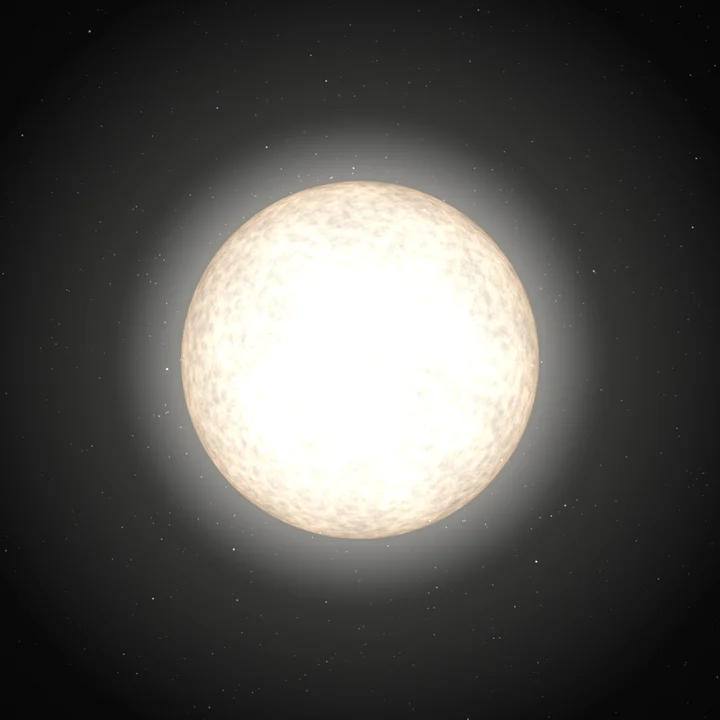
Procyon facts at a glance
- Type: a yellow-white subgiant, spectral type F5IV-V, in Canis Minor.
- Distance: 11.5 light-years (3.51 parsecs).
- Temperature: 6,654 K (6,381 °C, 11,518 °F) at the surface.
- Size: 203 times the Earth's width (1.9 solar radii).
- Mass: 1.5 times the Sun's.
- Planets: none known.
The star before the dog
Procyon is one of the brightest stars in the sky, a clear white light shining at magnitude 0.37 in the little constellation of Canis Minor, the Lesser Dog. Its name is Greek for "before the dog": from the Mediterranean it rises shortly before Sirius, the Dog Star, as if announcing it. It is also one of our near neighbours, just 11.5 light-years away, and only a handful of stars visible to the naked eye are closer.
It is a little bigger and hotter than the Sun: about 1.9 times as wide, some 1,290,000 km in radius, with a surface at 6,654 kelvin against the Sun's 5,772. It holds about 1.5 times the Sun's mass and gives out about 6.9 times as much light. That extra heat is why it looks white with the faintest yellow tinge, rather than the Sun's warmer white.
A star at a turning point
Procyon is classed F5IV-V, a label that sits on the border between a main-sequence star and a subgiant. That is a fair description of where it is in life: it is running out of hydrogen in its core and has begun to swell. In time it will grow into an orange and then a red giant, before shrinking to a white dwarf.
Procyon is also one of the stars astronomers use to test their models of stellar interiors. Its surface rings with faint oscillations, sound waves trapped inside the star, and measuring them tells us about the layers beneath. Detecting them was a famous tussle: a Canadian space telescope saw nothing in 2004, and it took a worldwide ground-based campaign a few years later to pin the oscillations down.
The ghost that pulled it
In 1844 the German astronomer Friedrich Bessel noticed that Procyon did not travel across the sky in a straight line but in a gentle wave, and concluded that it was being tugged by an unseen companion. He had found the same thing for Sirius. Half a century later, in 1896, John Martin Schaeberle at Lick Observatory finally saw the companion, a faint point almost lost in Procyon's glare.
That companion, Procyon B, is a white dwarf: the exposed core of a star that has already lived and died. It has a little over half the Sun's mass packed into a ball only slightly larger than the Earth, and the two stars circle each other about once every forty years. Procyon B was once the heavier of the pair, which is why it aged first; Procyon A will one day follow it down the same path.
No planets have been found around Procyon. Its habitable zone, where a planet could keep liquid water, would lie from 2.4 to 4.1 AU, but Procyon B's orbit swings through the system not far beyond that, and when it swelled into a giant and shed its outer layers it would have disturbed whatever was there.
| Body | Kind | Orbit, AU | Year, days | Mass, Earths | Temp., K |
|---|---|---|---|---|---|
| Procyon inner belt game-made | Asteroid belt | 5.4–8.5 | — | — | 172 |
| Procyon outer belt game-made | Icy belt | 24–43 | — | — | 79 |
Finding Procyon
Procyon is easy to find on winter evenings in the northern hemisphere, or summer evenings in the southern. It forms the Winter Triangle with Sirius, below it, and orange Betelgeuse in Orion, and it is part of the larger Winter Hexagon. It lies just north of the celestial equator, so it is visible from every inhabited part of the Earth.
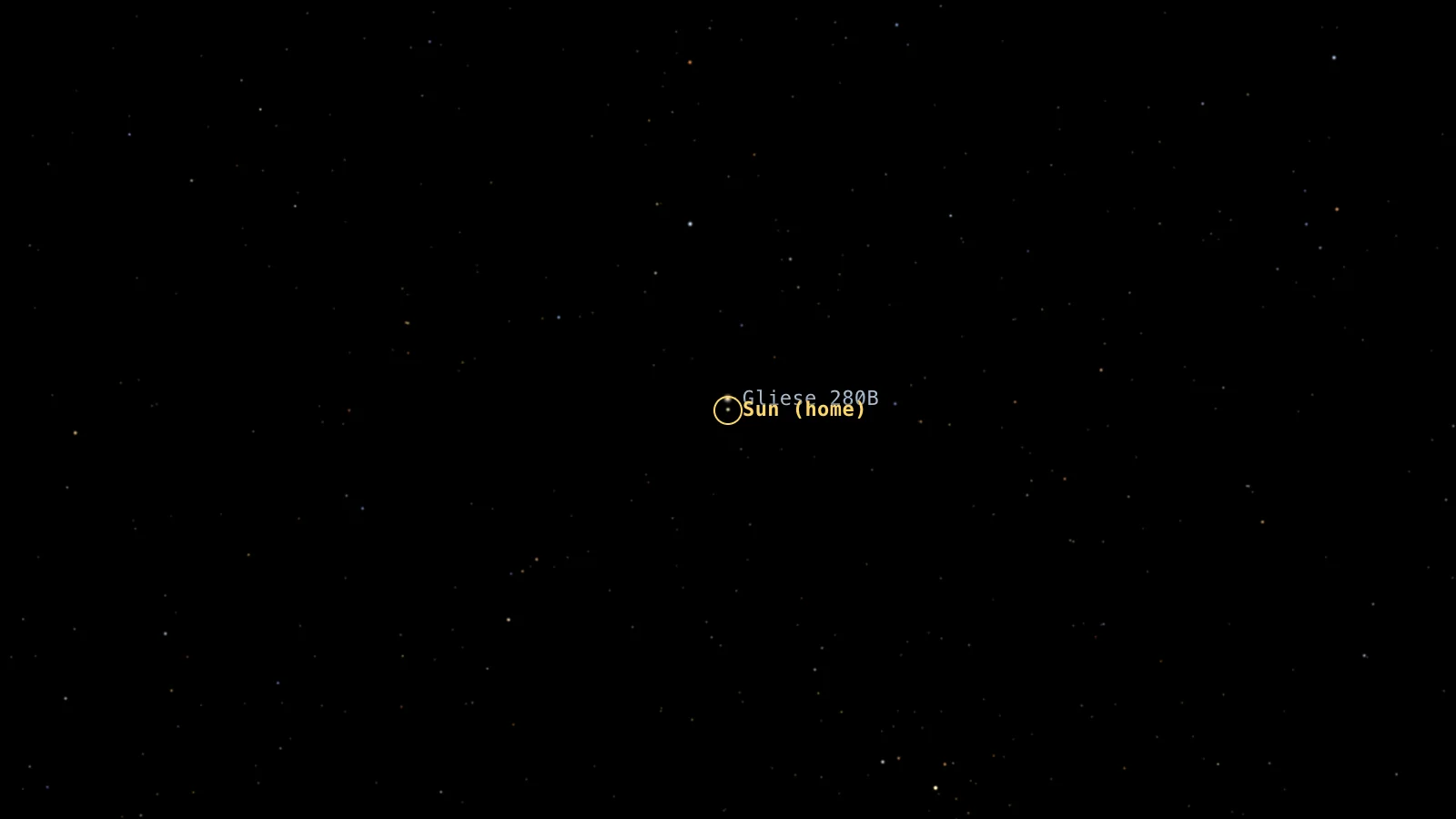
With Canis Major, Canis Minor makes up Orion's two hunting dogs, though the Lesser Dog has only one other star of note beside Procyon. Procyon B is far too faint for the eye and hard even for good telescopes, because it never strays far from its brilliant partner.
Going there
A ship accelerating at one g for half the journey and braking for the other half would reach Procyon in 5.1 years by its own clocks, while 13 years passed on Earth, peaking at 98.9 % of the speed of light.
Light
11.5 years
The light reaching us now left Procyon in 2015.
At a steady 1 g
5.1 years aboard
13 years pass on Earth; top speed 98.9 % of light.
From a world near Procyon, the white dwarf would be a point of light roughly as bright as the full Moon, but squeezed into a single dazzling dot, drifting slowly against the stars over the decades. Sirius would blaze brighter than any star in our own sky, and the Sun would be a modest star in Aquila, near Altair.
Finding Procyon in the night sky
Procyon is in the constellation Canis Minor. At magnitude 0.4 it is one of the brightest stars in the sky, easy to see even from a city.
It stands highest in the evening sky (around 9 pm) in February, and it is well placed in the evening from January to April: winter in the northern hemisphere, summer in the southern.
It never rises south of latitude 85° S; the farther north you are, the higher it climbs.
To find it, start from Sirius (magnitude -1.4): Procyon is 26° to its northeast, about 3 fists at arm's length (a fist held out covers about 10°). It is also 26° east of Betelgeuse and 23° south of Pollux.
Data
Measured values come from the papers cited. The game's estimates are what Solarwind works out from the star catalogue's colour and brightness alone; where the two differ, the measurement is the better value.
| Measured | Game's estimate | ||
|---|---|---|---|
| Distance | — | 11.46 ly · 3.514 pc | from Gaia/Hipparcos parallax |
| Parallax | — | 284.6 mas | |
| Right ascension | — | 7h 39m 17s | J2016 |
| Declination | — | +5° 13′ | |
| Constellation | Canis Minor | — | |
| Spectral type | F5IV-V+DQZ[1] | F5IV-V | |
| Temperature | 6,654 K[2] | 6,724 K | the Sun: 5,772 K |
| Radius | 1.86 R☉[3] | 1.89 R☉ | 19 × Jupiter |
| Mass | 1.50 M☉[3] | 1.35 M☉ (rough) | 1,572 × Jupiter |
| Luminosity | 6.93 L☉[3] | 6.61 L☉ | |
| Apparent magnitude (V) | 0.3700 [4] | 0.40 | naked-eye limit ≈ 6 |
| Absolute magnitude | — | 2.67 | |
| Habitable zone | — | 2.4–4.1 AU | Kopparapu et al. 2014, from the measured temperature |
| Frost line | — | 7.1 AU | where water freezes |
Nearest stars
- Gliese 280B0.0545 ly
- Luyten's Star1.01 ly
- Gliese 234B4.58 ly
- Ross 6144.60 ly
- Gliese GJ 11114.95 ly
- Gliese 244B5.23 ly
- Sirius5.23 ly
- Gliese GJ 35225.46 ly
- Gliese GJ 1116A7.72 ly
- Gliese GJ 1116B7.87 ly
Quick answers
What type of star is Procyon B?
A white dwarf: the dense, cooling core of a star that has finished its life. It has a little over half the Sun's mass in a body only slightly larger than the Earth, and it orbits Procyon A about once every forty years.
Is Procyon a main-sequence star?
Only just. Procyon A is classed F5IV-V, on the boundary between the main sequence and the subgiants: it is running out of hydrogen in its core and has started to swell. Its companion, Procyon B, is a white dwarf.
Which is brighter, Sirius B or Procyon?
Procyon, by far. Procyon shines at magnitude 0.37, one of the brightest stars in the sky, while Sirius B is a white dwarf thousands of times fainter, invisible to the naked eye and swamped by Sirius A beside it.
What does the name Procyon mean?
It is Greek for "before the dog". Seen from the Mediterranean, Procyon rises a little before Sirius, the Dog Star, so it was its herald.
How far away is Procyon?
Procyon is 11.5 light-years (3.51 parsecs) from the Sun, so the light you see from it left 11.5 years ago.
Can you see Procyon with the naked eye?
Yes: at magnitude 0.37 it is visible to the naked eye under a dark sky.
Where is Procyon in the night sky?
In the constellation Canis Minor. It is highest in the evening sky around February and never rises south of latitude 85° S. From Sirius, look 26° to the northeast.
What type of star is Procyon?
A yellow-white subgiant of spectral type F5IV-V, with a surface temperature of about 6,654 K (the Sun's is 5,772 K).
How big is Procyon compared with the Sun?
Its radius is 1.86 times the Sun's, about 1,300,000 km; its mass is 1.50 solar masses, and it is 6.93 times as luminous as the Sun.
How hot is Procyon?
Its surface is about 6,654 K (6,381 °C, 11,518 °F), hotter than the Sun's 5,772 K.
What colour is Procyon?
At 6,654 K its light is white: cooler stars glow redder, hotter ones bluer.
How massive is Procyon?
About 1.50 times the Sun's mass, or 1,572 Jupiters.
How luminous is Procyon?
It is about 6.93 times as luminous as the Sun (6.93 solar luminosities).
Will Procyon go supernova?
No. At about 1.5 solar masses it is too light: stars under about 8 solar masses end by shedding their outer layers and leaving a white dwarf.
What season is Procyon visible in?
In the north it is a winter star: it stands highest in the evening sky in February and is well placed from January to April. In the southern hemisphere those months are summer.
What galaxy is Procyon in?
The Milky Way, our own galaxy: every star you can see without a telescope belongs to it. At 11.5 light-years Procyon is a close neighbour on the scale of the galaxy, which is about 100,000 light-years across, and it lies in the same spiral arm as the Sun, the Orion Arm.
How long would it take to travel to Procyon?
Light takes 11.5 years. A ship accelerating at a steady 1 g and braking halfway would arrive after 5.1 years aboard (13 years on Earth), peaking at 98.9 % of the speed of light.
Sources
Last updated .
- General Catalogue of Stellar Spectral Classifications
- Abundances in the Local Region II: F, G, and K Dwarfs and Subgiants
- Wikipedia, via Wikidata
- VizieR Online Data Catalog: Stellar Photometry in Johnson's 11-color system (Ducati, 2002)
Positions and photometry: HYG Database v4.1 (CC BY-SA 4.0) and the Gaia Catalogue of Nearby Stars, ESA/Gaia/DPAC. Planets: the NASA Exoplanet Archive, operated by Caltech under contract with NASA. Identifiers: Wikidata (CC0), Q13034; SIMBAD. Habitable zone: Kopparapu et al. 2014. Text: written with an AI model from the data on this page, checked against the sources.
Also known as: 10 CMi · 1C 12.01 · 1ES 0736+05.3 · 1RXS J073918.3+051332 · 2EUVE J0739+05.2 · 2MASS J07391805+0513298 · AG+05 1072 · ASCC 1030621 · BD+05 1739 · CCDM J07393+0514A · CSV 100884 · Ci 20 432 · EUVE J0739+05.2 · FAUST 1387 · FK5 291 · GC 10277 · GCRV 5099 · GJ 280 · GJ 280 A · GJ 280.0 · HD 61421 · HIC 37279 · HIP 37279 · HR 2943 · IDS 07341+0529 A · IRAS 07366+0520 · IRC +10170 · JP11 1576 · LFT 541 · LHS 233 · LSPM J0739+0513 · LTT 12053 · N30 1726 · NLTT 18229 · NSV 3672 · PLX 1805 · PM 07367+0521 · PMC 90-93 212 · PPM 153068 · RAFGL 1161 · ROT 1234 · RX J0739.3+0513 · SAO 115756 · SBC7 317 · SBC9 467 · SPOCS 352 · TD1 10647 · TIC 280310048 · TYC 187-2184-1 · UBV 7352 · WDS J07393+0514A · WEB 7381 · Zkh 106 · [TSA98] J073919.85+051356.36 · uvby98 100061421 · α CMi