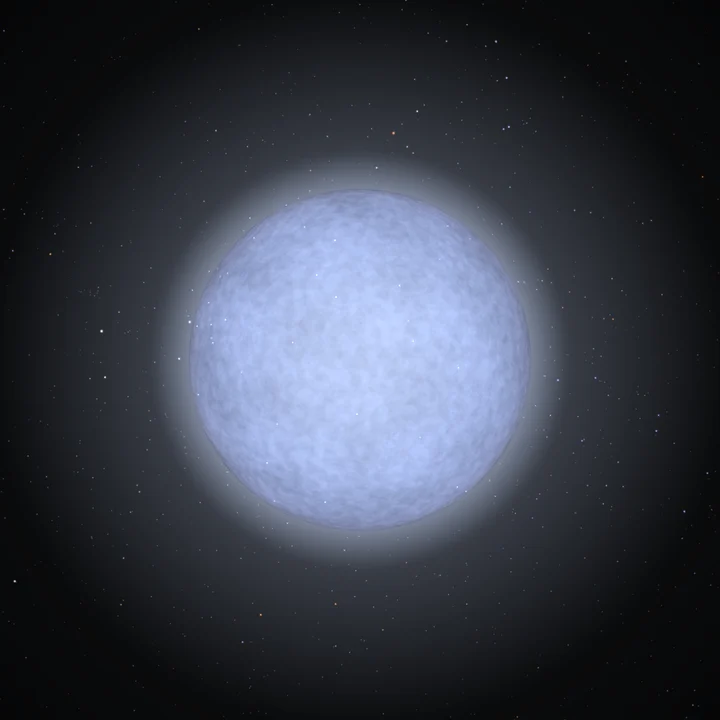
Algol facts at a glance
- Type: a blue-white star, spectral type B8V, in Perseus.
- Distance: 89.9 light-years (27.6 parsecs).
- Temperature: 12,445 K (12,172 °C, 21,941 °F) at the surface.
- Size: 376 times the Earth's width (3.4 solar radii).
- Mass: 3.5 times the Sun's.
- Planets: none known.
The Demon Star
Most stars hold steady. Algol, in the constellation Perseus, does not: every few days, regular as clockwork, it fades for several hours to a fraction of its usual brightness, then recovers. You can watch it happen with no telescope at all. Its name comes from the Arabic for "the head of the ghoul", and in the old star maps it marks the severed head of the Gorgon Medusa, held up in Perseus's hand. A winking eye in a monster's head earned it the name the Demon Star.
Normally it shines at magnitude 2.12, a bright, white star 89.9 light-years away. What makes it wink is that it is not one star but several, and two of them pass in front of each other as seen from the Earth.
The first eclipsing binary
The Italian astronomer Geminiano Montanari noticed in 1667 that Algol's brightness changed. In 1782 and 1783 John Goodricke, a young English astronomer who was profoundly deaf, timed its dimmings carefully, found that they repeated with a fixed period, and suggested that something dark might be passing in front of the star. He was right. In 1889 Hermann Carl Vogel showed from Algol's spectrum that the bright star was swinging back and forth in an orbit, proving it had a companion.
Algol became the prototype of eclipsing binaries: pairs of stars whose orbits we see nearly edge-on, so that each star passes in front of the other once per orbit. When the dim companion covers the bright star, Algol fades deeply; half an orbit later, when the bright star covers the companion, it dims only slightly, too little for the eye to notice. Eclipsing binaries are now one of astronomy's best tools for weighing and measuring stars directly.
A paradox, solved
The bright star, Algol A, is a blue-white B8V main-sequence star with a surface at about 12,445 kelvin, against the Sun's 5,772. Its companion, Algol B, is a cooler, orange subgiant: lighter than Algol A, yet further through its life. That broke a basic rule. Two stars born together should age in step, and the heavier one should evolve first.
The answer is that the stars have traded mass. Algol B was once the heavier star. When it began to swell at the end of its main-sequence life it overflowed the region it could hold on to, and much of its outer gas spilled onto Algol A. The donor shrank in mass while its partner grew, reversing their roles. This "Algol paradox" was one of the first clear signs that stars in close pairs can live quite differently from stars alone, and many such systems are now called Algol-type binaries.
A third star, and a crowded neighbourhood
A third star, Algol C, orbits the close pair at a greater distance, going round every couple of years. It is too close to the others to see separately in a telescope, but its pull makes the eclipses arrive slightly early and slightly late in turn, and interferometers have since resolved it. The inner pair is also a source of radio and X-ray flares, from the magnetically active orange star.
No planets are known around Algol, and with stars that have swapped gas back and forth a stable, temperate planet seems unlikely. The fact table shows only a modelled belt of debris, not an observed one.
| Body | Kind | Orbit, AU | Year, days | Mass, Earths | Temp., K |
|---|---|---|---|---|---|
| Algol inner belt game-made | Asteroid belt | 16–25 | — | — | 203 |
Watching Algol wink
Algol is easy to find in the northern autumn and winter sky: in Perseus, between Cassiopeia's W and the Pleiades. Compare it with nearby stars of similar brightness, and on a night when an eclipse is due, check again every hour or so. Over a few hours you will see it fade until it matches much fainter stars around it, and then climb back. Astronomy magazines and websites publish the times of the coming minima.
You do not need any equipment, only patience and a dark-enough sky. It is one of the few ways to watch a star's orbit with your own eyes.
Visiting Algol
From a ship near the system you would see two stars almost touching: a hot blue-white sun and a larger, dimmer orange one, whirling round each other every few days, with a thin stream of gas drawn from one to the other. The third star would be a bright point not far away.
A ship that could accelerate at a steady one g for half the way and brake for the other half would arrive after 8.8 years aboard, while 92 years passed at home, touching 99.977 % of the speed of light on the way.
Light
89.9 years
The light reaching us now left Algol in 1936.
At a steady 1 g
8.8 years aboard
92 years pass on Earth; top speed 99.977 % of light.
Finding Algol in the night sky
Algol is in the constellation Perseus. At magnitude 2.1 it is a naked-eye star, easy to see away from bright city lights.
North of latitude 49° N (Reykjavík, Helsinki or London) it never sets: it circles the north celestial pole all night, every night of the year. It stands highest in the evening sky (around 9 pm) in December.
It never rises south of latitude 49° S; the farther north you are, the higher it climbs.
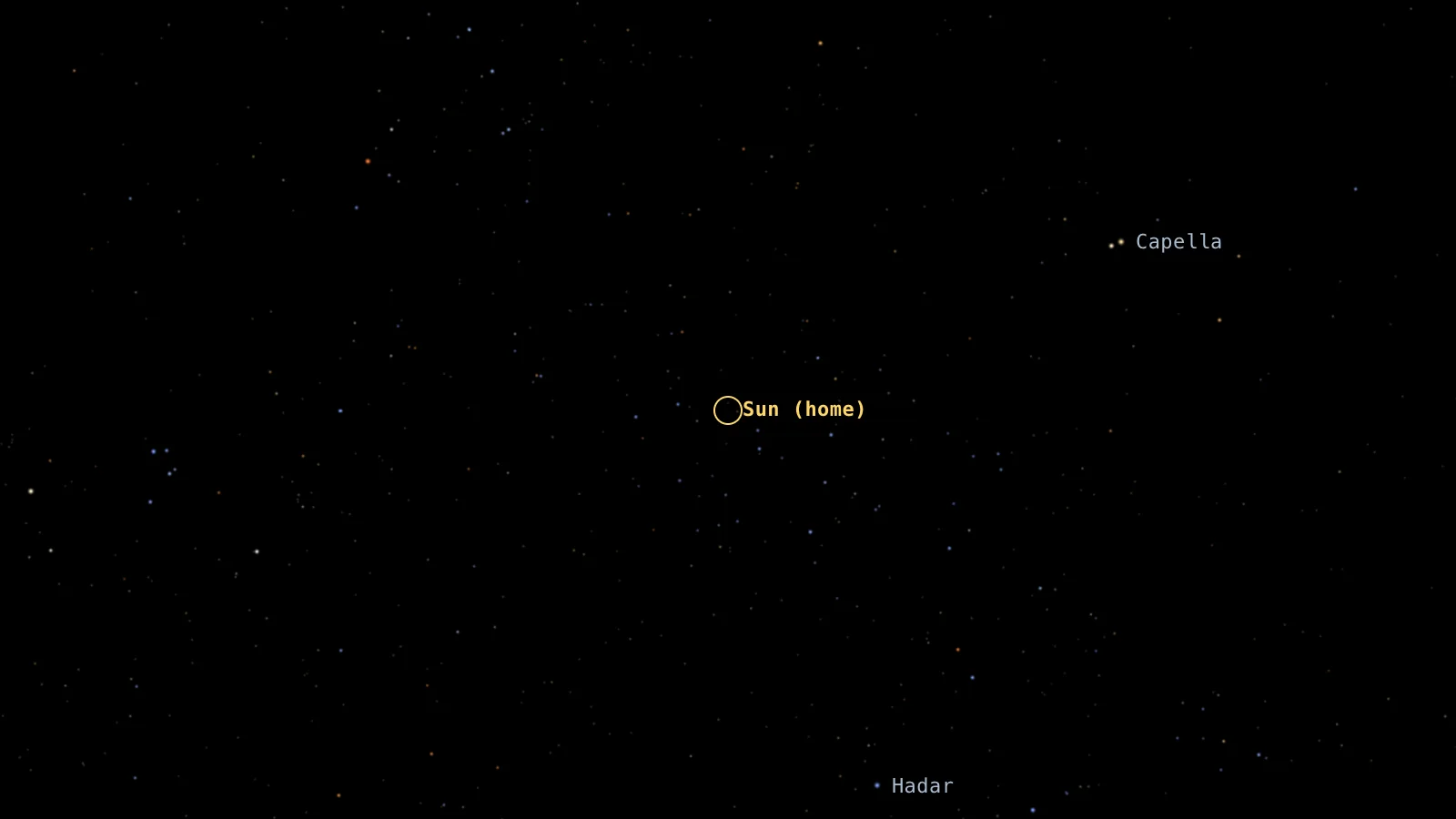
To find it, start from Capella (magnitude 0.1): Algol is 24° to its west, about 2 fists at arm's length (a fist held out covers about 10°). It is also 9.3° south of Mirfak and 31° northwest of Aldebaran.
Data
Measured values come from the papers cited. The game's estimates are what Solarwind works out from the star catalogue's colour and brightness alone; where the two differ, the measurement is the better value.
| Measured | Game's estimate | ||
|---|---|---|---|
| Distance | — | 89.92 ly · 27.57 pc | from Gaia/Hipparcos parallax |
| Parallax | — | 36.27 mas | |
| Right ascension | — | 3h 8m 10s | J2016 |
| Declination | — | +40° 57′ | |
| Constellation | Perseus | — | |
| Spectral type | B8V[1] | B8V | |
| Temperature | 12,450 K[2] | 10,125 K | the Sun: 5,772 K |
| Radius | — | 3.44 R☉ | 34 × Jupiter |
| Mass | — | 3.50 M☉ | 3,667 × Jupiter |
| Luminosity | — | 112 L☉ | |
| Apparent magnitude (V) | 2.120 [3] | 2.09 | naked-eye limit ≈ 6 |
| Absolute magnitude | — | -0.110 | |
| Habitable zone | — | 9.3–16 AU | Kopparapu et al. 2014, from the measured temperature |
| Frost line | — | 29 AU | where water freezes |
Nearest stars
- Gliese GJ 3199A2.01 ly
- J0306+40212.68 ly
- J0311+43114.01 ly
- J0316+38574.09 ly
- Gliese GJ 32014.38 ly
- J0316+38554.73 ly
- J0257+41115.53 ly
- J0304+43186.36 ly
- HIP 157977.18 ly
- HIP 162098.51 ly
Quick answers
Why is Algol called the Demon Star?
Its name is from the Arabic for "the head of the ghoul", because it marks the head of the monster Medusa that Perseus holds in the old constellation pictures. Its regular winking, as one star eclipses the other, may also have added to its sinister reputation, although whether ancient observers knew of the dimming is uncertain.
What kind of star system is Algol?
A triple star. Two stars orbit each other very closely, nearly edge-on to us, so they eclipse each other every few days; a third star circles the pair further out. It is the prototype of eclipsing binaries.
Is Algol a main sequence star?
The brightest star of the system, Algol A, is a main-sequence star. Its close companion is a subgiant that has already left the main sequence and has given much of its gas to Algol A.
How do I find Algol?
Look in Perseus, in the northern sky, between the W of Cassiopeia and the Pleiades. It is the second-brightest star in Perseus, a little south-west of Mirfak, and it is best seen from autumn to early spring in the evening.
How far away is Algol?
Algol is 89.9 light-years (27.6 parsecs) from the Sun, so the light you see from it left 89.9 years ago.
Can you see Algol with the naked eye?
Yes: at magnitude 2.12 it is visible to the naked eye under a dark sky, from the northern hemisphere.
Where is Algol in the night sky?
In the constellation Perseus. It is highest in the evening sky around December and never rises south of latitude 49° S. From Capella, look 24° to the west.
What type of star is Algol?
A blue-white star of spectral type B8V, with a surface temperature of about 12,445 K (the Sun's is 5,772 K).
How big is Algol compared with the Sun?
Its radius is 3.44 times the Sun's, about 2,400,000 km; its mass is 3.50 solar masses, and it is 112 times as luminous as the Sun.
How hot is Algol?
Its surface is about 12,445 K (12,172 °C, 21,941 °F), hotter than the Sun's 5,772 K.
What colour is Algol?
At 12,445 K its light is blue-white: cooler stars glow redder, hotter ones bluer.
How massive is Algol?
About 3.50 times the Sun's mass, or 3,667 Jupiters: the game's estimate from its colour and brightness.
How luminous is Algol?
It is about 112 times as luminous as the Sun (112 solar luminosities), the game's estimate from its colour and brightness.
What galaxy is Algol in?
The Milky Way, our own galaxy: every star you can see without a telescope belongs to it. At 89.9 light-years Algol is a close neighbour on the scale of the galaxy, which is about 100,000 light-years across, and it lies in the same spiral arm as the Sun, the Orion Arm.
How long would it take to travel to Algol?
Light takes 89.9 years. A ship accelerating at a steady 1 g and braking halfway would arrive after 8.8 years aboard (92 years on Earth), peaking at 99.977 % of the speed of light.
Sources
Last updated .
- MK classifications of some northern hemisphere binary systems
- Rotational velocities of A-type stars. IV. Evolution of rotational velocities
- VizieR Online Data Catalog: Stellar Photometry in Johnson's 11-color system (Ducati, 2002)
Positions and photometry: HYG Database v4.1 (CC BY-SA 4.0) and the Gaia Catalogue of Nearby Stars, ESA/Gaia/DPAC. Planets: the NASA Exoplanet Archive, operated by Caltech under contract with NASA. Identifiers: Wikidata (CC0), Q13080; SIMBAD. Habitable zone: Kopparapu et al. 2014. Text: written with an AI model from the data on this page, checked against the sources.
Also known as: 1ES 0304+40.7 · 1RXS J030810.0+405727 · 1XRS 03049+407 · 26 Per · 2EUVE J0308+40.9 · 2MASS J03081012+4057204 · 2MAXI J0308+410 · AAVSO 0301+40 · ADS 2362 A · AG+40 360 · BD+40 673 · CCDM J03082+4057A · CEL 301 · EUVE J0308+40.9 · FK5 111 · GC 3733 · GCRV 1731 · GJ 9110 · GJ 9110 A · Gaia DR2 239863001382455424 · HD 19356 · HIC 14576 · HIP 14576 · HR 936 · IDS 03017+4034 A · IRAS 03048+4045 · IRC +40055 · JP11 752 · N30 636 · PLX 646 · PMC 90-93 80 · PMSC 03017+4034A · PPM 45864 · RAFGL 443 · ROT 417 · RX J0308.1+4057 · SAO 38592 · SBC7 113 · SBC7 114 · SBC9 157 · SBC9 158 · TD1 1905 · TIC 346783960 · TYC 2851-2168-1 · UBV 21464 · UBV M 9337 · WDS J03082+4057A · WDS J03082+4057Aa,Ab · WEB 2833 · WEB 2834 · XSS J03089+4101 · bet Per · β Per