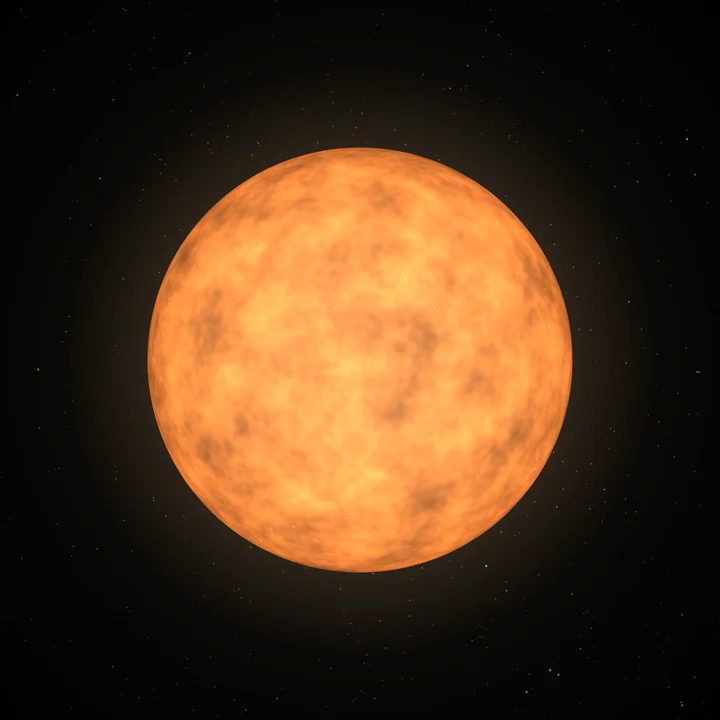
Aldebaran facts at a glance
- Type: an orange giant, spectral type K5 III, in Taurus.
- Distance: 66.6 light-years (20.4 parsecs).
- Temperature: 4,055 K (3,782 °C, 6,839 °F) at the surface.
- Size: 4,925 times the Earth's width (45 solar radii).
- Mass: 1.1 times the Sun's.
- Age: about 6.6 billion years.
- Planets: one.
The eye of the bull
Aldebaran is the fiery orange eye of Taurus, the Bull, and one of the easiest stars in the sky to recognise. It lies 66.6 light-years away and shines at magnitude 0.87, among the brightest stars of the night, with a colour that is unmistakable even to the naked eye. Its name comes from the Arabic al-Dabarān, "the follower", because it rises after the Pleiades and seems to chase them across the sky.
It is an orange giant, classified K5 III: a star that has finished burning the hydrogen in its core and swollen enormously. It is about 45 times as wide as the Sun, some 31,400,000 km in radius; put it where the Sun is and its surface would reach about halfway to the orbit of Mercury. Its surface is cool, around 4,055 kelvin against the Sun's 5,772, but it is so large that it gives out about 470 times the Sun's light.
The Sun's future, seen from outside
For all its size, Aldebaran is not much heavier than the Sun: about 1.1 solar masses. That makes it a preview of our own star's old age. Aldebaran is about 6.6 billion years old. It spent most of that time as an ordinary main-sequence star, then ran out of hydrogen in its core; now hydrogen burns in a shell around a contracting core of helium, and the outer layers have puffed up into a vast, tenuous envelope.
In some billions of years the Sun will do the same. Aldebaran's surface is so diffuse that it shimmers: it varies slightly in brightness, and its outer layers boil with huge convection cells. Like other cool giants, it is also losing gas from its surface in a slow, steady wind.
A giant and a cluster that are not related
Aldebaran appears to sit at the tip of the V-shaped Hyades, the nearest open star cluster, which forms the Bull's face. The resemblance is a coincidence of perspective. The Hyades are about twice as far away, and Aldebaran simply lies in the foreground, about halfway between us and the cluster.
Because it lies close to the ecliptic, the Moon often passes in front of Aldebaran, blotting it out in an event called an occultation. Such occultations come in series lasting several years, and astronomers have used the precise moment the star winks out to measure its angular size. Because the edge of the Moon is so sharp, the star fades over a few thousandths of a second rather than instantly, and that fade reveals that it is a disc, not a point.
A disputed planet
In 2015 astronomers announced a giant planet orbiting Aldebaran, found from a slow, regular wobble in the star's motion. If real, Aldebaran b has at least 2,100 times the Earth's mass, several times the mass of Jupiter, and orbits in 629 days at 1.46 AU, roughly the distance of Mars from the Sun. Around a star this luminous, though, that is a scorching orbit: the planet would receive about 220 times the starlight the Earth does, with an equilibrium temperature near 1,090 kelvin.
The planet is not secure. Giant stars like Aldebaran have their own slow rhythms, from oscillations and rotating patches on their surfaces, that can mimic a planet's tug, and later observations found that the signal changed in ways a planet would not explain. Some astronomers now suspect the wobble comes from the star itself. Life there is out of the question either way: the habitable zone of a star this bright lies far out, between 22 and 42 AU, and it has moved outwards as the star has grown.
Finding it in the sky
Aldebaran is a winter star for northern observers and a summer one in the southern hemisphere. Find Orion, then follow the three stars of his belt up and to the right (in the northern hemisphere) to the first bright orange star: that is Aldebaran. The Pleiades lie further along the same line. Near the ecliptic, it can be seen from almost anywhere on Earth.
A long way to the follower
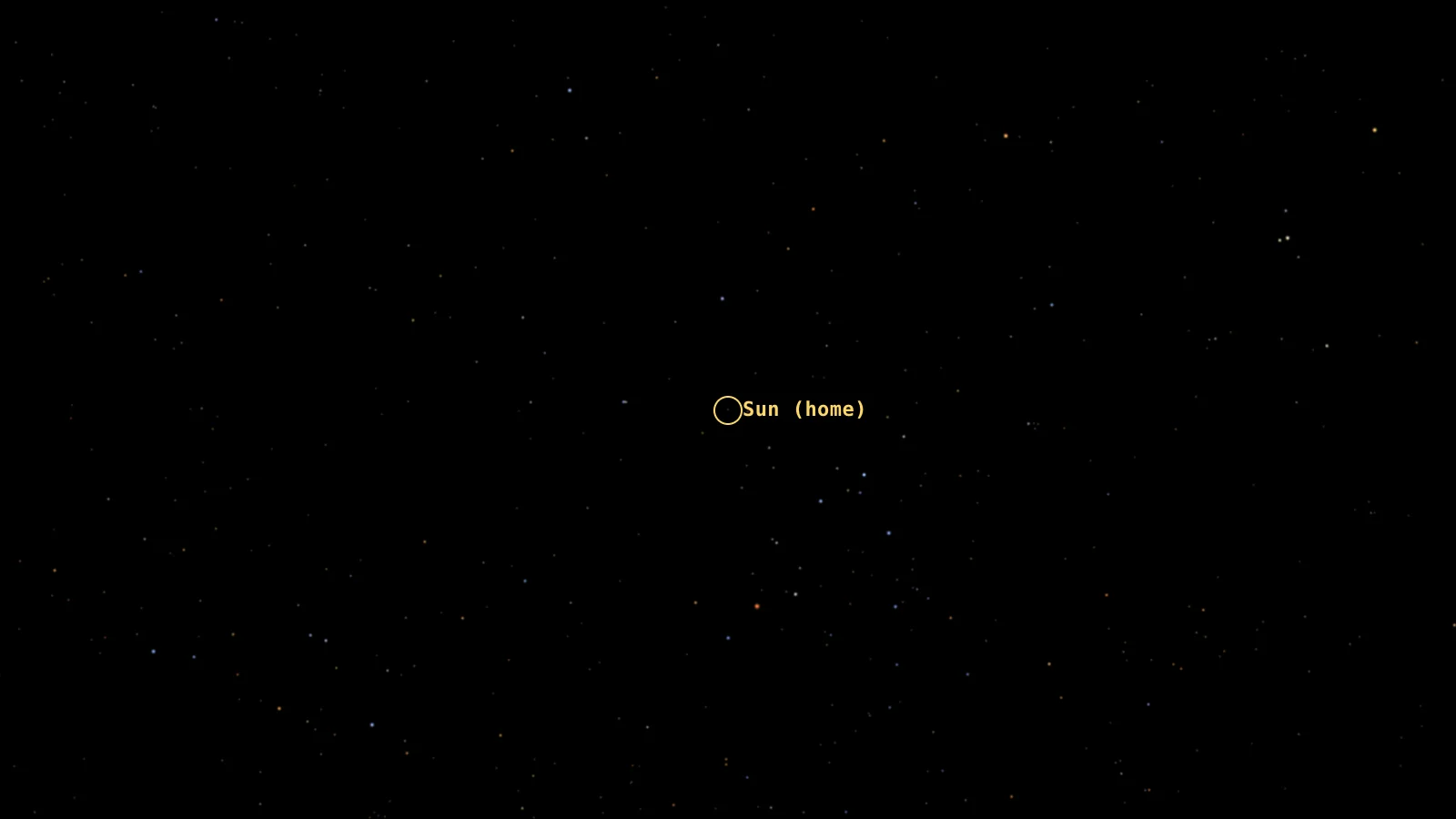
At 66.6 light-years, Aldebaran's light set out a lifetime ago. The Pioneer 10 spacecraft, launched in 1972, is drifting in its general direction but will need millions of years to cover the distance. A ship accelerating at a steady one g for half the way and braking for the other half would arrive after 8.3 years aboard, while 69 years passed on Earth, reaching 99.960 % of the speed of light at the turnaround.
Light
66.6 years
The light reaching us now left Aldebaran in 1959.
At a steady 1 g
8.3 years aboard
69 years pass on Earth; top speed 99.960 % of light.
From up close, Aldebaran would fill a great slice of the sky of any planet near it, a dull orange glow mottled by convection, much as the swollen Sun will one day look from the Earth.
Finding Aldebaran in the night sky
Aldebaran is in the constellation Taurus. At magnitude 0.9 it is one of the brightest stars in the sky, easy to see even from a city.
It stands highest in the evening sky (around 9 pm) in January, and it is well placed in the evening from December to March: winter in the northern hemisphere, summer in the southern.
It never rises south of latitude 73° S; the farther north you are, the higher it climbs.
To find it, start from Betelgeuse (magnitude 0.4): Aldebaran is 21° to its northwest, about 2 fists at arm's length (a fist held out covers about 10°). It is also 26° north of Rigel and 31° south of Capella.
Data
Measured values come from the papers cited. The game's estimates are what Solarwind works out from the star catalogue's colour and brightness alone; where the two differ, the measurement is the better value.
| Measured | Game's estimate | ||
|---|---|---|---|
| Distance | — | 66.65 ly · 20.43 pc | from Gaia/Hipparcos parallax |
| Parallax | — | 48.94 mas | |
| Right ascension | — | 4h 35m 55s | J2016 |
| Declination | — | +16° 31′ | |
| Constellation | Taurus | — | |
| Spectral type | K5 III[1] | K5III | |
| Temperature | 4,055 ± 70 K[1] | 3,734 K | the Sun: 5,772 K |
| Radius | 45.1 ± 0.10 R☉[1] | 61.3 R☉ | 450 × Jupiter |
| Mass | 1.13 ± 0.11 M☉[1] | 2.18 M☉ (rough) | 1,184 × Jupiter |
| Luminosity | 470 L☉[2] | 659 L☉ | |
| Apparent magnitude (V) | 0.8720 [3] | 0.87 | naked-eye limit ≈ 6 |
| Absolute magnitude | — | -0.680 | |
| Habitable zone | — | 22–42 AU | Kopparapu et al. 2014, from the measured temperature |
| Frost line | — | 59 AU | where water freezes |
Nearest stars
- Gliese 171.1B2.37 ly
- Gliese GJ 32844.92 ly
- J0452+14405.41 ly
- J0416+13106.74 ly
- Gliese GJ 32746.89 ly
- J0422+10318.10 ly
- Gliese GJ 3301A9.04 ly
- J0503+21239.48 ly
- Gliese GJ 33359.55 ly
- J0424+15059.59 ly
Quick answers
Is Aldebaran a main-sequence star?
No. It was one for most of its life, but it has used up the hydrogen in its core and become a giant, classified K5 III. Today it burns hydrogen in a shell around its core.
Is Aldebaran a binary star?
Not in a close sense. A few faint stars appear near it in the sky, and one red dwarf may share its motion through space, but whether it is a true distant companion is uncertain. Aldebaran is usually treated as a single star, possibly with a planet.
Where is Aldebaran located?
In the constellation Taurus, as the Bull's eye, at the tip of the V of the Hyades cluster. Follow Orion's belt upwards to the right (from the northern hemisphere) to find it.
Is Aldebaran part of the Hyades cluster?
No. It lies in the foreground, about halfway between us and the cluster, and only lines up with it by chance.
How far away is Aldebaran?
Aldebaran is 66.6 light-years (20.4 parsecs) from the Sun, so the light you see from it left 66.6 years ago.
Can you see Aldebaran with the naked eye?
Yes: at magnitude 0.87 it is visible to the naked eye under a dark sky.
Where is Aldebaran in the night sky?
In the constellation Taurus. It is highest in the evening sky around January and never rises south of latitude 73° S. From Betelgeuse, look 21° to the northwest.
What type of star is Aldebaran?
An orange giant of spectral type K5 III, with a surface temperature of about 4,055 K (the Sun's is 5,772 K).
How big is Aldebaran compared with the Sun?
Its radius is 45.1 times the Sun's, about 31,000,000 km; its mass is 1.13 solar masses, and it is 470 times as luminous as the Sun.
How hot is Aldebaran?
Its surface is about 4,055 K (3,782 °C, 6,839 °F), cooler than the Sun's 5,772 K.
What colour is Aldebaran?
At 4,055 K its light is orange: cooler stars glow redder, hotter ones bluer.
How massive is Aldebaran?
About 1.13 times the Sun's mass, or 1,184 Jupiters.
How luminous is Aldebaran?
It is about 470 times as luminous as the Sun (470 solar luminosities).
Will Aldebaran go supernova?
No. At about 1.1 solar masses it is too light: stars under about 8 solar masses end by shedding their outer layers and leaving a white dwarf.
What season is Aldebaran visible in?
In the north it is a winter star: it stands highest in the evening sky in January and is well placed from December to March. In the southern hemisphere those months are summer.
What galaxy is Aldebaran in?
The Milky Way, our own galaxy: every star you can see without a telescope belongs to it. At 66.6 light-years Aldebaran is a close neighbour on the scale of the galaxy, which is about 100,000 light-years across, and it lies in the same spiral arm as the Sun, the Orion Arm.
Does Aldebaran have planets?
Yes: one confirmed planet, alf Tau b (1.5 AU, a year of 629 days).
How long would it take to travel to Aldebaran?
Light takes 66.6 years. A ship accelerating at a steady 1 g and braking halfway would arrive after 8.3 years aboard (69 years on Earth), peaking at 99.960 % of the speed of light.
Sources
Last updated .
Positions and photometry: HYG Database v4.1 (CC BY-SA 4.0) and the Gaia Catalogue of Nearby Stars, ESA/Gaia/DPAC. Planets: the NASA Exoplanet Archive, operated by Caltech under contract with NASA. Identifiers: Wikidata (CC0), Q12170; SIMBAD. Habitable zone: Kopparapu et al. 2014. Text: written with an AI model from the data on this page, checked against the sources.
Also known as: 2MASS J04355524+1630331 · 87 Tau · ADS 3321 A · AG+16 400 · ASCC 838711 · BD+16 629 · CCDM J04359+1631A · CEL 436 · CSV 6116 · FK5 168 · GC 5605 · GCRV 2689 · GJ 171.1 A · GJ 9159 A · GSC 01266-01416 · HD 29139 · HIC 21421 · HIP 21421 · HR 1457 · IDS 04302+1619 A · IRAS 04330+1624 · IRC +20087 · JP11 898 · LSPM J0435+1630 · LTT 11462 · N30 962 · NLTT 13584 · PLX 1014 · PMC 90-93 119 · PPM 120061 · RAFGL 601 · ROT 655 · SAO 94027 · SRS 30168 · TD1 3349 · TIC 245873777 · TYC 1266-1416-1 · UBV 4426 · UBV M 10223 · WDS J04359+1631A · WEB 4111 · YZ 16 1233 · alf Tau · uvby98 100029139 · α Tau