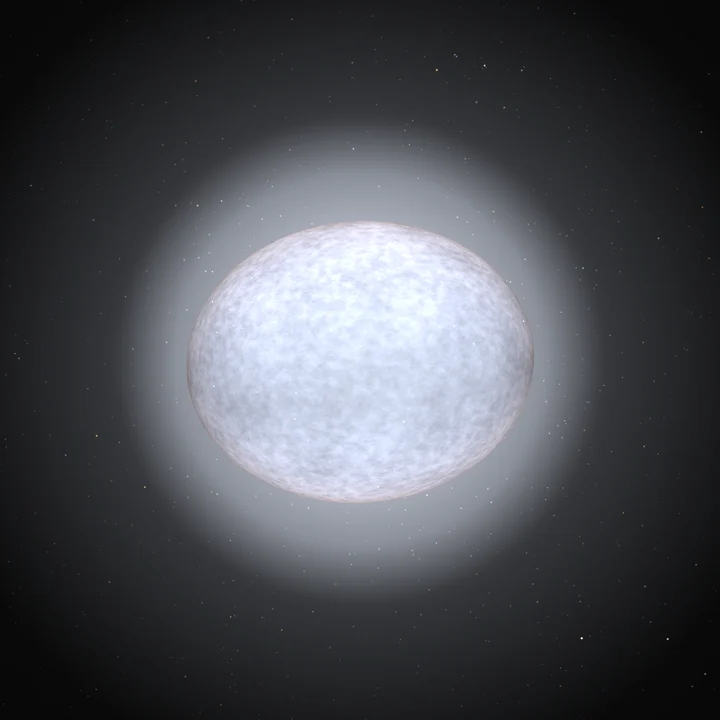
Altair facts at a glance
- Type: a white star, spectral type A7Vn, in Aquila.
- Distance: 16.7 light-years (5.13 parsecs).
- Temperature: 7,377 K (7,104 °C, 12,819 °F) at the surface.
- Size: 186 times the Earth's width (1.7 solar radii).
- Mass: 1.7 times the Sun's.
- Planets: none known.
The flying eagle
Altair is the bright star of Aquila, the Eagle, and its name is Arabic for "the flying one", from a phrase meaning "the flying eagle". At 16.7 light-years it is one of the nearest bright stars, and at magnitude 0.76 one of the brightest in the sky. With Vega and Deneb it makes up the Summer Triangle that dominates northern summer evenings.
It is a white A7Vn star, a little heavier and bigger than the Sun: about 1.7 times its mass and 1.7 times its radius on average, with a surface at around 7,377 kelvin against the Sun's 5,772. It gives out about 11 times the Sun's light. That much is ordinary for a star of its kind. What is not ordinary is how fast it spins.
A star squashed by its own spin
The Sun takes almost a month to turn once. Altair turns in less than half an Earth day, so fast that its equator races round at hundreds of kilometres a second, a sizeable fraction of the speed at which it would start to fly apart. The spin flings its equator outwards, and Altair is visibly flattened: noticeably wider across its equator than from pole to pole, more like a squashed ball than a sphere.
Spinning so fast does something else. The poles, closer to the centre, are hotter and brighter, while the bulging equator is cooler and darker, an effect called gravity darkening. Altair has no single temperature; its poles may be a couple of thousand kelvin hotter than its equator, and the figure in the fact table is an average.
A photograph of another star's surface
We know Altair's shape because we have seen it. Its disc is far too small for any single telescope, so astronomers use interferometers, which combine the light from several telescopes spread over hundreds of metres to see details as fine as a single giant telescope that wide could. In 2001 the Palomar Testbed Interferometer showed that Altair was not round.
In 2007 a team led by John Monnier used the CHARA array on Mount Wilson to make an actual image of Altair's surface: the first picture of the face of a main-sequence star other than the Sun. It showed the flattened outline and the bright poles and dark equator, just as gravity darkening predicts. Altair has been a test case for fast-spinning stars ever since. It also pulsates gently, ringing with many small, overlapping oscillations, which the WIRE satellite detected in 2005.
No known planets
No planets have been found around Altair. Its fast spin broadens its spectral lines so much that the small wobbles a planet would cause are hard to measure, so the search is difficult rather than finished. A planet warm enough for liquid water would orbit about 2.9 to 5.0 AU from it, in the region where Jupiter is in our Solar System.
The bodies shown in the system figure are modelled belts of debris, not observed ones.
| Body | Kind | Orbit, AU | Year, days | Mass, Earths | Temp., K |
|---|---|---|---|---|---|
| Altair inner belt game-made | Asteroid belt | 5.3–8.3 | — | — | 193 |
| Altair outer belt game-made | Icy belt | 48–80 | — | — | 63 |
The Weaver and the Cowherd
In China, Japan and Korea, Altair is the Cowherd, a young man parted from his love, the Weaver Girl, who is the star Vega, by the river of the Milky Way. Once a year, on the seventh day of the seventh lunar month, magpies form a bridge so the two can meet. The story is celebrated as the Qixi festival in China and Tanabata in Japan, and it is one of the best-loved tales told about any pair of stars.
To find Altair, look for the Summer Triangle high in the south on summer evenings in the northern hemisphere. Altair is the corner furthest south, with a fainter star on either side of it, a short line of three that makes it easy to tell apart. From the southern hemisphere it is visible too, lower in the north in winter.
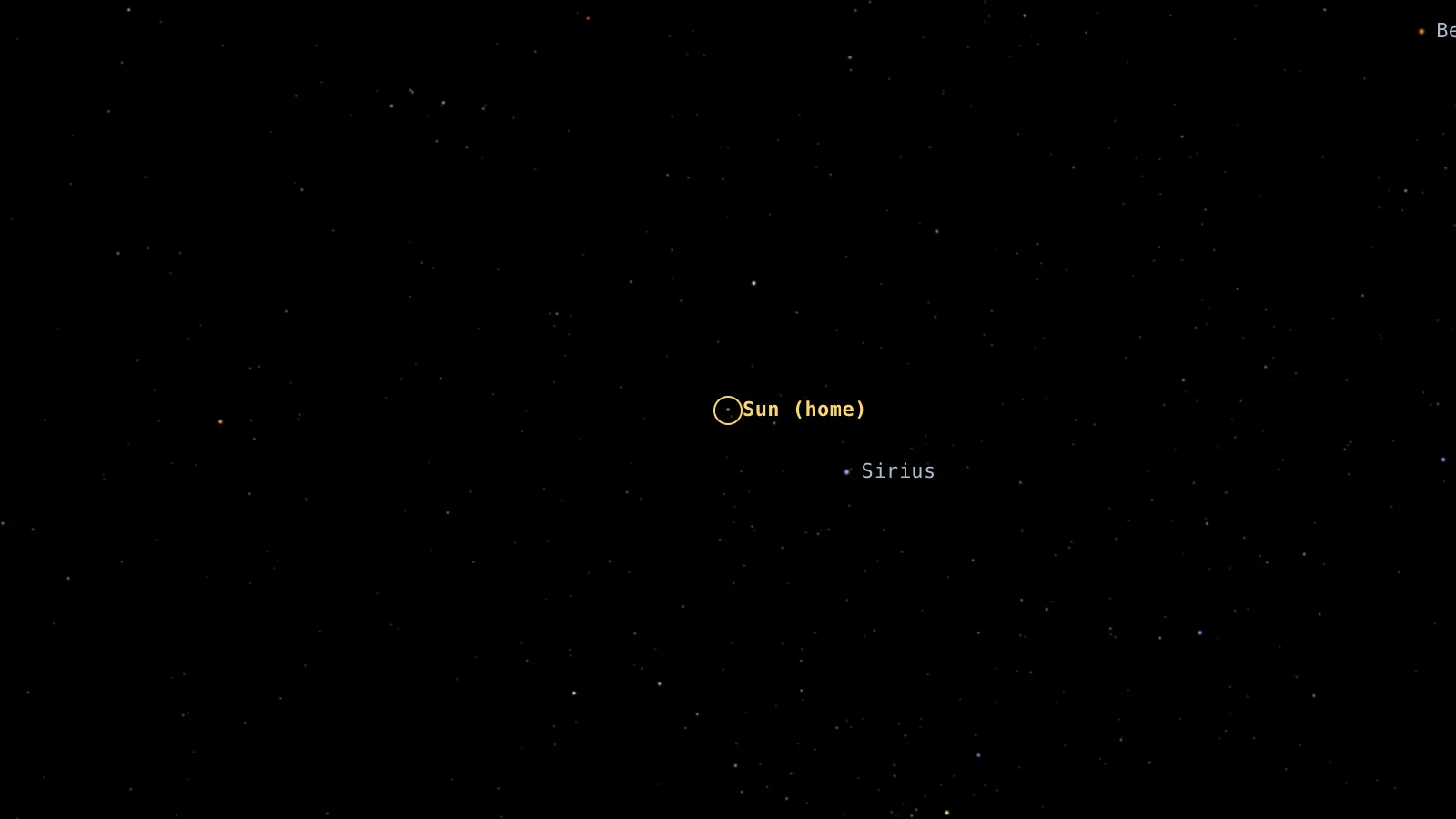
Visiting Altair
From one of its planets, if it had any, Altair would be a brilliant white sun that looks slightly oval, brightest at top and bottom, turning so fast that its spots and features would race across its face. The Sun, from there, would be an unremarkable star.
A ship that could accelerate at a steady one g for half the way and brake for the other half would arrive after 5.7 years aboard, while 19 years passed at home, touching 99.45 % of the speed of light on the way.
Light
16.7 years
The light reaching us now left Altair in 2009.
At a steady 1 g
5.7 years aboard
19 years pass on Earth; top speed 99.45 % of light.
Finding Altair in the night sky
Altair is in the constellation Aquila. At magnitude 0.8 it is one of the brightest stars in the sky, easy to see even from a city.
It stands highest in the evening sky (around 9 pm) in September, and it is well placed in the evening from August to November: autumn in the northern hemisphere, spring in the southern.
It never rises south of latitude 81° S; the farther north you are, the higher it climbs.
To find it, start from Vega (magnitude 0.0): Altair is 34° to its southeast, about 3 fists at arm's length (a fist held out covers about 10°). It is also 38° south of Deneb and 34° east of Rasalhague.
Data
Measured values come from the papers cited. The game's estimates are what Solarwind works out from the star catalogue's colour and brightness alone; where the two differ, the measurement is the better value.
| Measured | Game's estimate | ||
|---|---|---|---|
| Distance | — | 16.73 ly · 5.129 pc | from Gaia/Hipparcos parallax |
| Parallax | — | 195.0 mas | |
| Right ascension | — | 19h 50m 48s | J2016 |
| Declination | — | +8° 52′ | |
| Constellation | Aquila | — | |
| Spectral type | A7Vn[1] | A7IV-V | |
| Temperature | 7,377 K[2] | 8,011 K | the Sun: 5,772 K |
| Radius | 1.70 R☉[3] | 1.65 R☉ | 17 × Jupiter |
| Mass | 1.70 M☉[3] | 1.50 M☉ (rough) | 1,782 × Jupiter |
| Luminosity | 10.7 L☉[3] | 10.1 L☉ | |
| Apparent magnitude (V) | 0.7600 [4] | 0.76 | naked-eye limit ≈ 6 |
| Absolute magnitude | — | 2.21 | |
| Habitable zone | — | 2.9–5.0 AU | Kopparapu et al. 2014, from the measured temperature |
| Frost line | — | 8.8 AU | where water freezes |
Nearest stars
- Gliese 752B3.87 ly
- Gliese 752A3.87 ly
- J1928+23567.72 ly
- Gliese 702B7.78 ly
- 70 Oph7.78 ly
- HIP 1030399.21 ly
- J1835+32599.22 ly
- 61 Cyg9.75 ly
- J1848+07419.81 ly
Quick answers
Is Altair a main sequence star?
Yes, or very nearly. It is classed A7Vn, a main-sequence star (the n marks the broad, smeared spectral lines of a fast spinner), still fusing hydrogen in its core. Its fast spin makes it look slightly cooler and more evolved than it really is.
How old is Altair?
Not well known, but probably young: much younger than the Sun. Models of its flattened, fast-spinning shape point to an age of only a small fraction of the Sun's, while older estimates came out higher.
Why is Altair flattened?
It spins so fast, once in less than half a day, that its equator bulges outwards. Interferometers have measured and imaged its shape directly, showing it noticeably wider at the equator than through the poles.
What is the story of Altair and Vega?
In East Asian legend Altair is the Cowherd and Vega the Weaver Girl, lovers separated by the Milky Way who may meet only once a year. Their meeting is celebrated as Qixi in China and Tanabata in Japan.
How far away is Altair?
Altair is 16.7 light-years (5.13 parsecs) from the Sun, so the light you see from it left 16.7 years ago.
Can you see Altair with the naked eye?
Yes: at magnitude 0.76 it is visible to the naked eye under a dark sky.
Where is Altair in the night sky?
In the constellation Aquila. It is highest in the evening sky around September and never rises south of latitude 81° S. From Vega, look 34° to the southeast.
What type of star is Altair?
A white star of spectral type A7Vn, with a surface temperature of about 7,377 K (the Sun's is 5,772 K).
How big is Altair compared with the Sun?
Its radius is 1.70 times the Sun's, about 1,200,000 km; its mass is 1.70 solar masses, and it is 10.7 times as luminous as the Sun.
How hot is Altair?
Its surface is about 7,377 K (7,104 °C, 12,819 °F), hotter than the Sun's 5,772 K.
What colour is Altair?
At 7,377 K its light is white: cooler stars glow redder, hotter ones bluer.
How massive is Altair?
About 1.70 times the Sun's mass, or 1,782 Jupiters.
How luminous is Altair?
It is about 10.7 times as luminous as the Sun (10.7 solar luminosities).
Will Altair go supernova?
No. At about 1.7 solar masses it is too light: stars under about 8 solar masses end by shedding their outer layers and leaving a white dwarf.
What season is Altair visible in?
In the north it is a autumn star: it stands highest in the evening sky in September and is well placed from August to November. In the southern hemisphere those months are spring.
What galaxy is Altair in?
The Milky Way, our own galaxy: every star you can see without a telescope belongs to it. At 16.7 light-years Altair is a close neighbour on the scale of the galaxy, which is about 100,000 light-years across, and it lies in the same spiral arm as the Sun, the Orion Arm.
How long would it take to travel to Altair?
Light takes 16.7 years. A ship accelerating at a steady 1 g and braking halfway would arrive after 5.7 years aboard (19 years on Earth), peaking at 99.45 % of the speed of light.
Sources
Last updated .
- Source on Wikidata
- Abundances in the Local Region II: F, G, and K Dwarfs and Subgiants
- Wikipedia, via Wikidata
- VizieR Online Data Catalog: Stellar Photometry in Johnson's 11-color system (Ducati, 2002)
Positions and photometry: HYG Database v4.1 (CC BY-SA 4.0) and the Gaia Catalogue of Nearby Stars, ESA/Gaia/DPAC. Planets: the NASA Exoplanet Archive, operated by Caltech under contract with NASA. Identifiers: Wikidata (CC0), Q12975; SIMBAD. Habitable zone: Kopparapu et al. 2014. Text: written with an AI model from the data on this page, checked against the sources.
Also known as: 1ES 1948+08.7 · 1RXS J195047.0+085159 · 2MASS J19504698+0852060 · 53 Aql · ADS 13009 A · AG+08 2636 · ASCC 1075038 · BD+08 4236 · CCDM J19508+0852A · Ci 20 1169 · FK5 745 · GC 27470 · GCRV 12193 · GJ 768 · GSC 01058-03399 · HD 187642 · HIC 97649 · HIP 97649 · HR 7557 · IDS 19459+0836 A · IRAS 19483+0844 · IRC +10441 · JP11 3142 · LFT 1499 · LHS 3490 · LSPM J1950+0852 · LTT 15795 · N30 4388 · NLTT 48314 · NSV 24910 · PLX 4665 · PLX 4665.00 · PM 19484+0844 · PMC 90-93 530 · PPM 168779 · RAFGL 2463 · ROT 2857 · SAO 125122 · TD1 25537 · TIC 70257116 · TYC 1058-3399-1 · UBV 16885 · UBV M 24205 · WDS J19508+0852A · WEB 17173 · Zkh 297 · alf Aql · uvby98 100187642 · α Aql