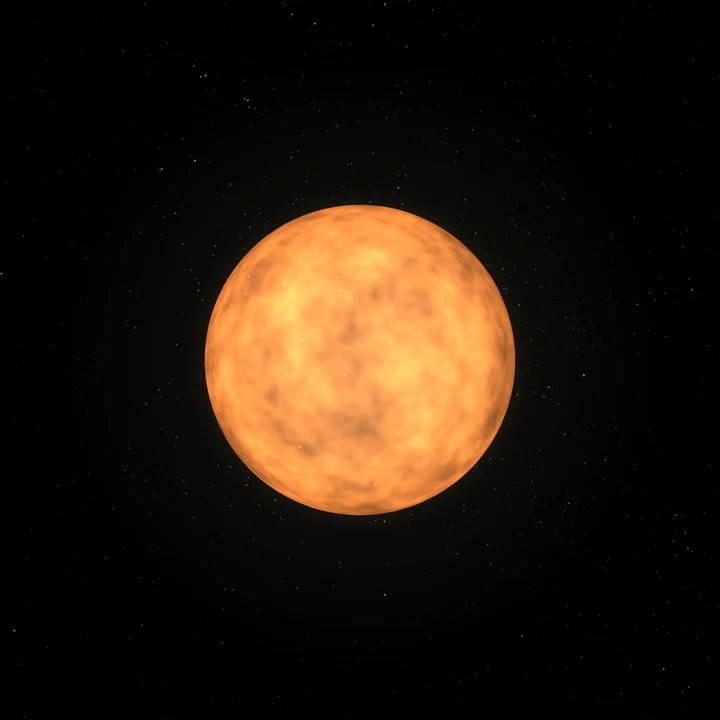
Betelgeuse facts at a glance
- Type: a red supergiant, spectral type M1-M2Ia-Iab, in Orion.
- Distance: 498 light-years (153 parsecs).
- Temperature: 3,654 K (3,381 °C, 6,118 °F) at the surface.
- Size: 83,864 times the Earth's width (770 solar radii).
- Mass: 18 times the Sun's.
- Planets: none known.
Orion's red shoulder
Betelgeuse is the orange-red star at Orion's shoulder, one of the few stars whose colour anyone can see at a glance. It is a red supergiant of type M1-M2Ia-Iab: a star many times the Sun's mass, near the end of a short and extravagant life, swollen so large that put in place of the Sun it would swallow Mercury, Venus, the Earth and Mars and reach out into the asteroid belt.
How large exactly is hard to say, because Betelgeuse has no sharp edge and its distance is uncertain. One careful recent estimate puts its radius at about 770 times the Sun's, some 534,000,000 km, with a surface temperature of about 3,654 kelvin against the Sun's 5,772. It holds perhaps 18 times the Sun's mass and shines tens of thousands of times more brightly than the Sun, most of it in infrared light our eyes cannot see.
Hard to measure
Even its distance is debated. This page uses 498 light-years, from the Hipparcos satellite's parallax, but measuring the tiny yearly shift of a star whose own disc is larger than that shift, and whose blotchy surface keeps moving its centre of light, is difficult. Different methods give answers from about five hundred to more than seven hundred light-years, and every size and brightness figure for the star moves with it.
Betelgeuse was also the first star after the Sun whose size was measured. In 1920 Albert Michelson and Francis Pease fitted an interferometer to the great telescope on Mount Wilson and caught the width of its disc, and in the 1990s the Hubble Space Telescope took the first direct picture of another star's surface, showing a disc with a large bright spot. Modern images show huge convection cells, each far larger than the whole Sun, churning on its surface, and plumes of gas reaching out several times the star's own radius.
The Great Dimming
Betelgeuse is a variable star, slowly brightening and fading on a cycle of a little over a year, with a longer swing of about six years on top. Then, at the end of 2019, it faded as never before. By February 2020 it had lost more than half its light, and Orion's shoulder looked visibly wrong to anyone who knew the constellation. The internet asked whether it was about to explode.
It was not. Observations with Hubble and the Very Large Telescope pieced together what happened: a large bubble of hot gas burst out of the star, cooled as it moved away and condensed into a cloud of dust, which blocked part of the star from our view while a cooler patch on its surface dimmed it further. By the spring Betelgeuse had recovered, and it has since settled back into its usual pattern of flickers.
The six-year swing may have a cause of its own. Some astronomers proposed that a small companion star circles Betelgeuse, stirring the dust around it as it goes, and in 2025 a team using the Gemini North telescope reported a faint possible companion right where it was expected. It is not yet confirmed. No planets are known.
When will it explode?
Betelgeuse is young, only about ten million years old, but a star this heavy lives fast. It has already used up the hydrogen in its core and is now burning helium. When the fuel in its core runs out, the core will collapse and the star will explode as a supernova, probably leaving a neutron star behind. Most models put that moment somewhere in the next hundred thousand years: tomorrow or long after anyone reading this, nobody can say, and no sign so far points to it being soon.
When it happens it will be a sight. For a few months Betelgeuse would shine nearly as brightly as a half Moon, cast shadows at night and be visible in daylight, then fade over months and years until Orion is missing a shoulder. At its distance the explosion poses no danger to the Earth.
In the winter sky
Betelgeuse is easy to find from almost anywhere on Earth: it is the bright orange star at the upper left of Orion as seen from the northern hemisphere, opposite the blue-white Rigel at his foot, and with Sirius and Procyon it forms the Winter Triangle. It is best seen on evenings from December to March. Its name comes from Arabic, where it was "the hand of al-Jawzā'", a figure of the giant now called Orion; a misreading of the Arabic letters by medieval scribes gave us the "B" at its start. English speakers say "BET-el-jooz" or, often, "beetle-juice".
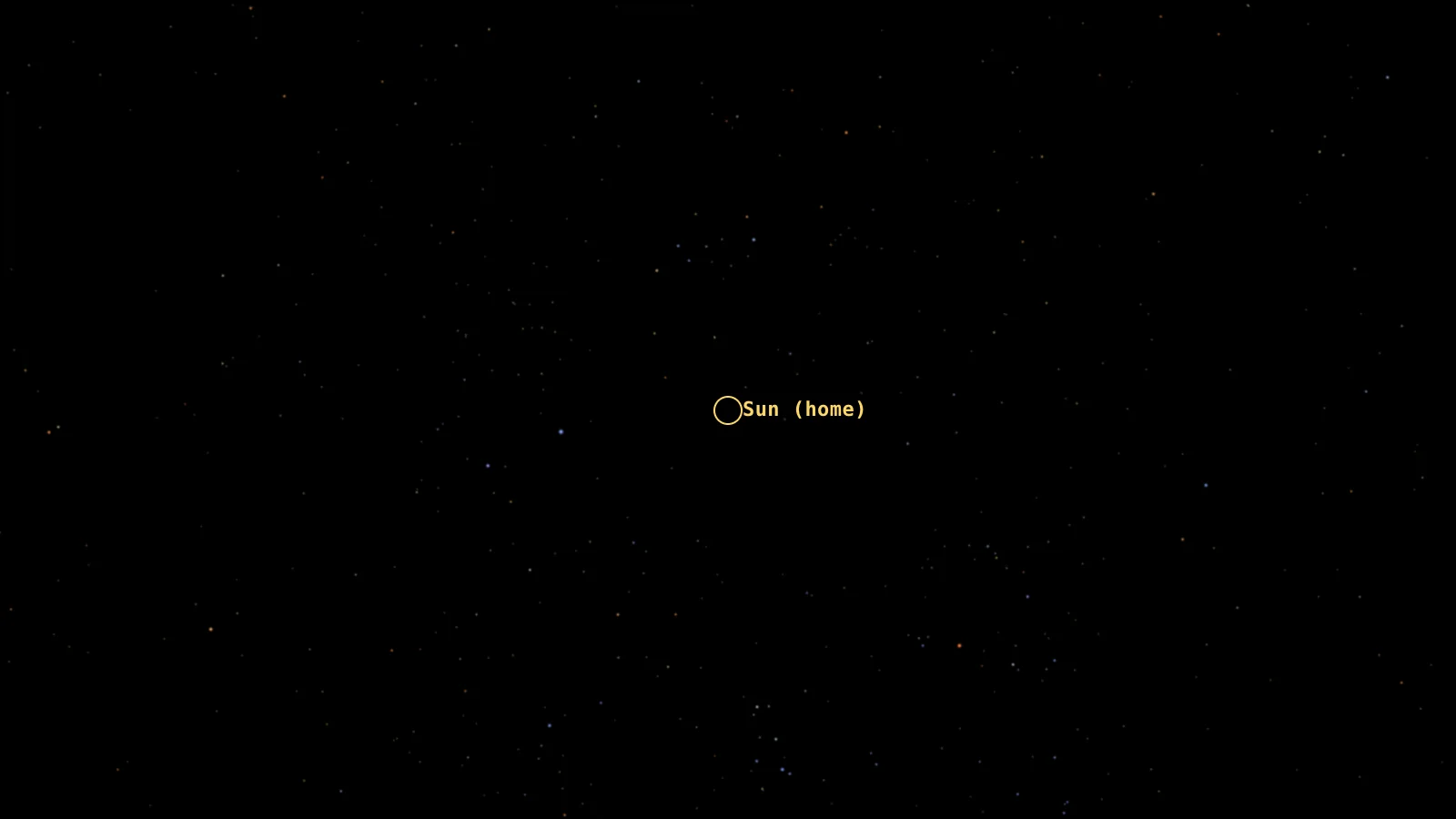
From Betelgeuse itself, the Sun would be far too faint to see without a telescope, one dim point among millions.
Going there
The light you see from Betelgeuse tonight left it about 498 years ago, before the age of telescopes. A ship accelerating at a steady one g for half the journey and braking for the other half would take only 12 years by its crew's clocks, so close to the speed of light would it fly, peaking at 99.99924 % of it, while 500 years went by on Earth.
Light
498 years
The light reaching us now left Betelgeuse in 1528.
At a steady 1 g
12 years aboard
500 years pass on Earth; top speed 99.99924 % of light.
Arriving would be strange. The star would fill an enormous part of the sky as a dim, mottled orange wall, its edge fading into its own dusty wind. A planet warm enough for liquid water would need to orbit between 320 and 610 AU from it, several times farther out than Neptune is from the Sun, and nothing living would have time to evolve there before the star exploded.
Finding Betelgeuse in the night sky
Betelgeuse is in the constellation Orion. At magnitude 0.4 it is one of the brightest stars in the sky, easy to see even from a city.
It stands highest in the evening sky (around 9 pm) in February, and it is well placed in the evening from January to April: winter in the northern hemisphere, summer in the southern.
It never rises south of latitude 83° S; the farther north you are, the higher it climbs.
To find it, start from Sirius (magnitude -1.4): Betelgeuse is 27° to its northwest, about 3 fists at arm's length (a fist held out covers about 10°). It is also 19° northeast of Rigel and 7.5° east of Bellatrix.
Data
Measured values come from the papers cited. The game's estimates are what Solarwind works out from the star catalogue's colour and brightness alone; where the two differ, the measurement is the better value.
| Measured | Game's estimate | ||
|---|---|---|---|
| Distance | — | 498.0 ly · 152.7 pc | from Gaia/Hipparcos parallax |
| Parallax | — | 6.550 mas | |
| Right ascension | — | 5h 55m 10s | J2016 |
| Declination | — | +7° 24′ | |
| Constellation | Orion | — | |
| Spectral type | M1-M2Ia-Iab[1] | M2Ib | |
| Temperature | 3,654 K[2] | 3,794 K | the Sun: 5,772 K |
| Radius | 768 R☉[3] | 508 R☉ | 7,600 × Jupiter |
| Mass | 17.8 M☉[3] | 19.8 M☉ (rough) | 18,653 × Jupiter |
| Luminosity | 95,000 L☉ from the radius and temperature | 48,100 L☉ | |
| Apparent magnitude (V) | 0.4200 [4] | 0.45 | naked-eye limit ≈ 6 |
| Absolute magnitude | — | -5.47 | |
| Habitable zone | — | 320–610 AU | Kopparapu et al. 2014, from the measured temperature |
| Frost line | — | 830 AU | where water freezes |
Nearest stars
- HIP 2812229.3 ly
- HIP 2711164.0 ly
- 38 Ori73.9 ly
- HIP 2669080.6 ly
- HIP 24774103 ly
- HIP 24591112 ly
- HIP 23421127 ly
- HIP 23266133 ly
- HIP 22548139 ly
- HIP 32376139 ly
Quick answers
When will Betelgeuse explode?
Nobody knows. It is near the end of its life and will become a supernova, but most models put that within the next hundred thousand years, not in our lifetimes specifically. The Great Dimming of 2019–2020 was caused by dust, not by an approaching explosion.
How do you pronounce Betelgeuse?
Most English speakers say "BET-el-jooz" or "BEET-el-jooz", and many say "beetle-juice", which is just as accepted. The name comes from Arabic, garbled by centuries of copying.
How old is Betelgeuse?
About ten million years old, by most estimates a little less: a fraction of a per cent of the Sun's age. Massive stars burn their fuel so quickly that it is already near the end of its life.
What constellation is Betelgeuse in?
Orion, the hunter, where it marks his shoulder. It is the constellation's Alpha star, Alpha Orionis, although Rigel is usually a little brighter.
How far away is Betelgeuse?
Betelgeuse is 498 light-years (153 parsecs) from the Sun, so the light you see from it left 498 years ago.
Can you see Betelgeuse with the naked eye?
Yes: at magnitude 0.42 it is visible to the naked eye under a dark sky.
Where is Betelgeuse in the night sky?
In the constellation Orion. It is highest in the evening sky around February and never rises south of latitude 83° S. From Sirius, look 27° to the northwest.
What type of star is Betelgeuse?
A red supergiant of spectral type M1-M2Ia-Iab, with a surface temperature of about 3,654 K (the Sun's is 5,772 K).
How big is Betelgeuse compared with the Sun?
Its radius is 768 times the Sun's, about 530,000,000 km; its mass is 17.8 solar masses, and it is 94,700 times as luminous as the Sun.
How hot is Betelgeuse?
Its surface is about 3,654 K (3,381 °C, 6,118 °F), cooler than the Sun's 5,772 K.
What colour is Betelgeuse?
At 3,654 K its light is orange-red: cooler stars glow redder, hotter ones bluer.
How massive is Betelgeuse?
About 17.8 times the Sun's mass, or 18,653 Jupiters.
How luminous is Betelgeuse?
It is about 94,700 times as luminous as the Sun (94,700 solar luminosities), worked out from its measured radius and temperature.
Is Betelgeuse a main sequence star?
No. Its luminosity class, Ia-Iab, marks a supergiant: a massive star that has used up the hydrogen in its core and left the main sequence.
Will Betelgeuse go supernova?
Yes. At about 18 solar masses it is above the 8 or so a star needs to end in a core-collapse supernova, leaving a neutron star or a black hole. It has already left the main sequence, so on the cosmic clock that is soon, but nobody can predict the date.
What season is Betelgeuse visible in?
In the north it is a winter star: it stands highest in the evening sky in February and is well placed from January to April. In the southern hemisphere those months are summer.
What galaxy is Betelgeuse in?
The Milky Way, our own galaxy: every star you can see without a telescope belongs to it. At 498 light-years Betelgeuse is a close neighbour on the scale of the galaxy, which is about 100,000 light-years across, and it lies in the same spiral arm as the Sun, the Orion Arm.
How long would it take to travel to Betelgeuse?
Light takes 498 years. A ship accelerating at a steady 1 g and braking halfway would arrive after 12 years aboard (500 years on Earth), peaking at 99.99924 % of the speed of light.
Sources
Last updated .
- Source on Wikidata
- Stellar atmospheric parameters for 754 spectra from the X-shooter Spectral Library
- Standing on the Shoulders of Giants: New Mass and Distance Estimates for Betelgeuse through Combined Evolutionary, Asteroseismic, and Hydrodynamic Simulations with MESA
- The HYG Database
Positions and photometry: HYG Database v4.1 (CC BY-SA 4.0) and the Gaia Catalogue of Nearby Stars, ESA/Gaia/DPAC. Planets: the NASA Exoplanet Archive, operated by Caltech under contract with NASA. Identifiers: Wikidata (CC0), Q12124; SIMBAD. Habitable zone: Kopparapu et al. 2014. Text: written with an AI model from the data on this page, checked against the sources.
Also known as: 2MASS J05551028+0724255 · 58 Ori · AAVSO 0549+07 · ADS 4506 AP · AG+07 681 · BD+07 1055 · CCDM J05552+0724AP · FK5 224 · GC 7451 · GCRV 3679 · GEN# +1.00039801 · GSC 00129-01873 · HD 39801 · HIC 27989 · HIP 27989 · HR 2061 · IRAS 05524+0723 · IRC +10100 · JP11 1282 · N30 1266 · PLX 1362 · PLX 1362.00 · PMC 90-93 162 · PPM 149643 · RAFGL 836 · SAO 113271 · SKY# 9804 · TD1 5587 · TIC 269273552 · TYC 129-1873-1 · UBV 21314 · WDS J05552+0724A · WDS J05552+0724Aa,Ab · WDS J05552+0724Aa,Ac · WEB 5485 · YZ 7 2503 · [LFO93] 0552+07 · alf Ori · α Ori