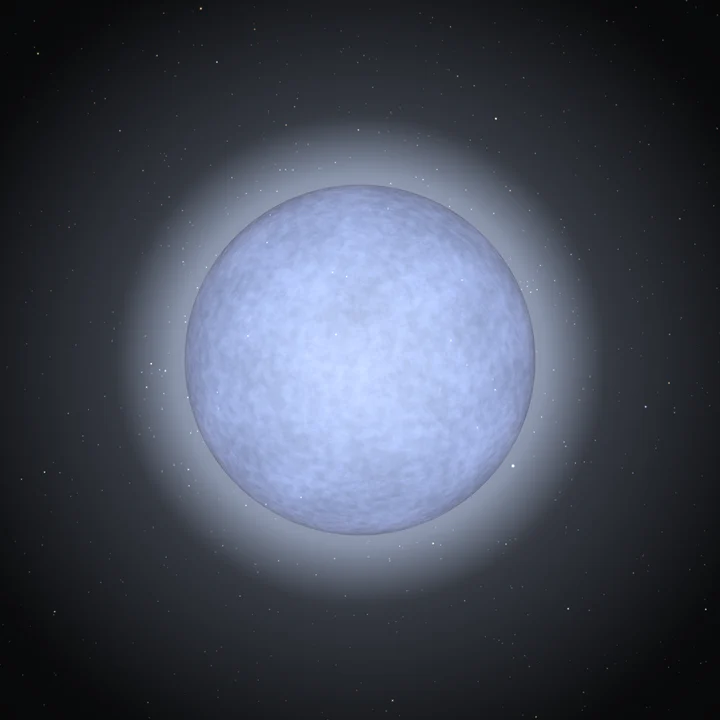
Sirius facts at a glance
- Type: a white star, spectral type A0mA1 Va, in Canis Major.
- Distance: 8.71 light-years (2.67 parsecs).
- Temperature: 9,845 K (9,572 °C, 17,261 °F) at the surface.
- Size: 187 times the Earth's width (1.7 solar radii).
- Mass: 2.1 times the Sun's.
- Planets: none known.
The brightest star in the night sky
Sirius outshines every other star in the night sky. At magnitude −1.46 it is nearly twice as bright as Canopus, the runner-up, and on a clear winter evening it is hard to miss: a fierce white point low in the south for northern observers, flashing red, green and blue as the air near the horizon bends its light. Only the Moon, Venus, Jupiter and sometimes Mars and Mercury are brighter.
It is not an especially powerful star. Sirius looks so bright mainly because it is close: only 8.71 light-years away, one of the Sun's nearest neighbours. It is a hot main-sequence star of type A0mA1 Va, about 2.1 times the Sun's mass and 1.7 times its radius, some 1,190,000 km. Its surface glows at around 9,845 kelvin, against the Sun's 5,772, and it gives out about 25 times as much light.
The Dog Star
Sirius is the brightest star of Canis Major, the Great Dog, which is why it has been called the Dog Star since antiquity. Its name comes from the Greek for "glowing" or "scorching". In ancient Greece its first appearance in the dawn sky came in the hottest weeks of summer, and the heat was blamed on it: the origin of the "dog days". In ancient Egypt, where it was the goddess Sopdet, its return to the dawn sky foretold the yearly flooding of the Nile and marked the start of the year.
The "m" in its class means it is a metallic-line star: its spectrum shows unusually strong lines of iron and other metals. That is probably a surface effect rather than its true make-up. Sirius spins slowly for a star of its kind, and in its calm outer layers some elements sink while others are pushed up by light, painting the surface with a chemistry the interior does not share.
A dead companion
In 1844 Friedrich Bessel noticed that Sirius does not move across the sky in a straight line but weaves gently from side to side, and concluded that an unseen companion was pulling on it. In 1862 the telescope maker Alvan Graham Clark, testing a new lens in Massachusetts, saw it: a faint speck right beside the glare of Sirius. The two orbit each other about once every fifty years.
The companion, Sirius B, turned out to be one of the strangest objects then known. Its light showed it to be hot, yet it was ten thousand times fainter than Sirius, so it had to be tiny. It is a white dwarf: the exposed core of a star that has already lived and died, holding about as much mass as the Sun packed into a ball about the size of the Earth. A teaspoon of its matter would weigh as much as a lorry. It was one of the first white dwarfs whose mass could be weighed from an orbit, and the gravity at its surface was one of the early tests of Einstein's general relativity.
Sirius B was once the bigger of the pair. It started out several times heavier than the Sun, burned through its fuel first, swelled into a red giant and shed its outer layers, all within the few hundred million years the system has existed. Exactly how its original mass fits its present one is still one of the puzzles astronomers are working on. Sirius A will follow the same road, much later. No planets are known around either star.
Finding Sirius
Sirius is easy to find. Follow the three stars of Orion's Belt down and to the left, as seen from the northern hemisphere, and the first brilliant star you reach is Sirius. With Betelgeuse in Orion and Procyon in Canis Minor it forms the Winter Triangle. From the southern hemisphere it rides high in the summer sky. Because it lies south of the celestial equator, it never rises at all from the high Arctic, such as Svalbard or northern Greenland.
Sirius B is much harder: it is lost in the glare of its companion and needs a good telescope, steady air and a time when the two are widely separated in their orbit.
From Sirius, the Sun would be a bright star in the opposite part of the sky from where Sirius appears to us, one of the brighter stars in that sky but nothing special. Procyon, another close neighbour with a white dwarf of its own, would be one of the brightest stars in the sky of Sirius.
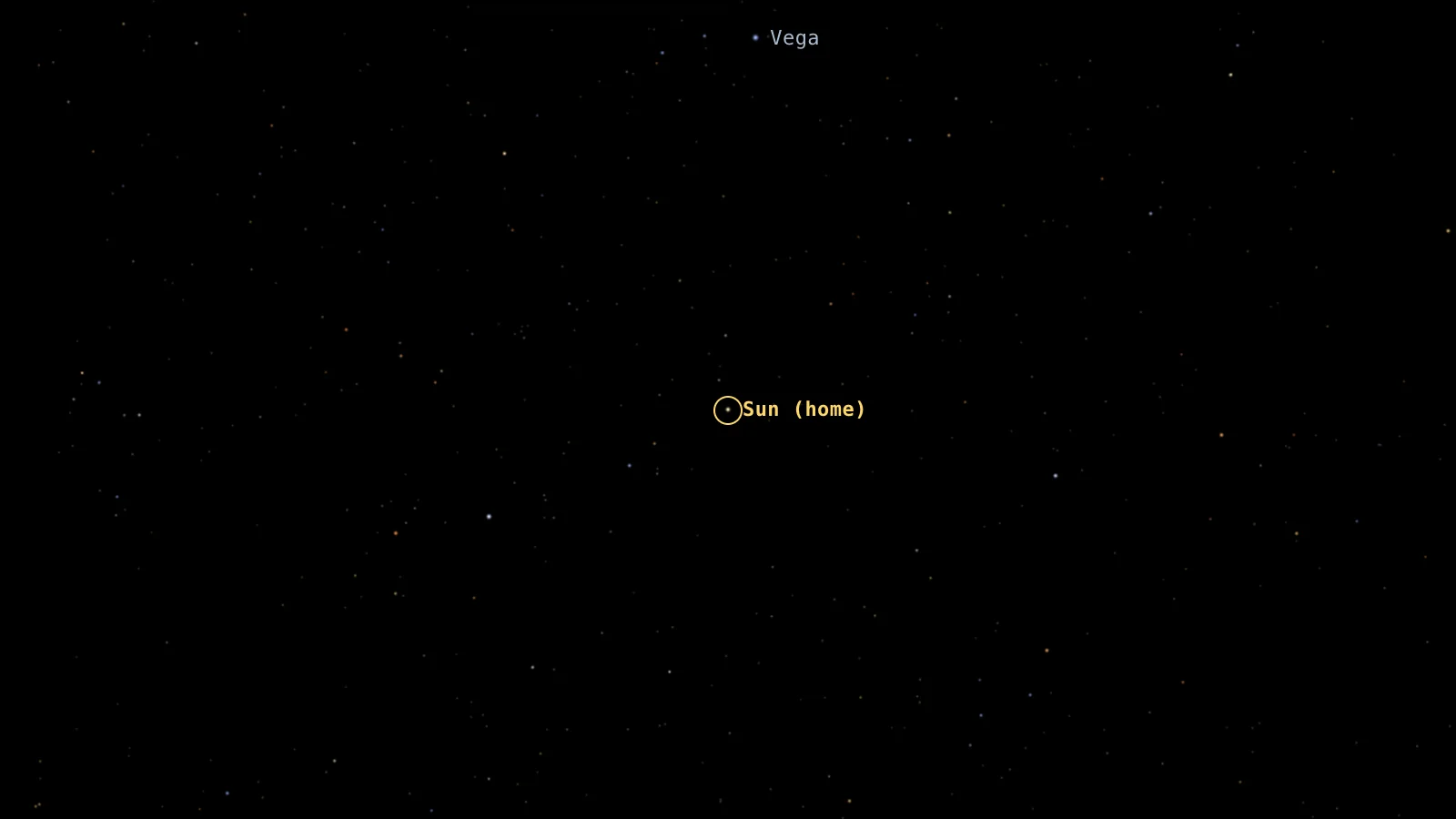
Going there
Sirius is close enough that a voyage is easy to imagine. Its light takes 8.71 years to reach us. A ship accelerating at a steady one g for the first half of the trip and braking for the second would arrive after 4.6 years on board, while 10 years passed on Earth, touching 98.3 % of the speed of light at the midpoint.
Light
8.71 years
The light reaching us now left Sirius in 2017.
At a steady 1 g
4.6 years aboard
10 years pass on Earth; top speed 98.3 % of light.
You would arrive at a white sun far brighter than ours, with a habitable zone, where liquid water could last on a planet's surface, between 4.4 and 7.5 AU from it. Sirius B would be a tiny, intensely bright point, its distance from Sirius swinging between roughly Saturn's distance from the Sun and Neptune's over each orbit, and its gravity would make stable planet orbits possible only close in to either star.
Finding Sirius in the night sky
Sirius is in the constellation Canis Major. At magnitude -1.5 it is one of the brightest stars in the sky, easy to see even from a city.
It stands highest in the evening sky (around 9 pm) in February, and it is well placed in the evening from January to April: winter in the northern hemisphere, summer in the southern.
It never rises north of latitude 73° N; the farther south you are, the higher it climbs.
To find it, start from Rigel (magnitude 0.2): Sirius is 24° to its southeast, about 2 fists at arm's length (a fist held out covers about 10°). It is also 5.5° east of Mirzam and 26° southwest of Procyon.
Data
Measured values come from the papers cited. The game's estimates are what Solarwind works out from the star catalogue's colour and brightness alone; where the two differ, the measurement is the better value.
| Measured | Game's estimate | ||
|---|---|---|---|
| Distance | — | 8.707 ly · 2.670 pc | from Gaia/Hipparcos parallax |
| Parallax | — | 374.6 mas | |
| Right ascension | — | 6h 45m 9s | J2016 |
| Declination | — | −16° 43′ | |
| Constellation | Canis Major | — | |
| Spectral type | A0mA1 Va[1] | A0m | |
| Temperature | 9,845 K[2] | 10,002 K | the Sun: 5,772 K |
| Radius | 1.71 R☉[3] | 1.72 R☉ | 17 × Jupiter |
| Mass | 2.06 M☉[3] | 2.32 M☉ | 2,162 × Jupiter |
| Luminosity | 24.7 L☉[3] | 26.5 L☉ | |
| Apparent magnitude (V) | -1.460 [4] | −1.44 | naked-eye limit ≈ 6 |
| Absolute magnitude | — | 1.43 | |
| Habitable zone | — | 4.4–7.5 AU | Kopparapu et al. 2014, from the measured temperature |
| Frost line | — | 13 AU | where water freezes |
Nearest stars
Quick answers
Is Sirius the North Star?
No. The North Star is Polaris, in Ursa Minor, which stays almost fixed above the north pole. Sirius lies well south of the celestial equator and rises and sets like most stars, best seen on winter evenings in the northern hemisphere.
What constellation is Sirius in?
Canis Major, the Great Dog, which follows Orion across the sky. Sirius is its brightest star, Alpha Canis Majoris.
Why is Sirius called the Dog Star?
Because it is the brightest star of Canis Major, the Great Dog, one of Orion's hunting dogs in Greek myth. Its early-morning rising in the hottest part of the Greek summer gave us the phrase "dog days".
What type of star is Sirius B?
A white dwarf: the hot, Earth-sized core left behind after a star has used up its fuel and shed its outer layers. It has about the mass of the Sun and was one of the first white dwarfs whose mass was measured from an orbit.
How old is Sirius?
A few hundred million years, much younger than the Sun. Its age comes from matching both stars, the white dwarf and its bright companion, to models of how stars evolve.
How far away is Sirius?
Sirius is 8.71 light-years (2.67 parsecs) from the Sun, so the light you see from it left 8.71 years ago. That makes it the 7th nearest star to the Sun.
Can you see Sirius with the naked eye?
Yes: at magnitude −1.46 it is visible to the naked eye under a dark sky.
Where is Sirius in the night sky?
In the constellation Canis Major. It is highest in the evening sky around February and never rises north of latitude 73° N. From Rigel, look 24° to the southeast.
What type of star is Sirius?
A white star of spectral type A0mA1 Va, with a surface temperature of about 9,845 K (the Sun's is 5,772 K).
How big is Sirius compared with the Sun?
Its radius is 1.71 times the Sun's, about 1,200,000 km; its mass is 2.06 solar masses, and it is 24.7 times as luminous as the Sun.
How hot is Sirius?
Its surface is about 9,845 K (9,572 °C, 17,261 °F), hotter than the Sun's 5,772 K.
What colour is Sirius?
At 9,845 K its light is bluish white: cooler stars glow redder, hotter ones bluer.
How massive is Sirius?
About 2.06 times the Sun's mass, or 2,162 Jupiters.
How luminous is Sirius?
It is about 24.7 times as luminous as the Sun (24.7 solar luminosities).
Is Sirius a main sequence star?
Yes. Its luminosity class, V, marks a main-sequence star: like the Sun, it shines by fusing hydrogen into helium in its core.
Will Sirius go supernova?
No. At about 2.1 solar masses it is too light: stars under about 8 solar masses end by shedding their outer layers and leaving a white dwarf.
What season is Sirius visible in?
In the north it is a winter star: it stands highest in the evening sky in February and is well placed from January to April. In the southern hemisphere those months are summer.
What galaxy is Sirius in?
The Milky Way, our own galaxy: every star you can see without a telescope belongs to it. At 8.71 light-years Sirius is a close neighbour on the scale of the galaxy, which is about 100,000 light-years across, and it lies in the same spiral arm as the Sun, the Orion Arm.
How long would it take to travel to Sirius?
Light takes 8.71 years. A ship accelerating at a steady 1 g and braking halfway would arrive after 4.6 years aboard (10 years on Earth), peaking at 98.3 % of the speed of light.
Sources
Last updated .
- Source on Wikidata
- Source on Wikidata
- The Sirius System and Its Astrophysical Puzzles: Hubble Space Telescope and Ground-based Astrometry
- VizieR Online Data Catalog: Stellar Photometry in Johnson's 11-color system (Ducati, 2002)
Positions and photometry: HYG Database v4.1 (CC BY-SA 4.0) and the Gaia Catalogue of Nearby Stars, ESA/Gaia/DPAC. Planets: the NASA Exoplanet Archive, operated by Caltech under contract with NASA. Identifiers: Wikidata (CC0), Q13415844; SIMBAD. Habitable zone: Kopparapu et al. 2014. Text: written with an AI model from the data on this page, checked against the sources.
Also known as: 2MASS J06450887-1642566 · 9 CMa · ADS 5423 A · AKARI-FIS-V1 J0645085-164258 · CCDM J06451-1643A · CEL 1368 · Ci 20 396 · FK5 257 · GC 8833 · GCRV 4392 · GEN# +1.00048915A · GJ 244 A · HD 48915 · HD 48915A · HGAM 556 · HIC 32349 · HIP 32349 · HR 2491 · IDS 06408-1635 A · IRAS 06429-1639 · IRAS S06429-1639 · IRAS S06430-1639 · IRC -20105 · JP11 1425 · LFT 486 · LHS 219 · LPM 243 · LTT 2638 · N30 1470 · NLTT 16953 · NSV 17173 · PLX 1577 · PM 06430-1639A · PMC 90-93 186 · PPM 217626 · RAFGL 1007 · ROT 1088 · Renson 13090 · SAO 151881 · SBC7 288 · SBC9 416 · SKY# 11855 · TD1 8027 · TIC 322899250 · TYC 5949-2777-1 · UBV 6709 · UBV M 12413 · WDS J06451-1643A · WEB 6525 · Zkh 91 · uvby98 100048915 A · α CMa