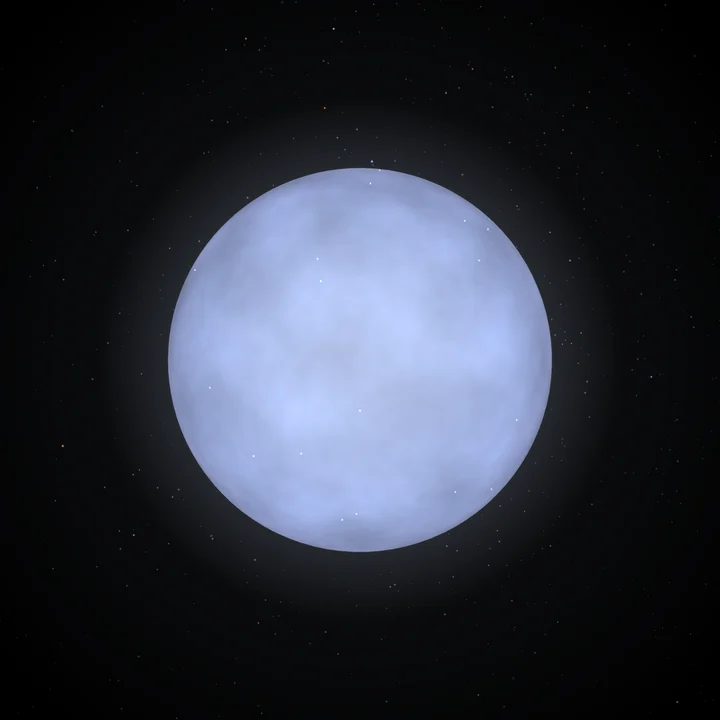
Rigel facts at a glance
- Type: a blue-white supergiant, spectral type B8Ia, in Orion.
- Distance: 863 light-years (265 parsecs).
- Temperature: 12,130 K (11,857 °C, 21,374 °F) at the surface.
- Size: 8,616 times the Earth's width (79 solar radii).
- Mass: 18 times the Sun's.
- Planets: none known.
Orion's blue-white foot
Rigel is the brilliant blue-white star at the foot of Orion, diagonally across the constellation from red Betelgeuse. It is usually the brighter of the two and the seventh brightest star in the night sky, though it is by far the most distant star in that top ten: about 863 light-years, so far that the light you see tonight left it in the Middle Ages.
To look that bright from so far, it has to be extraordinary. Rigel is a blue supergiant of type B8Ia, about 18 times the Sun's mass, with a surface at around 12,130 kelvin against the Sun's 5,772 and a radius of 79 times the Sun's, some 54,900,000 km. Put in the Sun's place it would reach almost to the orbit of Mercury. Its output is tens of thousands of times the Sun's, perhaps more than a hundred thousand: if it were as close as Sirius, it would cast shadows at night.
A star in a hurry
Rigel is only several million years old, yet it is already past the prime of its life. Stars this heavy burn through the hydrogen in their cores in a few million years, and Rigel has left the main sequence, the long steady stage where the Sun now sits. It is now a supergiant, its core contracting and heating up while its outer layers swell.
Where exactly it is in that story is uncertain. It may be swelling on its way to becoming a red supergiant like Betelgeuse, or it may already have been one and be shrinking back again. Either way, its end is not in doubt: when its core runs out of fuel it will collapse, and Rigel will explode as a supernova, leaving a neutron star or perhaps a black hole.
Its surface is restless. Rigel pulsates irregularly by small amounts, the behaviour of the class of supergiants called Alpha Cygni variables, and it blows off a powerful wind of gas. Its light is strong enough to illuminate dust clouds nearby: the faint Witch Head Nebula, a wisp of dust some distance from it in the sky, shines by reflected Rigel light.
Not alone
Rigel has company. A modest telescope shows a faint star just beside it, Rigel B, which large telescopes split into a close pair, Rigel B and Rigel C; Rigel B is itself a spectroscopic binary, two stars too close to separate that betray themselves by the shifting lines in their combined spectrum. Rigel A may have a close companion of its own. The whole system has at least three stars and probably four, though the companions are dwarfed by the supergiant.
The companions orbit far out, at distances many times larger than the Solar System, and take many thousands of years to go round. No planets are known in the system, and the fierce ultraviolet light and short life of the main star would make it a poor place to look for them.
Finding Rigel
Rigel is one of the easiest stars to find, because almost everyone on Earth can see Orion. Northern observers find it at the lower right of the constellation, below the three stars of the Belt; southern observers see Orion upside down and Rigel at the top. It is best seen on evenings from December to March. Because it lies just south of the celestial equator, it can be seen from almost everywhere people live.
Its name comes from the Arabic for "the foot", from a longer phrase naming the foot of the giant now called Orion. Despite being usually the brightest star in Orion, it carries the label Beta Orionis; Betelgeuse took Alpha, perhaps because Betelgeuse varies and sometimes outshines it.
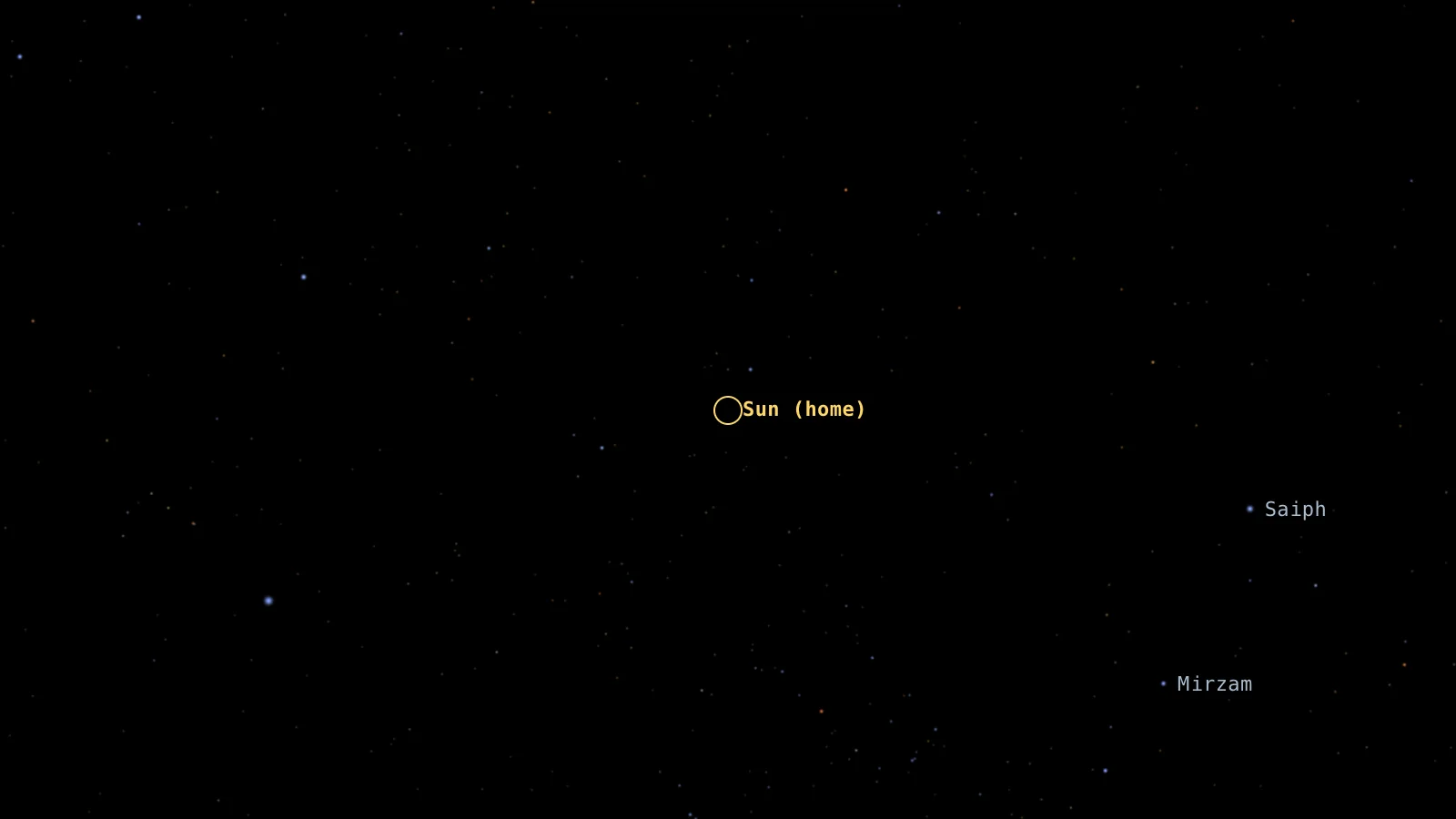
From Rigel the Sun is invisible to the naked eye, a faint dot that only a telescope could find.
Going there
At 863 light-years, a journey to Rigel is a long one by any clock on Earth: 860 years would pass at home. A ship accelerating at a steady one g for half the way and braking for the rest would be travelling at 99.99974 % of the speed of light at the midpoint, and time aboard would slow so much that the crew would age only 13 years.
Light
863 years
The light reaching us now left Rigel in 1163.
At a steady 1 g
13 years aboard
860 years pass on Earth; top speed 99.99974 % of light.
Arriving, you would face a blinding blue-white sun, much of its light in the ultraviolet. A planet warm enough for liquid water would have to orbit between 310 and 530 AU out, several times farther than Neptune is from the Sun, and would still be bathed in harsh radiation. The nearest catalogued star to Rigel, HIP 27604, lies 270 light-years away; in reality Rigel's surroundings are full of fainter stars, too far from us to be catalogued.
Finding Rigel in the night sky
Rigel is in the constellation Orion. At magnitude 0.1 it is one of the brightest stars in the sky, easy to see even from a city.
It stands highest in the evening sky (around 9 pm) in January, and it is well placed in the evening from December to March: winter in the northern hemisphere, summer in the southern.
It never rises north of latitude 82° N; the farther south you are, the higher it climbs.
To find it, start from Sirius (magnitude -1.4): Rigel is 24° to its west, about 2 fists at arm's length (a fist held out covers about 10°). It is also 19° southwest of Betelgeuse and 8.8° southwest of Alnilam.
Data
Measured values come from the papers cited. The game's estimates are what Solarwind works out from the star catalogue's colour and brightness alone; where the two differ, the measurement is the better value.
| Measured | Game's estimate | ||
|---|---|---|---|
| Distance | — | 862.8 ly · 264.6 pc | from Gaia/Hipparcos parallax |
| Parallax | — | 3.780 mas | |
| Right ascension | — | 5h 14m 32s | J2016 |
| Declination | — | −8° 12′ | |
| Constellation | Orion | — | |
| Spectral type | B8Ia[1] | B8Ia | |
| Temperature | 12,130 K[2] | 10,516 K | the Sun: 5,772 K |
| Radius | 78.9 R☉[3] | 76.7 R☉ | 790 × Jupiter |
| Mass | 18.0 M☉[3] | 21.5 M☉ (rough) | 18,863 × Jupiter |
| Luminosity | 120,000 L☉ from the radius and temperature | 64,800 L☉ | |
| Apparent magnitude (V) | 0.1300 [4] | 0.18 | naked-eye limit ≈ 6 |
| Absolute magnitude | — | -6.93 | |
| Habitable zone | — | 310–530 AU | Kopparapu et al. 2014, from the measured temperature |
| Frost line | — | 940 AU | where water freezes |
Nearest stars
- HIP 27604271 ly
- HIP 23057276 ly
- HIP 21000305 ly
- HIP 22689309 ly
- HIP 20831319 ly
- HIP 20169331 ly
- HIP 23287342 ly
- HIP 21453342 ly
- HIP 24774345 ly
- HIP 21906348 ly
Quick answers
Is Rigel a main sequence star?
No. It has used up the hydrogen in its core and left the main sequence, becoming a blue supergiant. It is only a few million years old, but stars of its mass age quickly.
What will happen to Rigel?
It will end as a supernova. When its core runs out of fuel it will collapse, blowing the star apart and leaving behind a neutron star or possibly a black hole, probably within the next few million years.
Is Rigel a binary star?
Yes, and more. Rigel has a faint companion pair, Rigel B and C, visible in a telescope, and Rigel B is itself a close binary, so the system has at least three stars and probably four.
Is Rigel the brightest star?
Not in the whole sky, where it is usually seventh. It is normally the brightest star in Orion, slightly brighter than Betelgeuse, which varies and occasionally overtakes it.
What constellation is Rigel in?
Orion, the hunter, where it marks his left foot. It is labelled Beta Orionis, although it is usually brighter than Alpha, Betelgeuse.
How far away is Rigel?
Rigel is 863 light-years (265 parsecs) from the Sun, so the light you see from it left 863 years ago.
Can you see Rigel with the naked eye?
Yes: at magnitude 0.13 it is visible to the naked eye under a dark sky.
Where is Rigel in the night sky?
In the constellation Orion. It is highest in the evening sky around January and never rises north of latitude 82° N. From Sirius, look 24° to the west.
What type of star is Rigel?
A blue-white supergiant of spectral type B8Ia, with a surface temperature of about 12,130 K (the Sun's is 5,772 K).
How big is Rigel compared with the Sun?
Its radius is 78.9 times the Sun's, about 55,000,000 km; its mass is 18.0 solar masses, and it is 121,000 times as luminous as the Sun.
How hot is Rigel?
Its surface is about 12,130 K (11,857 °C, 21,374 °F), hotter than the Sun's 5,772 K.
What colour is Rigel?
At 12,130 K its light is blue-white: cooler stars glow redder, hotter ones bluer.
How massive is Rigel?
About 18.0 times the Sun's mass, or 18,863 Jupiters.
How luminous is Rigel?
It is about 121,000 times as luminous as the Sun (121,000 solar luminosities), worked out from its measured radius and temperature.
Will Rigel go supernova?
Yes. At about 18 solar masses it is above the 8 or so a star needs to end in a core-collapse supernova, leaving a neutron star or a black hole. It has already left the main sequence, so on the cosmic clock that is soon, but nobody can predict the date.
What season is Rigel visible in?
In the north it is a winter star: it stands highest in the evening sky in January and is well placed from December to March. In the southern hemisphere those months are summer.
What galaxy is Rigel in?
The Milky Way, our own galaxy: every star you can see without a telescope belongs to it. At 863 light-years Rigel is a close neighbour on the scale of the galaxy, which is about 100,000 light-years across, and it lies in the same spiral arm as the Sun, the Orion Arm.
How long would it take to travel to Rigel?
Light takes 863 years. A ship accelerating at a steady 1 g and braking halfway would arrive after 13 years aboard (860 years on Earth), peaking at 99.99974 % of the speed of light.
Sources
Last updated .
- Rotational velocities and spectral types for a sample of binary systems
- Fundamental parameters of B supergiants from the BCD system. I. Calibration of the (λ_1, D) parameters into Teff
- Wikipedia, via Wikidata
- The HYG Database
Positions and photometry: HYG Database v4.1 (CC BY-SA 4.0) and the Gaia Catalogue of Nearby Stars, ESA/Gaia/DPAC. Planets: the NASA Exoplanet Archive, operated by Caltech under contract with NASA. Identifiers: Wikidata (CC0), Q12126; SIMBAD. Habitable zone: Kopparapu et al. 2014. Text: written with an AI model from the data on this page, checked against the sources.
Also known as: 19 Ori · 1RXS J051431.5-081112 · 2MASS J05143226-0812060 · AAVSO 0509-08 · ADS 3823 A · ALS 14772 · CCDM J05145-0812A · CEL 579 · CSV 100463 · EUVE J0514-08.1 · FK5 194 · GC 6410 · GCRV 3110 · GSC 05331-01752 · HD 34085 · HGAM 376 · HIC 24436 · HIP 24436 · HR 1713 · IDS 05097-0819 A · IRAS 05121-0815 · IRC -10085 · JP11 1014 · N30 1120 · NSV 1882 · PLX 1191 · PLX 1191.00 · PMC 90-93 140 · PMSC 05097-0819A · PPM 187839 · RAFGL 710 · ROT 749 · SACS 113 · SAO 131907 · SKY# 8263 · TD1 4253 · TIC 231308237 · TYC 5331-1752-1 · UBV 5016 · UBV M 10750 · VDB 36 · WDS J05145-0812A · WEB 4731 · bet Ori · uvby98 100034085 · β Ori