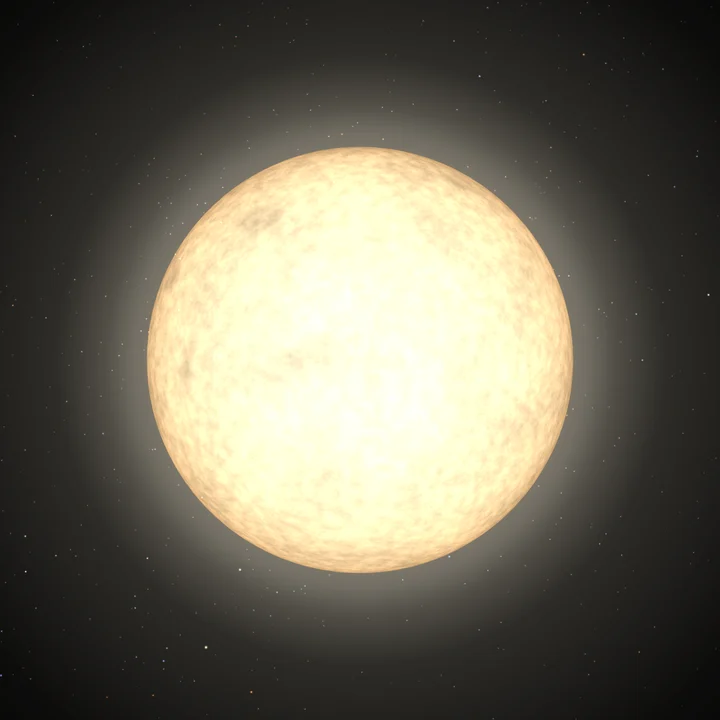
Sun facts at a glance
- A star: the Sun is a yellow dwarf (G2 V), not a planet, at the centre of the Solar System.
- Distance: 149.6 million km (1 AU); sunlight takes 8.3 minutes to reach the Earth.
- Temperature: 5,772 K (5,499 °C, 9,930 °F) at the surface, about 15.7 million K in the core.
- Size: 109 times the Earth's width (1.0 solar radii).
- Mass: 333,000 Earths, 99.8 % of the Solar System's mass.
- Age: about 4.6 billion years.
- Planets: eight, Earth and Mars in the habitable zone.
Our star
The Sun is the one star we know up close, and the starting point of astronomy. Its light, 8.3 minutes old when it reaches you, warms the Earth, drives its weather and feeds nearly every living thing on it. Seen from the neighbouring stars it is nothing special: a single yellow-white point among thousands. Seen from here it is magnitude −26.74, so bright that it turns the whole sky blue and hides every other star.
It is a ball of hot gas about 109 times as wide as the Earth, some 696,000 km in radius, and it holds about 333,000 times the Earth's mass: almost all of the matter in the Solar System. The units astronomers use to weigh and measure other stars, the solar radius, mass and luminosity, are defined by it.
An ordinary star, as stars go
Astronomers classify the Sun as G2 V: a main-sequence star in the middle of its working life, steadily fusing hydrogen into helium by nuclear fusion. Its visible surface, the photosphere, glows at 5,772 kelvin. It is often called a yellow dwarf, but its light is white; it looks yellow only because the Earth's air scatters away some of the blue, which is also why the sky is blue.
Most stars in the galaxy are smaller, cooler red dwarfs such as Proxima Centauri, so the Sun is brighter and heavier than the typical star. It is also alone: many stars of its kind have a companion, and the Sun has none.
The furnace at the centre
In the Sun's core the temperature is around fifteen million kelvin and the pressure crushing enough to force hydrogen nuclei together into helium. Every second it converts hundreds of millions of tonnes of hydrogen this way, and the tiny difference in mass becomes the energy that eventually leaves its surface as sunlight.
That energy takes its time. Light made in the core is absorbed and re-emitted countless times as it works its way out, and the journey through the Sun's dense interior takes tens of thousands of years or more. Near the surface the heat is carried by boiling convection instead, which is why the visible surface is covered in a shifting pattern of bright granules.
Wind, spots and storms
The Sun is never still. Its tangled magnetic field throws up dark sunspots, solar flares and coronal mass ejections, great clouds of plasma, waxing and waning over the solar cycle of about eleven years. Its outer atmosphere, the corona, is far hotter than the surface beneath it, and it blows off into space as the solar wind: a stream of charged particles that flows past every planet at a few hundred kilometres a second, shapes comet tails and lights up the Earth's auroras.
A family of eight planets
Eight planets orbit the Sun: the rocky Mercury, Venus, Earth and Mars, then the giants Jupiter, Saturn, Uranus and Neptune, with the asteroid belt between the two groups and the icy Kuiper belt beyond. The Earth goes round in 365 days at 1.00 AU, inside the Sun's habitable zone (0.95 to 1.7 AU), the range where a planet like ours can keep liquid water on its surface.
| Body | Kind | Orbit, AU | Year, days | Mass, Earths | Temp., K |
|---|---|---|---|---|---|
| Mercury known | Rocky planet | 0.387 | 87.9 | 0.055 | 445 |
| Venus known | Rocky planet | 0.723 | 225 | 0.82 | 326 |
| Earth known | Rocky planet habitable zone | 1.00 | 365 | 1.0 | 277 |
| Mars known | Rocky planet habitable zone | 1.52 | 687 | 0.11 | 224 |
| Main belt known | Asteroid belt | 2.1–3.3 | — | — | 171 |
| Jupiter known | Gas giant | 5.20 | 4,330 | 320 | 121 |
| Saturn known | Gas giant | 9.54 | 10,800 | 95 | 90 |
| Uranus known | Ice giant | 19.2 | 30,700 | 15 | 63 |
| Neptune known | Ice giant | 30.1 | 60,200 | 17 | 51 |
| Kuiper belt known | Icy belt | 30–50 | — | — | 45 |
Past and future
The Sun formed about 4.6 billion years ago from a collapsing cloud of gas and dust, the same cloud that made its planets; the oldest grains in meteorites date that moment. It is roughly halfway through its time on the main sequence and slowly brightening as it goes.
In about five billion years it will run out of hydrogen in its core and swell into a red giant, swallowing Mercury and Venus and perhaps the Earth. It will then shed its outer layers as a glowing nebula and shrink to a white dwarf, a cooling ember about the size of the Earth.
Our star from afar
From the nearest stars the Sun is just one of the brighter points in the sky. From Proxima Centauri, 4.2 light-years away, it would shine as a moderately bright star in the constellation Cassiopeia, adding a sixth star to the familiar W.
Light
8.3 minutes
Sunlight reaching you now left the Sun 8.3 minutes ago; from Proxima Centauri, its light takes 4.24 years.
To Proxima Centauri at a steady 1 g
3.5 years aboard
5.9 years pass on Earth; top speed 94.9 % of light.
Data
Measured values come from the papers cited. The game's estimates are what Solarwind works out from the star catalogue's colour and brightness alone; where the two differ, the measurement is the better value.
| Measured | Game's estimate | ||
|---|---|---|---|
| Distance | — | 1 AU · 8.32 light-minutes | from the Earth, on average |
| Spectral type | G2 V[1] | G2V | |
| Temperature | 5,772 K[2] | 5,742 K | the Sun: 5,772 K |
| Radius | 1.00 R☉[2] | 1.000 R☉ | 10.0 × Jupiter |
| Mass | 1.00 M☉[2] | 0.995 M☉ | 1,048 × Jupiter |
| Luminosity | 1.00 L☉[2] | 0.979 L☉ | |
| Apparent magnitude (V) | -26.74 [1] | −26.72 | naked-eye limit ≈ 6 |
| Absolute magnitude | — | 4.85 | |
| Habitable zone | — | 0.95–1.7 AU | Kopparapu et al. 2014, from the measured temperature |
| Frost line | — | 2.7 AU | where water freezes |
Nearest stars
- Proxima Centauri4.24 ly
- Alpha Centauri B4.32 ly
- Alpha Centauri4.32 ly
- Barnard's Star6.00 ly
- Wolf 3597.86 ly
- Lalande 211858.32 ly
- Sirius8.71 ly
- Gliese 244B8.71 ly
- Gliese 65A8.71 ly
- Gliese 65B8.87 ly
Quick answers
Is the Sun a star or a planet?
A star. A planet shines by reflected light and orbits a star; the Sun makes its own light by nuclear fusion and the planets orbit it. It is a G2 V main-sequence star, the same kind of object as the stars in the night sky.
Is there a star bigger than the Sun?
Many. Most stars are smaller than the Sun, but giants and supergiants dwarf it: Betelgeuse, a red supergiant, is hundreds of times wider. Among the stars within a few light-years of us, though, the Sun is one of the largest.
Is the Sun a main-sequence star?
Yes: it has been fusing hydrogen into helium in its core for about 4.6 billion years and will keep doing so for roughly five billion more.
How hot is the Sun?
Its visible surface, the photosphere, is 5,772 K (5,499 °C, 9,930 °F). The core, where nuclear fusion turns hydrogen into helium, is about 15.7 million K, and the thin outer atmosphere, the corona, reaches one to two million K.
What colour is the Sun?
White. Its light peaks in the green but mixes to white; it looks yellow, orange or red near the horizon only because the Earth's air scatters away the blue.
How long does sunlight take to reach the Earth?
About 8.3 minutes (499 seconds), travelling one astronomical unit at the speed of light.
When will the Sun die?
In about five billion years it will run out of hydrogen in its core, swell into a red giant, then shed its outer layers and end as a white dwarf. It is too small to explode as a supernova.
How far away is the Sun?
On average one astronomical unit, about 149.6 million km. Its light takes 8.3 minutes to reach the Earth.
Can you look at the Sun?
Never directly, and never through binoculars or a telescope without a proper solar filter: at magnitude −26.74 it is billions of times brighter than any other star and can damage your eyes in seconds.
What type of star is the Sun?
A yellow dwarf of spectral type G2 V: a main-sequence star fusing hydrogen into helium in its core, with a surface temperature of 5,772 K. Its light is white; it looks yellow through the Earth's air.
How big is the Sun compared with the Earth?
Its radius, about 695,700 km, is 109 times the Earth's, and it holds about 333,000 times the Earth's mass: over 99.8 % of all the mass in the Solar System.
How old is the Sun?
About 4.6 billion years, dated from the oldest solids in meteorites. It is roughly halfway through its life on the main sequence.
How many planets does the Sun have?
Eight: Mercury, Venus, Earth, Mars, Jupiter, Saturn, Uranus, Neptune. Earth and Mars lie in its habitable zone (0.95–1.7 AU).
What is the nearest star to the Sun?
Proxima Centauri, 4.24 light-years away. A ship accelerating at a steady 1 g and braking halfway would take 3.5 years aboard to get there.
Sources
Last updated .
Positions and photometry: HYG Database v4.1 (CC BY-SA 4.0) and the Gaia Catalogue of Nearby Stars, ESA/Gaia/DPAC. Planets: the NASA Exoplanet Archive, operated by Caltech under contract with NASA. Identifiers: Wikidata (CC0), Q525. Habitable zone: Kopparapu et al. 2014. Text: written with an AI model from the data on this page, checked against the sources.
Also known as: Sol · Helios