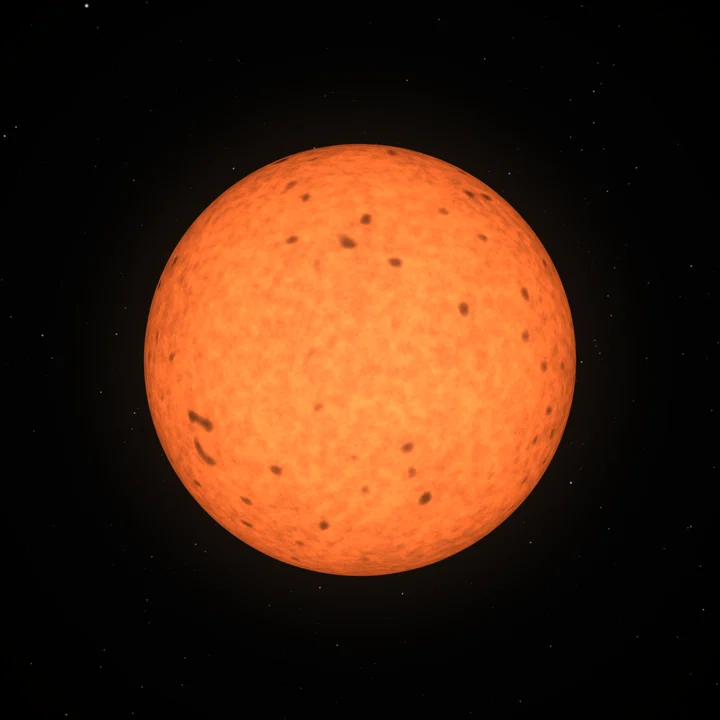
Barnard's Star facts at a glance
- Type: a red dwarf, spectral type M3.5-4 V, in Ophiuchus.
- Distance: 6.00 light-years (1.84 parsecs).
- Temperature: 3,195 K (2,922 °C, 5,291 °F) at the surface.
- Size: 20 times the Earth's width (0.19 solar radii).
- Mass: 0.16 times the Sun's.
- Age: about 8.5 billion years.
- Planets: four.
The runaway star
Barnard's Star is the fastest-moving star in our sky. All stars drift slowly against one another, but most so slowly that the constellations look the same for thousands of years. Barnard's Star crosses the width of the full Moon in under two centuries, and a patient photographer can see it shift from one year to the next.
It is also one of our closest neighbours, 6.00 light-years away. Only the three stars of the Alpha Centauri system are nearer, which makes Barnard's Star the closest single star to the Sun and the nearest star of any kind in the northern half of the sky. Even so, at magnitude 9.54 it is far too faint to see without a telescope.
A small, old red dwarf
Barnard's Star is a red dwarf of type M3.5-4 V: a small, cool star about 0.19 times the Sun's width, some 129,000 km in radius, only about 1.8 times as wide as Jupiter. It has about 0.16 times the Sun's mass, and its surface glows at around 3,195 kelvin against the Sun's 5,772. It gives out only 0.36 % of the Sun's light, most of it as infrared.
It is also old, probably older than the Sun and perhaps nearly twice its age. It is poor in heavy elements, spins slowly, and is mostly quiet, though it still lets off the occasional flare. Its speed is a clue to its age: it is not moving with the young stars of the galaxy's disc but passing through our neighbourhood on an orbit of its own.
Found by its motion
The American astronomer Edward Emerson Barnard noticed the star in 1916 by comparing photographs taken more than twenty years apart: a faint star in Ophiuchus had moved farther than any star then known. Its sideways motion turned out to be matched by a fast approach. Barnard's Star is heading towards us, and around the year 11,800 it is expected to pass closest, briefly becoming the nearest star to the Sun before it recedes again.
Barnard's Star also has a cautionary place in the history of planet hunting. In the 1960s the Dutch-American astronomer Peter van de Kamp announced that the star's position wobbled because of one or two giant planets. The wobble was later traced to changes in his telescope, and the planets did not exist. A super-Earth announced in 2018 met a similar fate when later data showed the signal came from the star itself.
Four small worlds
The real planets turned up in the end, and they are small. In 2024 a team using the ESPRESSO spectrograph on the Very Large Telescope found Barnard b, which goes round the star every 3.15 days at only 0.0229 AU. In 2025 another team, using the MAROON-X spectrograph in Hawaii, confirmed it and found three more: Barnard d, c and e, with years of 2.34, 4.12 and 6.74 days.
They are among the lightest planets ever found by the wobble they cause in their star. Their minimum masses run from 0.19 to 0.34 times the Earth's, so these are probably rocky worlds smaller than the Earth, somewhere between Mars and Venus in size. All four orbit far closer to their star than Mercury does to the Sun.
| Body | Kind | Orbit, AU | Year, days | Mass, Earths | Temp., K |
|---|---|---|---|---|---|
| Barnard d confirmed | Rocky planet | 0.0188 | 2.340[3] | ≥ 0.263[3] | 507 |
| Barnard b confirmed | Rocky planet | 0.0229 | 3.154[3] | ≥ 0.299[3] | 459 |
| Barnard c confirmed | Rocky planet | 0.0274 | 4.124[3] | ≥ 0.335[3] | 420 |
| Barnard e confirmed | Rocky planet | 0.0381 | 6.739[3] | ≥ 0.193[3] | 356 |
| Barnard's Star outer belt game-made | Icy belt | 0.25–0.41 | — | — | 122 |
None of them is likely to be habitable. The habitable zone of Barnard's Star lies from 0.062 to 0.12 AU, and all four planets orbit inside its inner edge. Even the outermost, Barnard e, receives about 2.4 times the starlight the Earth does, enough to heat it to roughly 340 kelvin, and the innermost, Barnard d, about 483 kelvin. Whether there are cooler planets farther out is not yet known.
Finding it in the sky
Barnard's Star lies in Ophiuchus, the Serpent Bearer, a few degrees from the star Beta Ophiuchi, close to the celestial equator and so reachable from almost anywhere on Earth. It is best seen on summer evenings in the northern hemisphere. Ordinary binoculars struggle to show it, but a small telescope will, as a faint orange-red point.
Because it moves so fast, star charts more than a few decades old put it in the wrong place. Amateur astronomers like to photograph it a few years apart and watch it march past the background stars.
A trip to the nearest single star
Barnard's Star was the target of Project Daedalus, a design study by the British Interplanetary Society in the 1970s for an uncrewed fusion-powered probe that would fly past it within a human lifetime. A ship that could accelerate at a steady one g for half the way and brake for the other half would arrive after 4.0 years aboard, while 7.7 years passed on Earth, touching 96.9 % of the speed of light.
Light
6.00 years
The light reaching us now left Barnard's Star in 2020.
At a steady 1 g
4.0 years aboard
7.7 years pass on Earth; top speed 96.9 % of light.
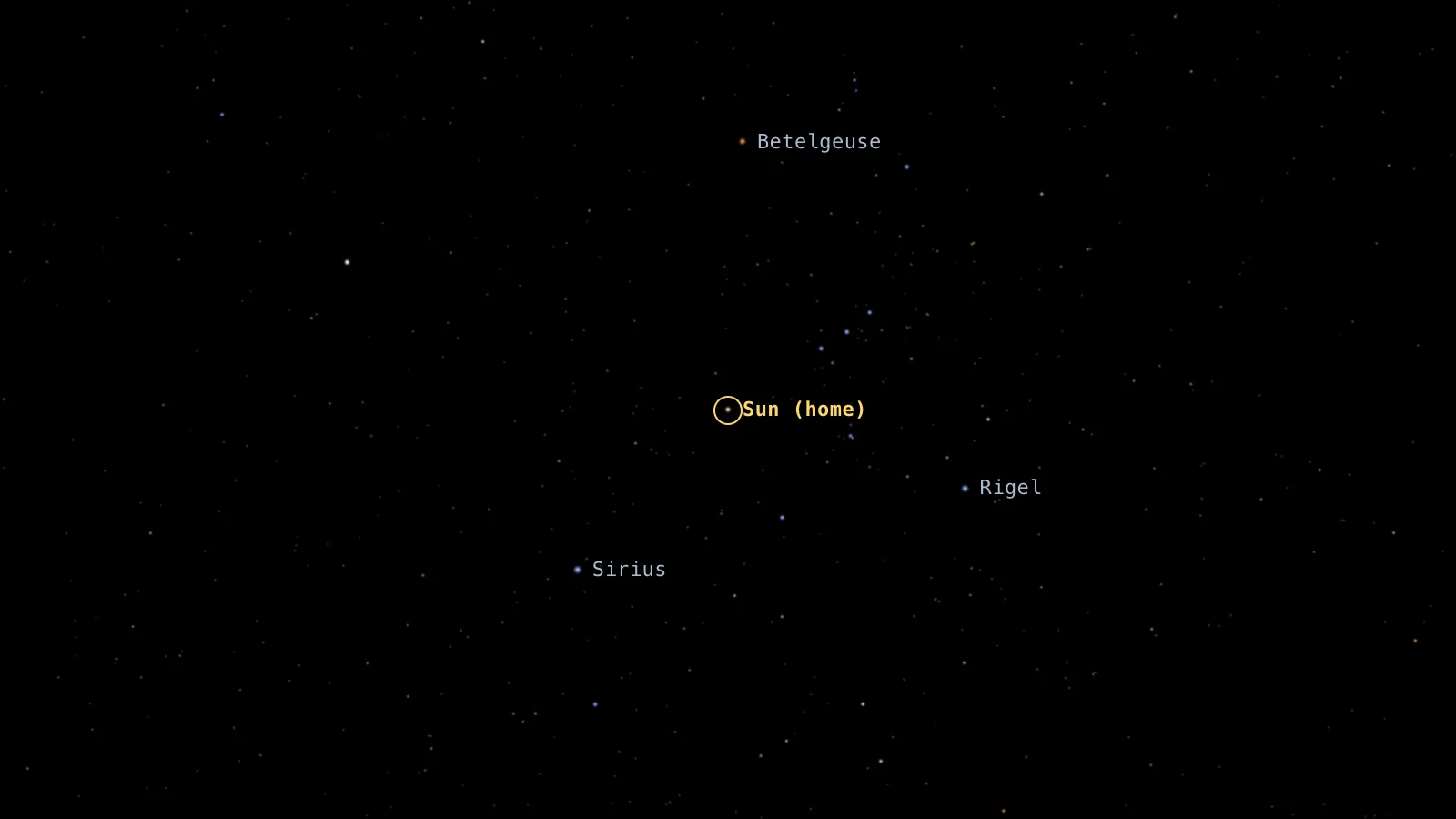
From a planet there the star would hang huge and dim, a dull red disc, and the Sun would be one of the brighter stars in the sky, on the far side from Ophiuchus, near Orion. Its nearest neighbour is the red dwarf Ross 154, about 5.5 light-years away.
Finding Barnard's Star in the night sky
Barnard's Star is in the constellation Ophiuchus. At magnitude 9.5 it is too faint for the naked eye or binoculars: a telescope of about 5 cm aperture shows it.
It stands highest in the evening sky (around 9 pm) in August, and it is well placed in the evening from July to October: summer in the northern hemisphere, winter in the southern.
It never rises south of latitude 85° S; the farther north you are, the higher it climbs.
To find it, start from Rasalhague (magnitude 2.1): Barnard's Star is 9.6° to its southeast, about one fist at arm's length (a fist held out covers about 10°). It is also 28° west of Altair.
Data
Measured values come from the papers cited. The game's estimates are what Solarwind works out from the star catalogue's colour and brightness alone; where the two differ, the measurement is the better value.
| Measured | Game's estimate | ||
|---|---|---|---|
| Distance | — | 6.001 ly · 1.840 pc | from Gaia/Hipparcos parallax |
| Parallax | — | 543.5 mas | |
| Right ascension | — | 17h 57m 48s | J2016 |
| Declination | — | +4° 44′ | |
| Constellation | Ophiuchus | — | |
| Spectral type | M3.5-4 V[1] | sdM4 | |
| Temperature | 3,195 ± 28 K[1] | 3,210 K | the Sun: 5,772 K |
| Radius | 0.185 ± 0.0060 R☉[1] | 0.201 R☉ | 1.8 × Jupiter |
| Mass | 0.162 ± 0.0070 M☉[1] | 0.169 M☉ | 170 × Jupiter |
| Luminosity | 0.00355 L☉[1] | 0.00387 L☉ | |
| Apparent magnitude (V) | 9.540 [2] | 9.54 | naked-eye limit ≈ 6 |
| Absolute magnitude | — | 13.2 | |
| Habitable zone | — | 0.062–0.12 AU | Kopparapu et al. 2014, from the measured temperature |
| Frost line | — | 0.16 AU | where water freezes |
Nearest stars
- Ross 1545.55 ly
- Sun6.00 ly
- Alpha Centauri6.49 ly
- Alpha Centauri B6.49 ly
- Proxima Centauri6.59 ly
- Wolf 10619.25 ly
- 61 Cyg9.33 ly
- Struve 2398 A9.43 ly
- Struve 2398 B9.48 ly
Quick answers
How many planets does Barnard's Star have?
Four confirmed: Barnard b, found in 2024, and Barnard c, d and e, found in 2025. All are smaller than the Earth and orbit very close to the star, with years of only a few days.
Is Barnard's Star moving towards Earth?
Yes. It is approaching the Sun fast, and around the year 11,800 it is expected to pass closest and briefly become the nearest star to us. After that it will move away again.
Does Barnard's Star have habitable planets?
Not as far as we know. All four known planets orbit inside the inner edge of the habitable zone and are too hot for liquid water on their surfaces. Cooler planets farther out have not been ruled out, but none has been found.
How old is Barnard's Star?
Older than the Sun, probably by several billion years. Its slow spin, weak activity, lack of heavy elements and fast orbit through the galaxy all point to a star that formed early in the galaxy's history, though the exact age is uncertain.
When was Barnard's Star discovered?
It was catalogued as a faint star earlier, but in 1916 Edward Emerson Barnard found that it moved faster across the sky than any other known star, and it has carried his name ever since.
How far away is Barnard's Star?
Barnard's Star is 6.00 light-years (1.84 parsecs) from the Sun, so the light you see from it left 6.00 years ago. That makes it the 4th nearest star to the Sun.
Can you see Barnard's Star with the naked eye?
No. At magnitude 9.54 it is about 26 times too faint for the naked eye; a telescope of about 5 cm aperture shows it.
Where is Barnard's Star in the night sky?
In the constellation Ophiuchus. It is highest in the evening sky around August and never rises south of latitude 85° S. From Rasalhague, look 9.6° to the southeast.
What type of star is Barnard's Star?
A red dwarf of spectral type M3.5-4 V, with a surface temperature of about 3,195 K (the Sun's is 5,772 K).
How big is Barnard's Star compared with the Sun?
Its radius is 0.185 times the Sun's, about 130,000 km, or 1.8 times Jupiter's; its mass is 0.162 solar masses, and it gives off 0.36 % of the Sun's light.
How hot is Barnard's Star?
Its surface is about 3,195 K (2,922 °C, 5,291 °F), cooler than the Sun's 5,772 K.
What colour is Barnard's Star?
At 3,195 K its light is orange-red: cooler stars glow redder, hotter ones bluer.
How massive is Barnard's Star?
About 0.162 times the Sun's mass, or 170 Jupiters.
How luminous is Barnard's Star?
It gives off 0.36 % of the Sun's light (0.00355 solar luminosities).
Is Barnard's Star a main sequence star?
Yes. Its luminosity class, V, marks a main-sequence star: like the Sun, it shines by fusing hydrogen into helium in its core.
Will Barnard's Star go supernova?
No. At about 0.16 solar masses it is too light: stars under about 8 solar masses end by shedding their outer layers and leaving a white dwarf.
What season is Barnard's Star visible in?
In the north it is a summer star: it stands highest in the evening sky in August and is well placed from July to October. In the southern hemisphere those months are winter.
What galaxy is Barnard's Star in?
The Milky Way, our own galaxy: every star you can see without a telescope belongs to it. At 6.00 light-years Barnard's Star is a close neighbour on the scale of the galaxy, which is about 100,000 light-years across, and it lies in the same spiral arm as the Sun, the Orion Arm.
Does Barnard's Star have planets?
Yes: four confirmed planets, Barnard d (0.019 AU, a year of 2.34 days) and Barnard b (0.023 AU, a year of 3.15 days) and Barnard c (0.027 AU, a year of 4.12 days) and Barnard e (0.038 AU, a year of 6.74 days).
How long would it take to travel to Barnard's Star?
Light takes 6.00 years. A ship accelerating at a steady 1 g and braking halfway would arrive after 4.0 years aboard (7.7 years on Earth), peaking at 96.9 % of the speed of light.
Sources
Last updated .
Positions and photometry: HYG Database v4.1 (CC BY-SA 4.0) and the Gaia Catalogue of Nearby Stars, ESA/Gaia/DPAC. Planets: the NASA Exoplanet Archive, operated by Caltech under contract with NASA. Identifiers: Wikidata (CC0), Q14268; SIMBAD. Habitable zone: Kopparapu et al. 2014. Text: written with an AI model from the data on this page, checked against the sources.
Also known as: 2MASS J17574849+0441405 · AC2000 146626 · ASCC 1153178 · BD+04 3561a · CCDM J17578+0441A · CSI+04-17554 · CSV 7737 · Ci 20 1069 · GCRV 10392 · GJ 699 · GSC 00425-00184 · GSC 00425-02502 · Gaia DR2 4472832130942575872 · HIC 87937 · HIP 87937 · IRAS 17553+0438 · JP11 18 · Karmn J17578+046 · LFT 1385 · LHS 57 · LSPM J1757+0441 · LTT 15309 · NLTT 45718 · NSV 9910 · PLX 4098 · PLX 4098.00 · PM J17578+0441N · TYC 425-2502-1 · UBV 15269 · UCAC2 33428712 · UCAC4 474-068224 · WEB 14849 · Zkh 269 · uvby98 000403561