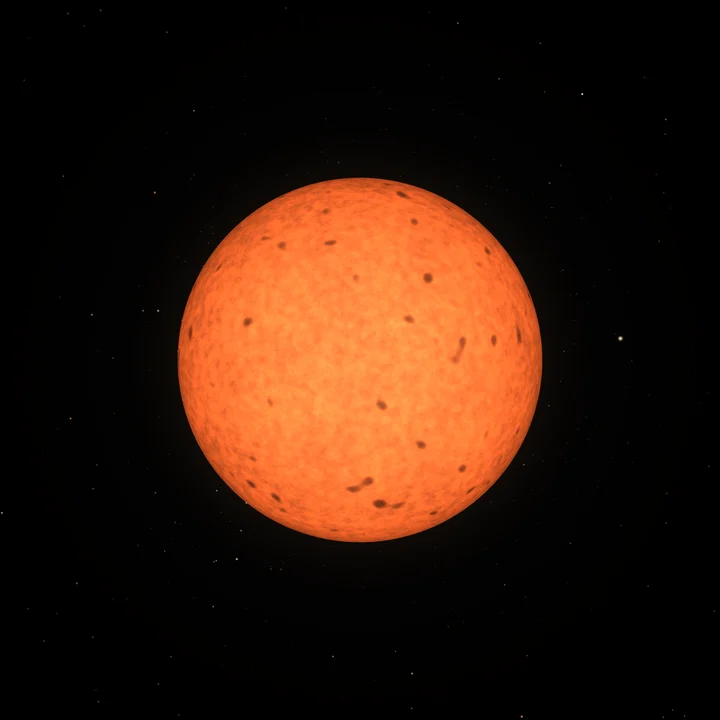
Proxima Centauri facts at a glance
- Type: a red dwarf, spectral type M5.5 V, in Centaurus.
- Distance: 4.24 light-years (1.30 parsecs), the nearest star to the Sun.
- Temperature: 2,900 K (2,627 °C, 4,760 °F) at the surface.
- Size: 15 times the Earth's width (0.14 solar radii).
- Mass: 0.12 times the Sun's.
- Planets: two, Proxima Cen b in the habitable zone.
The neighbour you cannot see
Of all the stars in the sky, the closest to us is one almost nobody has seen. Proxima Centauri lies 4.24 light-years away, so near that its light set out only a few years ago, yet it shines at magnitude 11.01, far too faint for the naked eye. It is a red dwarf: a small, cool, unassuming kind of star that makes up most of the stars in our galaxy and almost none of the ones we can see.
Shrink the Sun down to Proxima's size and you get a ball about 1.4 times as wide as Jupiter, some 98,100 km in radius. It weighs more than it looks, about 130 Jupiters, and its surface glows at around 2,900 kelvin, against the Sun's 5,772. All of that adds up to a star giving out only 0.15 % of the Sun's light, most of it as infrared that our eyes cannot see. Stand on a world near it and it would look a deep orange-red.
Found by its motion
Proxima was discovered in 1915 by Robert Innes at the Union Observatory in Johannesburg, who noticed a faint star sharing the motion of Alpha Centauri across the sky. Its name is Latin for "nearest", and it has held the title ever since: later measurements of its parallax, the tiny shift in its position as the Earth goes round the Sun, confirmed it as the closest star of all.
It is not alone. Proxima is the third, smallest member of the Alpha Centauri system, and it travels with the bright pair Rigil Kentaurus and Toliman, 0.18 light-years away from it. From Proxima those two would be a dazzling double star in the sky. Proxima orbits them slowly, once in roughly half a million years.
A star that throws tantrums
A red dwarf this small is convective all the way through: its interior churns like a pot on the boil, carrying heat to the surface and twisting the star's magnetic field into knots. When those knots snap, Proxima flares. In a few minutes it can brighten many times over in ultraviolet and X-rays, which is why variable-star catalogues also know it as V645 Centauri, a flare star.
The same frugality makes it nearly immortal. Proxima burns its hydrogen so slowly, and mixes it so thoroughly, that it will keep shining for a trillion years or more, long after the Sun has become a white dwarf.
Two planets, one in the habitable zone
In 2016 a campaign called the Pale Red Dot found a planet: Proxima b, given away by the star's tiny back-and-forth wobble as the planet tugs on it. It has at least 1.1 times the Earth's mass and goes round its star every 11.2 days, at just 0.0485 AU. That is far closer than Mercury is to the Sun, yet because Proxima is so dim, it puts Proxima b inside the habitable zone (0.041 to 0.081 AU), where a planet like the Earth could keep liquid water on its surface. It receives about 0.64 times the starlight the Earth does.
A second, smaller planet, Proxima d, was found later with the ESPRESSO spectrograph on the Very Large Telescope. It has at least 0.26 times the Earth's mass and a year of only 5.12 days, too close to the star to be temperate. A third, colder planet was proposed in 2019 but has not been confirmed.
Could anything live there?
Nobody knows yet. Proxima b sits where the temperature could be right, but it is probably tidally locked, with one face in endless day and the other in endless night, and Proxima's flares have been blasting it with radiation for billions of years. Whether it still has an atmosphere, let alone oceans, is one of the open questions astronomers most want to answer, and the planet is too close to its star in the sky for today's telescopes to photograph it directly.
Seeing it, and going there
Proxima lies deep in the southern sky, in Centaurus, near the brilliant Alpha Centauri. From the southern hemisphere a modest telescope shows it as an unremarkable reddish point, and it takes some patience to be sure you have the right one.
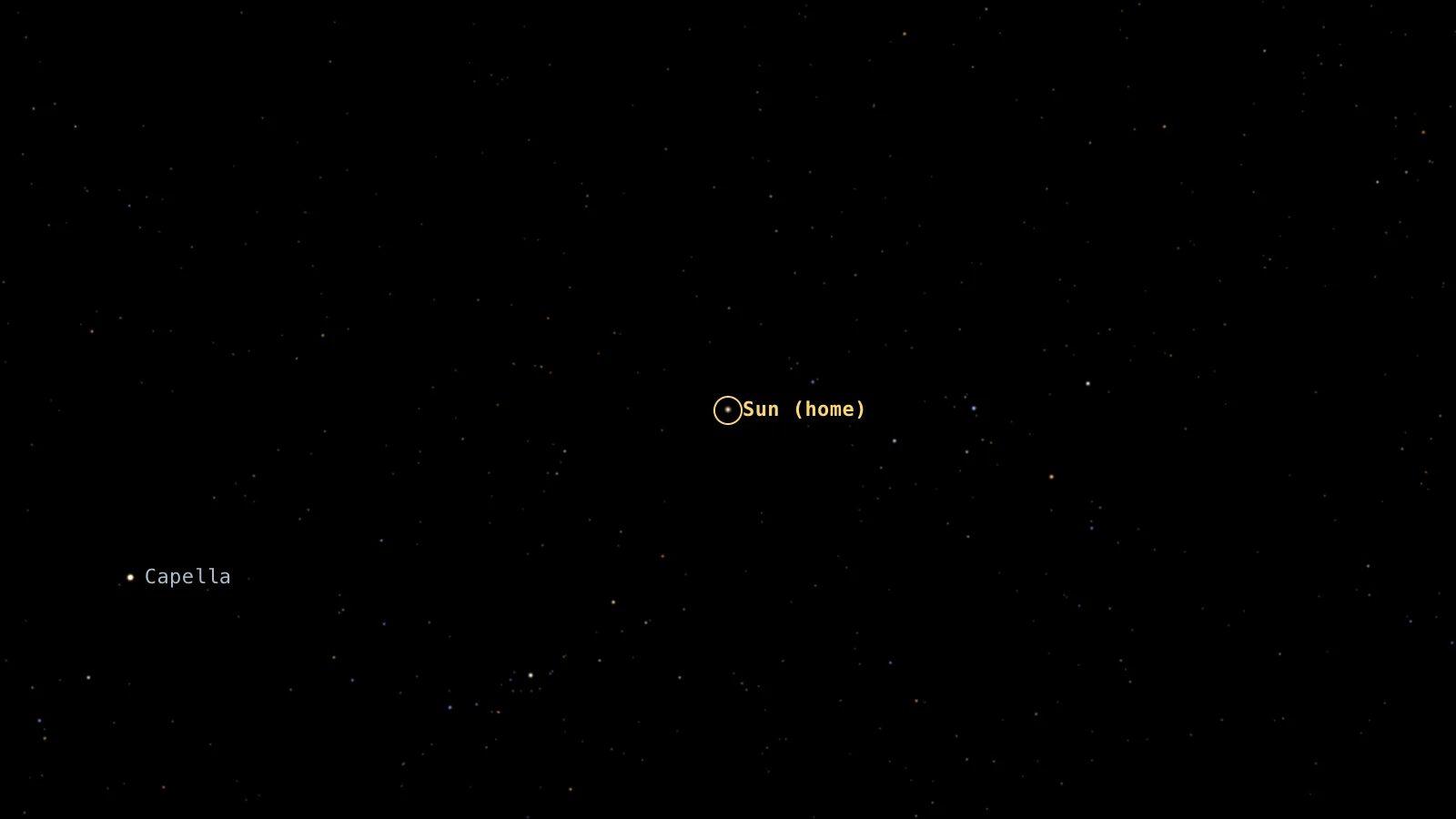
Going there is another matter. The fastest spacecraft we have launched would need tens of thousands of years. A ship that could accelerate at a steady one g for half the way and brake for the other half would arrive after 3.5 years aboard, while 5.9 years passed at home, touching 94.9 % of the speed of light on the way. Proposals such as Breakthrough Starshot hope to send tiny light-sail probes to the Alpha Centauri system within a human lifetime.
Light
4.24 years
The light reaching us now left Proxima Centauri in 2022.
At a steady 1 g
3.5 years aboard
5.9 years pass on Earth; top speed 94.9 % of light.
Finding Proxima Centauri in the night sky
Proxima Centauri is in the constellation Centaurus. At magnitude 11.0 it is too faint for the naked eye or binoculars: a telescope of about 6 cm aperture shows it.
South of latitude 27° S (Sydney, Buenos Aires or Wellington) it never sets: it circles the south celestial pole all night, every night of the year. It stands highest in the evening sky (around 9 pm) in June.
It never rises north of latitude 27° N, so it cannot be seen from Cairo, Tokyo or New York; the farther south you are, the higher it climbs.
To find it, start from Alpha Centauri (magnitude 0.0): Proxima Centauri is 2.2° to its southwest, close beside it. It is also 3.8° southeast of Hadar and 14° east of Acrux.
Data
Measured values come from the papers cited. The game's estimates are what Solarwind works out from the star catalogue's colour and brightness alone; where the two differ, the measurement is the better value.
| Measured | Game's estimate | ||
|---|---|---|---|
| Distance | — | 4.240 ly · 1.300 pc | from Gaia/Hipparcos parallax |
| Parallax | — | 769.2 mas | |
| Right ascension | — | 14h 29m 34s | J2016 |
| Declination | — | −62° 41′ | |
| Constellation | Centaurus | — | |
| Spectral type | M5.5 V[1] | M5Ve | |
| Temperature | 2,900 ± 100 K[1] | 3,060 K | the Sun: 5,772 K |
| Radius | 0.141 ± 0.021 R☉[1] | 0.107 R☉ | 1.4 × Jupiter |
| Mass | 0.122 ± 0.0022 M☉[1] | 0.0903 M☉ | 128 × Jupiter |
| Luminosity | 0.00151 L☉[1] | 0.000912 L☉ | |
| Apparent magnitude (V) | 11.01 [2] | 11.01 | naked-eye limit ≈ 6 |
| Absolute magnitude | — | 15.4 | |
| Habitable zone | — | 0.041–0.081 AU | Kopparapu et al. 2014, from the measured temperature |
| Frost line | — | 0.10 AU | where water freezes |
Nearest stars
- Alpha Centauri B0.181 ly
- Alpha Centauri0.181 ly
- Sun4.24 ly
- Barnard's Star6.59 ly
- Ross 1548.26 ly
- Wolf 3598.30 ly
- Sirius9.44 ly
- Gliese 244B9.45 ly
- J1845-63579.52 ly
- HIP 827259.53 ly
Quick answers
Is Proxima Centauri part of Alpha Centauri?
Yes. It is the third and smallest star of the Alpha Centauri system, orbiting the bright pair Rigil Kentaurus and Toliman about 0.18 light-years from them, once in roughly half a million years. It is sometimes called Alpha Centauri C.
Is Proxima Centauri b habitable?
Possibly, but unknown. It orbits inside the habitable zone and has at least 1.1 times the Earth's mass, so it is likely rocky, but it is probably tidally locked and is bathed in its star's flares. Whether it kept an atmosphere or water is not yet known.
Is there a Proxima Centauri c?
Not confirmed. A cold planet about seven times the Earth's mass, far out beyond the frost line, was proposed in 2019 from radial-velocity data, but later work has not confirmed it. The confirmed planets are b and the smaller d.
What constellation is Proxima Centauri in?
Centaurus, in the far southern sky, close to the bright Alpha Centauri pair and the Southern Cross.
How far away is Proxima Centauri?
Proxima Centauri is 4.24 light-years (1.30 parsecs) from the Sun, so the light you see from it left 4.24 years ago. That makes it the nearest star to the Sun.
Can you see Proxima Centauri with the naked eye?
No. At magnitude 11.01 it is about 100 times too faint for the naked eye; a telescope of about 6 cm aperture shows it, from the southern hemisphere.
Where is Proxima Centauri in the night sky?
In the constellation Centaurus. It is highest in the evening sky around June and never rises north of latitude 27° N. From Alpha Centauri, look 2.2° to the southwest.
What type of star is Proxima Centauri?
A red dwarf of spectral type M5.5 V, with a surface temperature of about 2,900 K (the Sun's is 5,772 K).
How big is Proxima Centauri compared with the Sun?
Its radius is 0.141 times the Sun's, about 98,000 km, or 1.4 times Jupiter's; its mass is 0.122 solar masses, and it gives off 0.15 % of the Sun's light.
How hot is Proxima Centauri?
Its surface is about 2,900 K (2,627 °C, 4,760 °F), cooler than the Sun's 5,772 K.
What colour is Proxima Centauri?
At 2,900 K its light is orange-red: cooler stars glow redder, hotter ones bluer.
How massive is Proxima Centauri?
About 0.122 times the Sun's mass, or 128 Jupiters.
How luminous is Proxima Centauri?
It gives off 0.15 % of the Sun's light (0.00151 solar luminosities).
Is Proxima Centauri a main sequence star?
Yes. Its luminosity class, V, marks a main-sequence star: like the Sun, it shines by fusing hydrogen into helium in its core.
Will Proxima Centauri go supernova?
No. At about 0.12 solar masses it is too light: stars under about 8 solar masses end by shedding their outer layers and leaving a white dwarf.
What galaxy is Proxima Centauri in?
The Milky Way, our own galaxy: every star you can see without a telescope belongs to it. At 4.24 light-years Proxima Centauri is a close neighbour on the scale of the galaxy, which is about 100,000 light-years across, and it lies in the same spiral arm as the Sun, the Orion Arm.
Does Proxima Centauri have planets?
Yes: two confirmed planets, Proxima Cen d (0.029 AU, a year of 5.12 days) and Proxima Cen b (0.048 AU, a year of 11.2 days). Proxima Cen b orbits inside the habitable zone, where liquid water could exist on the surface.
How long would it take to travel to Proxima Centauri?
Light takes 4.24 years. A ship accelerating at a steady 1 g and braking halfway would arrive after 3.5 years aboard (5.9 years on Earth), peaking at 94.9 % of the speed of light.
Sources
Last updated .
Positions and photometry: HYG Database v4.1 (CC BY-SA 4.0) and the Gaia Catalogue of Nearby Stars, ESA/Gaia/DPAC. Planets: the NASA Exoplanet Archive, operated by Caltech under contract with NASA. Identifiers: Wikidata (CC0), Q14266; SIMBAD. Habitable zone: Kopparapu et al. 2014. Text: written with an AI model from the data on this page, checked against the sources.
Also known as: 1ES 1426-62.4 · 1RXS J142947.9-624058 · 2EUVE J1429-62.6 · 2MASS J14294291-6240465 · CCDM J14396-6050C · CSV 2142 · Ci 20 861 · EUVE J1429-62.6 · EUVE J1430-62.6 · GJ 551 · Gaia DR2 5853498713160606720 · Gaia DR3 5853498713190525696 · HIC 70890 · HIP 70890 · IRAS 14260-6227 · JP11 5155 · JP11 5156 · JP11 5187 · LFT 1110 · LHS 49 · LPM 526 · LTT 5721 · NLTT 37460 · PLX 3278 · PLX 3278.00 · PM 14263-6228 · PM J14297-6240 · PMSC 14328-6025C · RX J1429.7-6240 · TIC 388857263 · V645 Cen · WDS J14396-6050C · Zkh 211 · [GKL99] 301