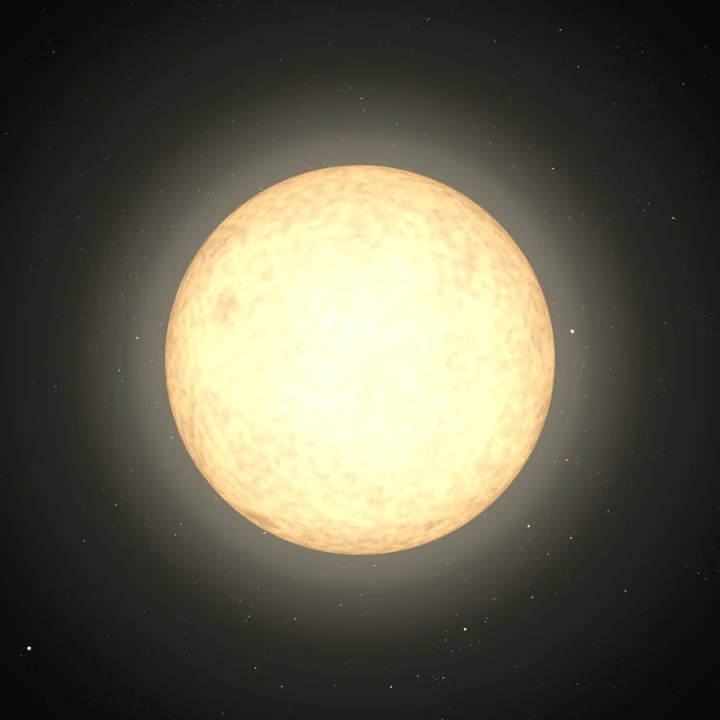
Alpha Centauri facts at a glance
- Type: a yellow dwarf, spectral type G2V, in Centaurus.
- Distance: 4.32 light-years (1.32 parsecs).
- Temperature: 5,795 K (5,522 °C, 9,971 °F) at the surface.
- Size: 134 times the Earth's width (1.2 solar radii).
- Mass: 1.1 times the Sun's.
- Planets: none known.
Our nearest neighbours
Alpha Centauri is the star system next door. Just 4.32 light-years away, it is three stars bound together by gravity: two Sun-like stars in a tight pair, Alpha Centauri A and B, and a faint red dwarf, Proxima Centauri, circling far outside them. To the naked eye the pair merges into a single brilliant point, the third-brightest star in the night sky after Sirius and Canopus.
This page is about the system and its main star, Alpha Centauri A, named Rigil Kentaurus, "the foot of the centaur". It is a G2V star, almost a twin of the Sun: about 1.2 times as wide, some 851,000 km in radius, with 1.1 times its mass. Being a little larger and heavier, it shines with about 150 % of the Sun's light, and to your eye its colour would be the same yellow-white.
Three stars, one system
Alpha Centauri B, named Toliman, is the smaller partner: an orange K dwarf a little cooler and dimmer than the Sun. A and B orbit each other once in about eighty years on a stretched, elliptical path. At their closest they come about as near as Saturn is to the Sun; at their widest they are roughly as far apart as Pluto. Seen from the Earth they are so close together in the sky that a small telescope is needed to split them.
The third member, Proxima Centauri, is a small red dwarf about a fifth of a light-year from the pair, too faint to see without a telescope. It is the nearest star of all to the Sun, slightly closer to us than A and B, and it takes hundreds of thousands of years to complete one orbit around them. Precise measurements of its motion, published in 2017, settled a long debate: Proxima really is bound to the pair, not just passing by.
How we measured the distance
Alpha Centauri was the first star whose distance was measured, or very nearly. In the 1830s Thomas Henderson at the Cape of Good Hope measured its parallax, the tiny seasonal shift in its position as the Earth orbits the Sun, and found it to be the closest star then known. Friedrich Bessel published the parallax of 61 Cygni first, so Henderson shares the credit.
Today's value is a parallax of 755.2 milliarcseconds: the shift of a coin seen from several kilometres away. Because A and B are bright, near and similar to the Sun, they have become test beds for stellar physics; their masses, sizes and pulsations are measured more precisely than for almost any other stars, and they are a little older than the Sun.
Searching for planets
With two Sun-like stars so close, Alpha Centauri is the obvious place to look for another Earth, and astronomers have looked hard. A planet around B was announced in 2012, but later analyses showed that the signal was most likely an artefact of the way the data were processed, and it was withdrawn. Proxima, by contrast, has confirmed planets, including Proxima b in its habitable zone.
Around A, the habitable zone runs from 1.2 to 2.1 AU, and the pair's orbit leaves room for stable planets there. In 2021 an infrared imaging campaign with the Very Large Telescope saw a faint candidate source near A, and in 2025 the James Webb Space Telescope reported a candidate giant planet, perhaps around Saturn's mass, orbiting in A's habitable zone. Neither is confirmed; follow-up observations are needed to show that the candidate is real and to measure its orbit. No planet around A or B is confirmed yet.
| Body | Kind | Orbit, AU | Year, days | Mass, Earths | Temp., K |
|---|---|---|---|---|---|
| Rigil Kentaurus inner belt game-made | Asteroid belt | 2.3–3.6 | — | — | 183 |
Seeing it in the sky
Alpha Centauri lies deep in the southern sky, in Centaurus, at a declination of about minus sixty degrees, so it never rises for most of Europe and North America. From the southern hemisphere it is unmistakable: it and Beta Centauri (Hadar) are the two bright "Pointers" that lead the eye to the Southern Cross. In a small telescope, the single point splits into a golden pair.
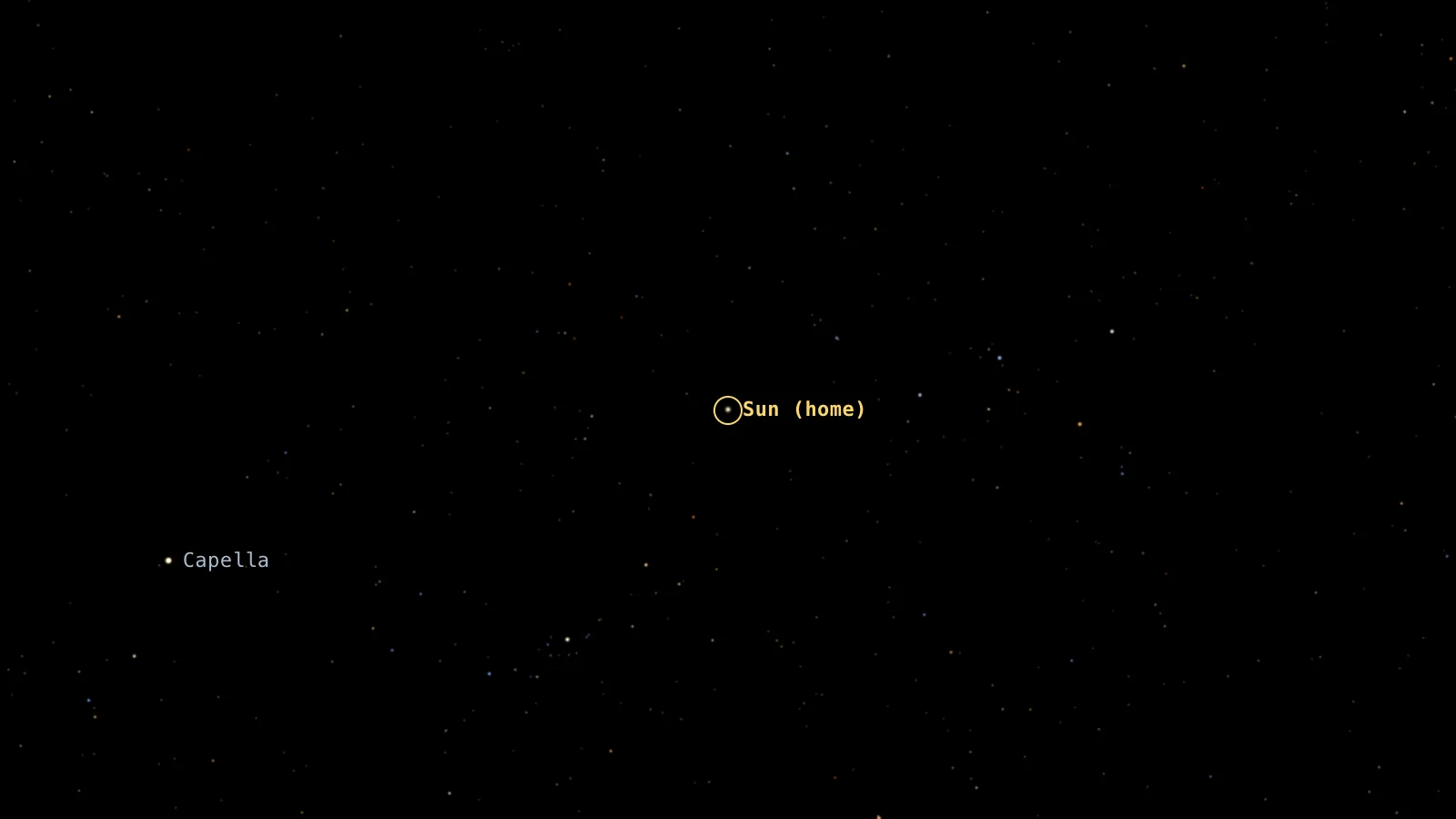
From Alpha Centauri, the sky would look almost the same as ours; the constellations are barely distorted by a move of a few light-years. The big difference is our Sun, which would appear as a moderately bright star in Cassiopeia, and the two companions: B would blaze as a brilliant second sun, and Proxima would be a dim red point.
The first stop beyond the Sun
As the nearest system, Alpha Centauri is the natural first target for interstellar travel. The fastest spacecraft we have built would still need many thousands of years. A ship that could accelerate at a steady one g for half the way and brake for the other half would arrive after 3.6 years aboard, while 5.9 years passed on Earth, reaching 95.0 % of the speed of light on the way. Breakthrough Starshot proposes gram-scale light-sail probes pushed by lasers, which might reach the system within a few decades of launch.
Light
4.32 years
The light reaching us now left Alpha Centauri in 2022.
At a steady 1 g
3.6 years aboard
5.9 years pass on Earth; top speed 95.0 % of light.
Finding Alpha Centauri in the night sky
Alpha Centauri is in the constellation Centaurus. At magnitude 0.0 it is one of the brightest stars in the sky, easy to see even from a city.
South of latitude 29° S (Sydney, Buenos Aires or Wellington) it never sets: it circles the south celestial pole all night, every night of the year. It stands highest in the evening sky (around 9 pm) in June.
It never rises north of latitude 29° N, so it cannot be seen from Cairo, Tokyo or New York; the farther south you are, the higher it climbs.
To find it, start from Hadar (magnitude 0.6): Alpha Centauri is 4.4° to its east, close beside it. It is also 16° east of Acrux and 14° east of Mimosa.
Data
Measured values come from the papers cited. The game's estimates are what Solarwind works out from the star catalogue's colour and brightness alone; where the two differ, the measurement is the better value.
| Measured | Game's estimate | ||
|---|---|---|---|
| Distance | — | 4.319 ly · 1.324 pc | from Gaia/Hipparcos parallax |
| Parallax | — | 755.2 mas | |
| Right ascension | — | 14h 39m 29s | J2016 |
| Declination | — | −60° 50′ | |
| Constellation | Centaurus | — | |
| Spectral type | G2V[1] | G2V | |
| Temperature | 5,795 ± 19 K[2] | 5,568 K | the Sun: 5,772 K |
| Radius | 1.22 ± 0.0053 R☉[2] | 1.34 R☉ | 12 × Jupiter |
| Mass | 1.11 ± 0.0039 M☉[3] | 1.12 M☉ | 1,159 × Jupiter |
| Luminosity | 1.52 L☉[4] | 1.56 L☉ | |
| Apparent magnitude (V) | 0.01000 [5] | −0.01 | naked-eye limit ≈ 6 |
| Absolute magnitude | — | 4.38 | |
| Habitable zone | — | 1.2–2.1 AU | Kopparapu et al. 2014, from the measured temperature |
| Frost line | — | 3.3 AU | where water freezes |
Nearest stars
- Alpha Centauri B0.000577 ly
- Proxima Centauri0.181 ly
- Sun4.32 ly
- Barnard's Star6.49 ly
- Ross 1548.14 ly
- Wolf 3598.32 ly
- HIP 827259.45 ly
- J1845-63579.46 ly
- Sirius9.61 ly
- Gliese 244B9.61 ly
Quick answers
What is Alpha Centauri C?
Alpha Centauri C is another name for Proxima Centauri, the third and smallest star of the system. It is a red dwarf about a fifth of a light-year from the bright pair A and B, and the nearest star to the Sun.
What is the difference between Alpha Centauri and Proxima Centauri?
Alpha Centauri usually means the bright pair A and B, two Sun-like stars that look like one star to the eye. Proxima Centauri is the faint red dwarf of the same system, slightly closer to us, and visible only in a telescope.
Is Alpha Centauri in the Milky Way?
Yes. It is one of our very nearest neighbours in the Milky Way, just 4.32 light-years away; every star you can see with the naked eye belongs to our galaxy.
How many planets are in the Alpha Centauri system?
Two are confirmed, both around Proxima Centauri: Proxima b, in its habitable zone, and the smaller Proxima d. A candidate giant planet around Alpha Centauri A, reported in 2025, is not yet confirmed, and no planet is known around B.
Is Alpha Centauri habitable?
No one knows yet. A and B are Sun-like stars with habitable zones where a planet could keep liquid water, but no planet has been confirmed there; Proxima b lies in its star's habitable zone, but it is battered by flares.
How far away is Alpha Centauri?
Alpha Centauri is 4.32 light-years (1.32 parsecs) from the Sun, so the light you see from it left 4.32 years ago. That makes it the 3rd nearest star to the Sun.
Can you see Alpha Centauri with the naked eye?
Yes: at magnitude 0.01 it is visible to the naked eye under a dark sky, from the southern hemisphere.
Where is Alpha Centauri in the night sky?
In the constellation Centaurus. It is highest in the evening sky around June and never rises north of latitude 29° N. From Hadar, look 4.4° to the east.
What type of star is Alpha Centauri?
A yellow dwarf of spectral type G2V, with a surface temperature of about 5,795 K (the Sun's is 5,772 K).
How big is Alpha Centauri compared with the Sun?
Its radius is 1.22 times the Sun's, about 850,000 km; its mass is 1.11 solar masses, and it is 1.52 times as luminous as the Sun.
How hot is Alpha Centauri?
Its surface is about 5,795 K (5,522 °C, 9,971 °F), hotter than the Sun's 5,772 K.
What colour is Alpha Centauri?
At 5,795 K its light is white with a hint of yellow: cooler stars glow redder, hotter ones bluer.
How massive is Alpha Centauri?
About 1.11 times the Sun's mass, or 1,159 Jupiters.
How luminous is Alpha Centauri?
It is about 1.52 times as luminous as the Sun (1.52 solar luminosities).
Is Alpha Centauri a main sequence star?
Yes. Its luminosity class, V, marks a main-sequence star: like the Sun, it shines by fusing hydrogen into helium in its core.
Will Alpha Centauri go supernova?
No. At about 1.1 solar masses it is too light: stars under about 8 solar masses end by shedding their outer layers and leaving a white dwarf.
What galaxy is Alpha Centauri in?
The Milky Way, our own galaxy: every star you can see without a telescope belongs to it. At 4.32 light-years Alpha Centauri is a close neighbour on the scale of the galaxy, which is about 100,000 light-years across, and it lies in the same spiral arm as the Sun, the Orion Arm.
How long would it take to travel to Alpha Centauri?
Light takes 4.32 years. A ship accelerating at a steady 1 g and braking halfway would arrive after 3.6 years aboard (5.9 years on Earth), peaking at 95.0 % of the speed of light.
Sources
Last updated .
- Search for associations containing young stars (SACY). I. Sample and searching method
- Kervella et al. 2017
- Pourbaix & Boffin 2016
- Wikipedia, via Wikidata
- VizieR Online Data Catalog: Stellar Photometry in Johnson's 11-color system (Ducati, 2002)
Positions and photometry: HYG Database v4.1 (CC BY-SA 4.0) and the Gaia Catalogue of Nearby Stars, ESA/Gaia/DPAC. Planets: the NASA Exoplanet Archive, operated by Caltech under contract with NASA. Identifiers: Wikidata (CC0), Q2090157; SIMBAD. Habitable zone: Kopparapu et al. 2014. Text: written with an AI model from the data on this page, checked against the sources.
Also known as: 2MASS J14393592-6050069 · CCDM J14396-6050A · GCRV 8517 · GJ 559 A · Gaia 5877748648270200064 · HD 128620 · HIC 71683 · HIP 71683 · HR 5459 · IDS 14328-6025 A · LFT 1127 · LHS 50 · LTT 5806 · NLTT 37984 · PLX 3309 · PM 14362-6038A · PMSC 14328-6025A · PPM 360911 · SBC7 520 · SBC9 815 · SPOCS 610 · TD1 17606 · TIC 471011145 · TYC 9007-5849-1 · WDS J14396-6050A · WEB 12354 · Zkh 209 · α Cen A · α¹ Cen