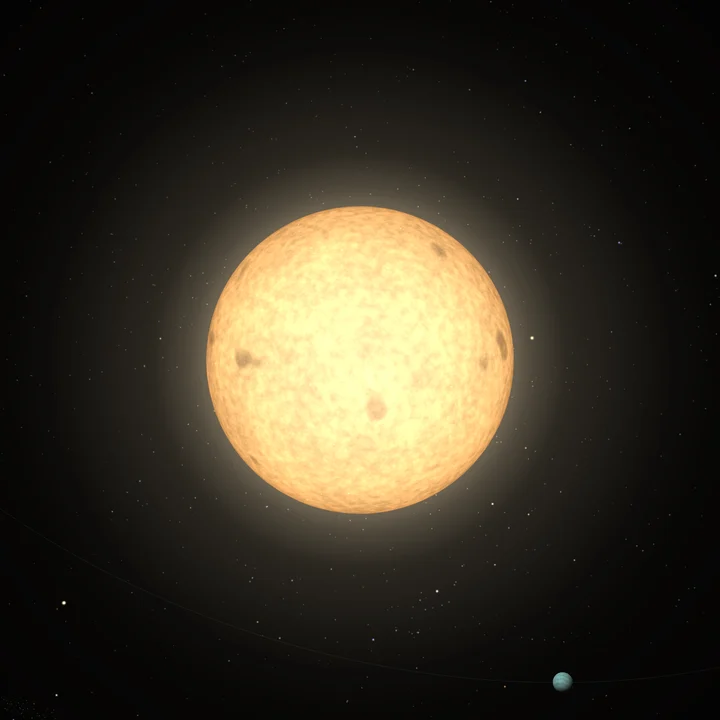
Alpha Centauri B facts at a glance
- Type: an orange dwarf, spectral type K1V, in Centaurus.
- Distance: 4.32 light-years (1.32 parsecs).
- Temperature: 5,231 K (4,958 °C, 8,956 °F) at the surface.
- Size: 94 times the Earth's width (0.86 solar radii).
- Mass: 0.94 times the Sun's.
- Planets: none known.
The smaller sun next door
Alpha Centauri B is the second star of the nearest star system to our own, 4.32 light-years away. On its own it would rank among the brightest stars in the sky, at magnitude 1.33; instead it hides in the glare of its partner, Alpha Centauri A, and the two merge into the single brilliant point that southern stargazers know as Alpha Centauri. Since 2018 it has its own proper name, Toliman, from an old Arabic name for the pair.
It is a K1V star, an orange dwarf: a little smaller, cooler and dimmer than the Sun. It is about 0.86 times the Sun's width, some 601,000 km in radius, with 0.94 times its mass, and it gives out about 50 % of the Sun's light. Stand on a planet near it and its light would look a shade warmer than sunlight, a soft golden orange.
A pair in an eighty-year dance
B and A orbit their common centre of mass once in about eighty years, on a markedly elliptical path. At their closest they come about as near as Saturn is to the Sun; at their widest they are roughly as far apart as Pluto. From a planet around B, A would be a second sun: a dazzling point always far brighter than the full Moon, bright enough to cast its own shadows, and at its closest a light in the daytime sky.
The third member of the system, the red dwarf Proxima Centauri, circles the pair far out, about a fifth of a light-year away, once in hundreds of thousands of years. For the whole family, the main star and its history, see Alpha Centauri.
One of the best-measured stars
Because B is so near, bright and ordinary, it is one of the best-studied stars in the sky. Its orbit around A gives its mass directly, interferometers have measured its diameter, and its gentle pulsations, detected as tiny shifts in its spectrum, reveal its interior. Together these make it a calibration point for the physics of all stars a little smaller than the Sun.
B is a little older than the Sun, as is A; the two formed together, from the same cloud, and both are rich in metals compared with the Sun. Like the Sun, B has a magnetic activity cycle, with starspots and X-ray brightness that wax and wane over roughly eight years, slightly shorter than our Sun's.
The planet that was not
In 2012 a team announced Alpha Centauri Bb, an Earth-mass planet racing round B in just over three days, found from the star's tiny wobble. It made headlines as the nearest exoplanet ever found. Later reanalyses showed that the signal was most likely produced by the way the noisy data had been filtered, and the planet is now considered not to exist. A Hubble search for transits in 2013 and 2014 found one possible dip that was never seen again.
No planet around B is confirmed today. The habitable zone, where a planet like the Earth could keep liquid water, lies from 0.70 to 1.2 AU, and calculations show that planets could keep stable orbits there despite A's pull. Small planets of a few Earth masses could still be hiding, below what today's instruments can detect.
| Body | Kind | Orbit, AU | Year, days | Mass, Earths | Temp., K |
|---|---|---|---|---|---|
| Toliman I game-made | Ice giant | 0.114 | 14.5 | 11 | 701 |
| Toliman inner belt game-made | Asteroid belt | 1.5–2.4 | — | — | 171 |
Seeing it, and going there
B lies in Centaurus, in the far southern sky, at a declination around minus sixty degrees, so it is invisible from most of Europe and North America. From the southern hemisphere, Alpha Centauri is the brighter of the two Pointers to the Southern Cross; a small telescope at high magnification splits it into a yellow-white A and a slightly fainter, more orange B.
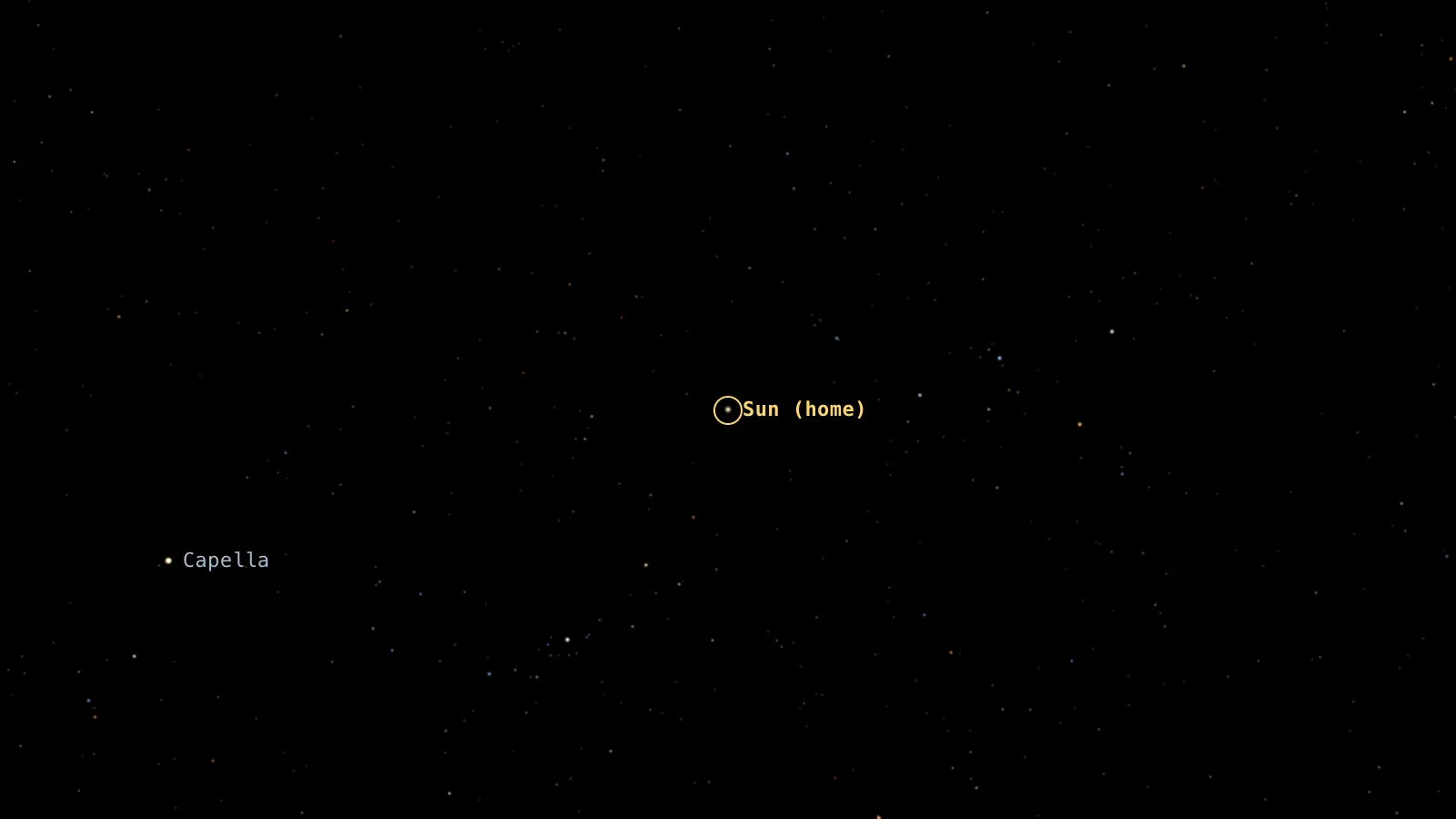
A ship that could accelerate at a steady one g for half the way and brake for the other half would reach B after 3.6 years aboard, while 5.9 years passed on Earth, touching 95.0 % of the speed of light at the midpoint.
Light
4.32 years
The light reaching us now left Alpha Centauri B in 2022.
At a steady 1 g
3.6 years aboard
5.9 years pass on Earth; top speed 95.0 % of light.
Finding Alpha Centauri B in the night sky
Alpha Centauri B is in the constellation Centaurus. At magnitude 1.3 it is one of the brightest stars in the sky, easy to see even from a city.
South of latitude 29° S (Sydney, Buenos Aires or Wellington) it never sets: it circles the south celestial pole all night, every night of the year. It stands highest in the evening sky (around 9 pm) in June.
It never rises north of latitude 29° N, so it cannot be seen from Cairo, Tokyo or New York; the farther south you are, the higher it climbs.
To find it, start from Hadar (magnitude 0.6): Alpha Centauri B is 4.4° to its east, close beside it. It is also 16° east of Acrux and 14° east of Mimosa.
Data
Measured values come from the papers cited. The game's estimates are what Solarwind works out from the star catalogue's colour and brightness alone; where the two differ, the measurement is the better value.
| Measured | Game's estimate | ||
|---|---|---|---|
| Distance | — | 4.319 ly · 1.324 pc | from Gaia/Hipparcos parallax |
| Parallax | — | 755.2 mas | |
| Right ascension | — | 14h 39m 28s | J2016 |
| Declination | — | −60° 50′ | |
| Constellation | Centaurus | — | |
| Spectral type | K1V[1] | K1V | |
| Temperature | 5,231 ± 21 K[2] | 4,996 K | the Sun: 5,772 K |
| Radius | 0.863 ± 0.0037 R☉[2] | 0.961 R☉ | 8.6 × Jupiter |
| Mass | 0.937 ± 0.0033 M☉[3] | 0.849 M☉ | 982 × Jupiter |
| Luminosity | 0.50 L☉ from the radius and temperature | 0.519 L☉ | |
| Apparent magnitude (V) | 1.330 [4] | 1.35 | naked-eye limit ≈ 6 |
| Absolute magnitude | — | 5.74 | |
| Habitable zone | — | 0.70–1.2 AU | Kopparapu et al. 2014, from the measured temperature |
| Frost line | — | 1.9 AU | where water freezes |
Nearest stars
- Alpha Centauri0.000577 ly
- Proxima Centauri0.181 ly
- Sun4.32 ly
- Barnard's Star6.49 ly
- Ross 1548.14 ly
- Wolf 3598.32 ly
- HIP 827259.45 ly
- J1845-63579.46 ly
- Sirius9.61 ly
- Gliese 244B9.61 ly
Quick answers
How far apart are Alpha Centauri A and B?
Their distance changes over their eighty-year orbit: at closest they are about as far apart as Saturn is from the Sun, and at widest about as far as Pluto. From the Earth they appear only a few arcseconds apart, too close to split without a telescope.
What colour is Alpha Centauri B?
Pale orange. It is an orange (K-type) dwarf, a little cooler than the Sun, so its light is slightly warmer in tone; next to the yellow-white A in a telescope the difference is easy to see.
Will Alpha Centauri A and B collide?
No. They are on a stable orbit, and even at their closest approach they stay further apart than Saturn is from the Sun. They will keep circling each other for billions of years.
Does Proxima Centauri orbit Alpha Centauri A and B?
Yes. Measurements of its motion show that Proxima is bound to the pair, orbiting about a fifth of a light-year away, once in hundreds of thousands of years.
How old is Alpha Centauri B?
It formed together with A, and both are thought to be a little older than the Sun, though estimates of the exact age differ.
How far away is Alpha Centauri B?
Alpha Centauri B is 4.32 light-years (1.32 parsecs) from the Sun, so the light you see from it left 4.32 years ago. That makes it the 2nd nearest star to the Sun.
Can you see Alpha Centauri B with the naked eye?
Yes: at magnitude 1.33 it is visible to the naked eye under a dark sky, from the southern hemisphere.
Where is Alpha Centauri B in the night sky?
In the constellation Centaurus. It is highest in the evening sky around June and never rises north of latitude 29° N. From Hadar, look 4.4° to the east.
What type of star is Alpha Centauri B?
An orange dwarf of spectral type K1V, with a surface temperature of about 5,231 K (the Sun's is 5,772 K).
How big is Alpha Centauri B compared with the Sun?
Its radius is 0.863 times the Sun's, about 600,000 km; its mass is 0.937 solar masses, and it gives off 50 % of the Sun's light.
How hot is Alpha Centauri B?
Its surface is about 5,231 K (4,958 °C, 8,956 °F), cooler than the Sun's 5,772 K.
How massive is Alpha Centauri B?
About 0.937 times the Sun's mass, or 982 Jupiters.
How luminous is Alpha Centauri B?
It gives off 50 % of the Sun's light (0.503 solar luminosities), worked out from its measured radius and temperature.
Is Alpha Centauri B a main sequence star?
Yes. Its luminosity class, V, marks a main-sequence star: like the Sun, it shines by fusing hydrogen into helium in its core.
Will Alpha Centauri B go supernova?
No. At about 0.94 solar masses it is too light: stars under about 8 solar masses end by shedding their outer layers and leaving a white dwarf.
What galaxy is Alpha Centauri B in?
The Milky Way, our own galaxy: every star you can see without a telescope belongs to it. At 4.32 light-years Alpha Centauri B is a close neighbour on the scale of the galaxy, which is about 100,000 light-years across, and it lies in the same spiral arm as the Sun, the Orion Arm.
How long would it take to travel to Alpha Centauri B?
Light takes 4.32 years. A ship accelerating at a steady 1 g and braking halfway would arrive after 3.6 years aboard (5.9 years on Earth), peaking at 95.0 % of the speed of light.
Sources
Last updated .
- Search for associations containing young stars (SACY). I. Sample and searching method
- Kervella et al. 2017
- Pourbaix & Boffin 2016
- VizieR Online Data Catalog: Stellar Photometry in Johnson's 11-color system (Ducati, 2002)
Positions and photometry: HYG Database v4.1 (CC BY-SA 4.0) and the Gaia Catalogue of Nearby Stars, ESA/Gaia/DPAC. Planets: the NASA Exoplanet Archive, operated by Caltech under contract with NASA. Identifiers: Wikidata (CC0), Q1052548; SIMBAD. Habitable zone: Kopparapu et al. 2014. Text: written with an AI model from the data on this page, checked against the sources.
Also known as: CCDM J14396-6050B · GCRV 8518 · GJ 559 B · HD 128621 · HIC 71681 · HIP 71681 · HR 5460 · IDS 14328-6025 B · LFT 1128 · LHS 51 · LTT 5807 · NLTT 37985 · PM 14362-6038B · PMSC 14328-6025B · RAVE J143935.1-605014 · SPOCS 609 · TIC 471011144 · TYC 9007-5848-1 · WDS J14396-6050B · Zkh 210 · α² Cen