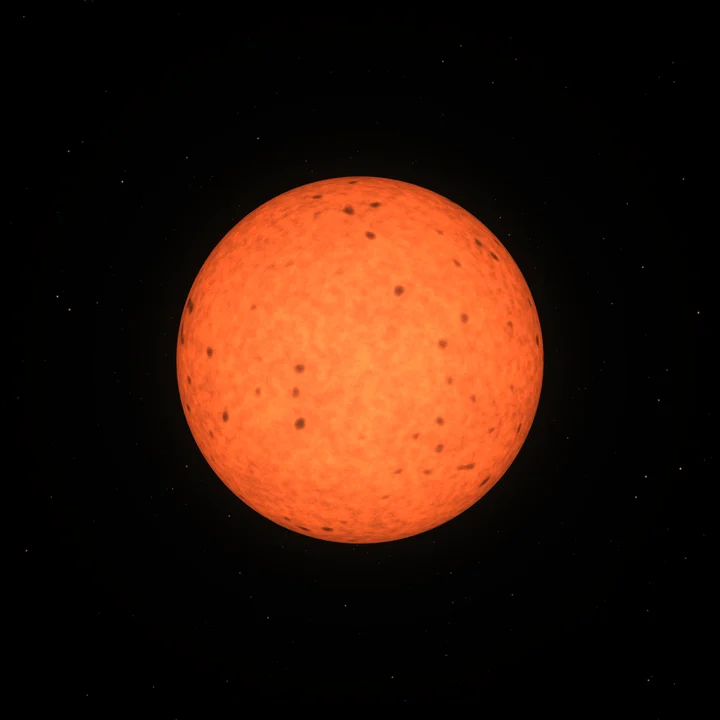
Wolf 359 facts at a glance
- Type: a red dwarf, spectral type M6.0 V, in Leo.
- Distance: 7.86 light-years (2.41 parsecs).
- Temperature: 2,525 K (2,252 °C, 4,085 °F) at the surface.
- Size: 16 times the Earth's width (0.14 solar radii).
- Mass: 0.11 times the Sun's.
- Age: about 0.10 billion years.
- Planets: none known.
A real star with a famous name
To many people Wolf 359 is a battle: the place where, in Star Trek, the Borg destroyed a Federation fleet. But the name belongs to a real star, and a remarkable one. Wolf 359 is a red dwarf just 7.86 light-years away, one of the half-dozen closest star systems to the Sun, and among the faintest and smallest true stars known nearby.
It is so dim that, although it is nearly our next-door neighbour, it shines at only magnitude 13.51. You would need a sizeable telescope to see it at all, and even then it is an unremarkable reddish speck.
Small, cool and faint
Wolf 359 is a red dwarf from the cool end of the M class, near the lower limit of what can still be a star. It has only about 0.11 times the Sun's mass, roughly 120 Jupiters, and measures about 0.14 times the Sun's width, some 100,000 km in radius: about 1.4 times as wide as Jupiter. A little less mass and it could not sustain fusion in its core at all, and would be a brown dwarf instead.
Its surface glows at only about 2,525 kelvin against the Sun's 5,772, cool enough for molecules to form in its atmosphere. It gives out about 0.11 % of the Sun's light, nearly all of it as infrared. Standing on a planet near it, you would see a deep red sun, dull enough in visible light to look at for a moment without squinting.
Found in a hunt for moving stars
The German astronomer Max Wolf found the star in 1917, by comparing photographic plates taken years apart and looking for faint stars that had moved. It was number 359 in his catalogue of stars with large proper motion, and the number stuck. Its motion was the clue that it was near; when its parallax was measured a few years later, it turned out to be one of the closest stars of all.
For a time it was the faintest star known. Since then astronomers have found many fainter stars and brown dwarfs, so it no longer holds that title, but it remains one of the least luminous stars that can be studied in detail, a benchmark for the smallest red dwarfs.
A flare star
Wolf 359 is also known as CN Leonis, a variable-star name it earned by flaring. Like other small red dwarfs, it is convective all the way through, and that churning twists its magnetic field until it snaps. In a flare the star can brighten sharply within minutes, and its hot, tangled corona glows in X-rays.
Its restlessness is partly a sign of youth. Estimates of its age vary, but it is thought to be young as stars go, perhaps as young as 100 million years, and young red dwarfs are the most violent. Over billions of years it will slowly calm down.
No planets have been confirmed. In 2019 astronomers proposed two candidates from small shifts in the star's spectrum, one close in and one far out, but later work attributed the inner signal to the star's own activity, and neither has been confirmed. Its habitable zone, where a planet could hold liquid water, would lie tight around the star, from 0.034 to 0.069 AU, where frequent flares would make life hard.
| Body | Kind | Orbit, AU | Year, days | Mass, Earths | Temp., K |
|---|---|---|---|---|---|
| Wolf 359 I game-made | Rocky planet | 0.0123 | 1.50 | 0.38 | 407 |
| Wolf 359 II game-made | Ice giant | 0.0209 | 3.33 | 4.9 | 312 |
| Wolf 359 III game-made | Ice giant | 0.0335 | 6.76 | 5.0 | 247 |
| Wolf 359 outer belt game-made | Icy belt | 0.11–0.18 | — | — | 122 |
Wolf 359 in fiction
Star Trek made the name famous. In "The Best of Both Worlds", an episode of The Next Generation first shown in 1990, a Starfleet armada makes its stand against a Borg cube at Wolf 359 and is almost entirely destroyed. The battle returned in the opening of Deep Space Nine, and it is now one of the best-known events in the series' history. Writers chose it because it is a real, close star: an ordinary place for an extraordinary fight.
The name also turns up elsewhere, from an episode of The Outer Limits in the 1960s to a radio-drama podcast set aboard a space station orbiting the star.
Finding and visiting it
Wolf 359 lies in Leo, the Lion, very close to the ecliptic, the path the Sun, Moon and planets follow across the sky, so the Moon sometimes passes in front of it. Finding it takes a good star chart and a telescope of reasonable size; it is a tiny red point among stars that look much the same.
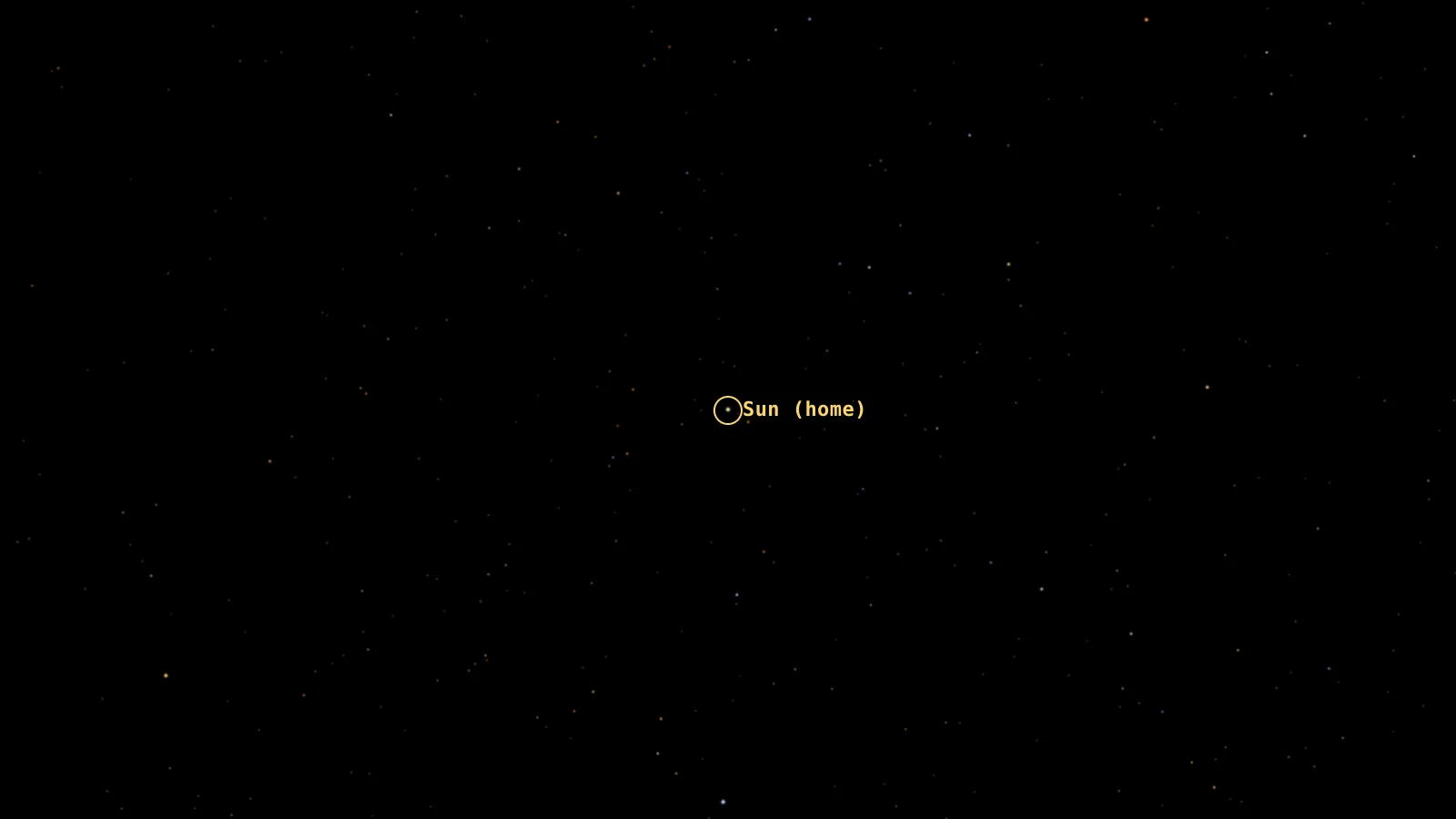
A ship accelerating at one g for half the journey and braking for the rest would reach it in 4.5 years aboard, while 9.6 years passed on Earth, touching 98.0 % of the speed of light on the way. Its nearest neighbour, 3.9 light-years away, is another red dwarf, Ross 128, and from Wolf 359 our Sun would be a fairly bright star in Aquarius.
Light
7.86 years
The light reaching us now left Wolf 359 in 2018.
At a steady 1 g
4.5 years aboard
9.6 years pass on Earth; top speed 98.0 % of light.
Finding Wolf 359 in the night sky
Wolf 359 is in the constellation Leo. At magnitude 13.5 it is too faint for the naked eye or binoculars: a telescope of about 20 cm aperture shows it.
It stands highest in the evening sky (around 9 pm) in April, and it is well placed in the evening from March to June: spring in the northern hemisphere, autumn in the southern.
It never rises south of latitude 83° S; the farther north you are, the higher it climbs.
To find it, start from Regulus (magnitude 1.4): Wolf 359 is 13° to its east, about one fist at arm's length (a fist held out covers about 10°). It is also 16° southeast of Algieba and 27° northeast of Alphard.
Data
Measured values come from the papers cited. The game's estimates are what Solarwind works out from the star catalogue's colour and brightness alone; where the two differ, the measurement is the better value.
| Measured | Game's estimate | ||
|---|---|---|---|
| Distance | — | 7.860 ly · 2.410 pc | from Gaia/Hipparcos parallax |
| Parallax | — | 414.9 mas | |
| Right ascension | — | 10h 56m 24s | J2016 |
| Declination | — | +7° 0′ | |
| Constellation | Leo | — | |
| Spectral type | M6.0 V[1] | M6 | |
| Temperature | 2,525 K[2] | 2,810 K | the Sun: 5,772 K |
| Radius | 0.144 R☉[3] | 0.111 R☉ | 1.4 × Jupiter |
| Mass | 0.110 M☉[3] | 0.0801 M☉ | 115 × Jupiter |
| Luminosity | 0.00106 L☉[3] | 0.000692 L☉ | |
| Apparent magnitude (V) | 13.51 [4] | 13.45 | naked-eye limit ≈ 6 |
| Absolute magnitude | — | 16.5 | |
| Habitable zone | — | 0.034–0.069 AU | Kopparapu et al. 2014, from the measured temperature |
| Frost line | — | 0.088 AU | where water freezes |
Nearest stars
- Ross 1283.89 ly
- Lalande 211854.07 ly
- Gliese GJ 11117.59 ly
- Gliese 473A7.65 ly
- Gliese GJ 36227.82 ly
- Sun7.86 ly
- Gliese 473B8.07 ly
- Proxima Centauri8.30 ly
- Alpha Centauri8.32 ly
- Alpha Centauri B8.32 ly
Quick answers
Is Wolf 359 a real star?
Yes. Long before Star Trek borrowed the name, Wolf 359 was a real red dwarf, discovered by Max Wolf in 1917. It is 7.86 light-years away in Leo, one of the closest stars to the Sun.
Is Wolf 359 the dimmest star?
No, though it was the faintest star known for a while after its discovery. It is one of the least luminous stars near the Sun, giving out about 0.11 % of the Sun's light, but fainter red dwarfs and much fainter brown dwarfs have since been found.
What will Wolf 359 evolve into?
Nothing dramatic, and not for a very long time. A red dwarf this small burns its hydrogen so slowly that it will shine for trillions of years, far longer than the universe has existed. Models suggest it will slowly heat up into a so-called blue dwarf and then fade as a white dwarf, without ever swelling into a giant.
Why is it called Wolf 359?
It was number 359 in a catalogue of fast-moving stars compiled by the German astronomer Max Wolf, who discovered it in 1917. Its variable-star name, for its flares, is CN Leonis.
How far away is Wolf 359?
Wolf 359 is 7.86 light-years (2.41 parsecs) from the Sun, so the light you see from it left 7.86 years ago. That makes it the 5th nearest star to the Sun.
Can you see Wolf 359 with the naked eye?
No. At magnitude 13.51 it is about 1,000 times too faint for the naked eye; a telescope of about 20 cm aperture shows it.
Where is Wolf 359 in the night sky?
In the constellation Leo. It is highest in the evening sky around April and never rises south of latitude 83° S. From Regulus, look 13° to the east.
What type of star is Wolf 359?
A red dwarf of spectral type M6.0 V, with a surface temperature of about 2,525 K (the Sun's is 5,772 K).
How big is Wolf 359 compared with the Sun?
Its radius is 0.144 times the Sun's, about 100,000 km, or 1.4 times Jupiter's; its mass is 0.110 solar masses, and it gives off 0.11 % of the Sun's light.
How hot is Wolf 359?
Its surface is about 2,525 K (2,252 °C, 4,085 °F), cooler than the Sun's 5,772 K.
What colour is Wolf 359?
At 2,525 K its light is orange-red: cooler stars glow redder, hotter ones bluer.
How massive is Wolf 359?
About 0.110 times the Sun's mass, or 115 Jupiters.
How luminous is Wolf 359?
It gives off 0.11 % of the Sun's light (0.00106 solar luminosities).
Is Wolf 359 a main sequence star?
Yes. Its luminosity class, V, marks a main-sequence star: like the Sun, it shines by fusing hydrogen into helium in its core.
Will Wolf 359 go supernova?
No. At about 0.11 solar masses it is too light: stars under about 8 solar masses end by shedding their outer layers and leaving a white dwarf.
What season is Wolf 359 visible in?
In the north it is a spring star: it stands highest in the evening sky in April and is well placed from March to June. In the southern hemisphere those months are autumn.
What galaxy is Wolf 359 in?
The Milky Way, our own galaxy: every star you can see without a telescope belongs to it. At 7.86 light-years Wolf 359 is a close neighbour on the scale of the galaxy, which is about 100,000 light-years across, and it lies in the same spiral arm as the Sun, the Orion Arm.
How long would it take to travel to Wolf 359?
Light takes 7.86 years. A ship accelerating at a steady 1 g and braking halfway would arrive after 4.5 years aboard (9.6 years on Earth), peaking at 98.0 % of the speed of light.
Sources
Last updated .
- Henry, Kirkpatrick & Simons 1994
- SWEET-Cat: A view on the planetary mass-radius relation
- Source on Wikidata
- UBVRI photometric standard stars in the magnitude range 11.5-16.0 around the celestial equator
Positions and photometry: HYG Database v4.1 (CC BY-SA 4.0) and the Gaia Catalogue of Nearby Stars, ESA/Gaia/DPAC. Planets: the NASA Exoplanet Archive, operated by Caltech under contract with NASA. Identifiers: Wikidata (CC0), Q291301; SIMBAD. Habitable zone: Kopparapu et al. 2014. Text: written with an AI model from the data on this page, checked against the sources.
Also known as: 1ES 1053+07.2 · 1RXS J105630.3+070118 · 2MASS J10562886+0700527 · ASAS J105629+0700.8 · CN Leo · CSV 6806 · Ci 20 600 · EPIC 201885041 · EUVE J1056+07.0 · GCRV 6780 · GEN# +6.10010406 · GJ 406 · GSC 00261-00377 · Gaia DR3 3864972938605115520 · JP11 5138 · JP11 5139 · JP11 5140 · JP11 5141 · Karmn J10564+070 · LFT 750 · LHS 36 · LSPM J1056+0700 · LTT 12923 · NLTT 25782 · PLX 2553 · PLX 2553.00 · PM 10541+0719 · PM J10564+0700 · RBS 922 · RX J1056.5+0701 · TIC 365006789 · UBV 10028 · UCAC4 486-052878 · WEB 9714 · WISEA J105626.19+070025.0 · Zkh 147 · [GKL99] 228 · [ZEH2003] RX J1056.5+0701 1